Public Goods & Free Rider Lab
A group shares a public good. Everyone starts with the same money and chooses how much to put into a shared pool, which is multiplied and split equally. See why each player is tempted to keep their money and free ride, even though the whole group does best when everyone contributes, and test policies that change the incentives.
Guided ExperimentWhy is free riding tempting?
Predict whether you can earn more by keeping your money than by contributing it, when the others in your group all contribute fully. Explain your reasoning using the idea of marginal per-capita return.
Write your hypothesis in the Lab Report panel, then click Next.
How the whole group does when no one contributes, under your current choice, and when everyone contributes fully. The dashed line marks the social optimum.
Controls
The pool is multiplied by this factor and split equally. Below the group size, each $1 you give returns less than $1 to you.
You keep whatever you do not contribute, plus your equal share of the multiplied pool.
Every player contributes whatever they choose. When the marginal per-capita return is below 1, each player is tempted to keep their money and free ride on everyone else.
Each $1 you contribute returns $0.5 to you but $2 to the group as a whole. Because it returns less than $1 to you, keeping your money is the better move for you alone.
The current group benefit is 75% of the way to the social optimum.
When the marginal per-capita return is below 1, keeping your money earns you more than contributing it, so each player is tempted to free ride. Yet full contribution maximizes the group benefit, so the individually best move and the socially best move pull in opposite directions.
Data Table
(0 rows)| # | Scenario | Group size | Multiplier | Your contribution($) | Your payoff($) | Group benefit($) |
|---|
Reference Guide
What a Public Good Is
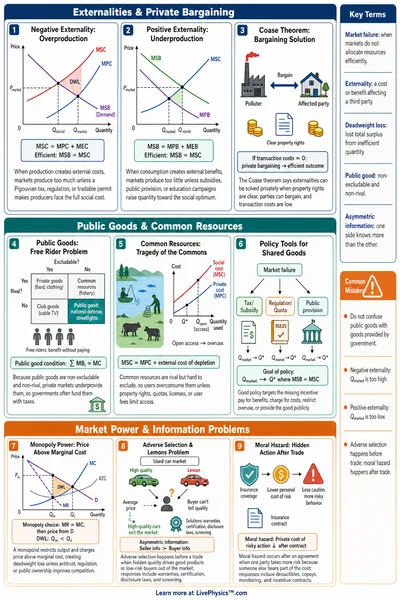
A public good is something the whole group can enjoy together, like clean air, a park, or street lighting. Once it exists, no one can be shut out of it, and one person using it does not use it up for others.
In this lab the public good is a shared pool of money. Each player decides how much of their own money to add. The pool is multiplied to reflect the value the group creates together, then split equally so everyone benefits the same amount.
The Free-Rider Problem and MPCR
The marginal per-capita return is the multiplier divided by the group size. It is how much of each $1 you contribute comes back to you personally. When it is below 1, you get back less than you put in, so keeping your money earns you more.
That is the free-rider problem. Each player does best for themselves by contributing little while enjoying everyone else's contributions, yet if everyone reasons that way, the shared good is never funded and the whole group ends up worse off.
How Mandatory Rules and Punishment Help
A mandatory minimum requires every player to contribute at least a set floor, much like a tax that funds a shared service. It guarantees a baseline of cooperation even when players would otherwise hold back.
Punishment takes a penalty from each player in proportion to how much they kept back. When the penalty is large enough, holding money out costs more than it saves, so contributing becomes the better personal choice and the group moves toward the social optimum.
How to Read the Lab
The bar chart compares the total group benefit when everyone free rides, under your current choice, and when everyone contributes fully, with a dashed line at the social optimum. The results panel shows your payoff, a typical other player's payoff, and the per-capita return.
Use the scenario presets to jump between cooperation, free riding, and large groups, then switch the policy to a mandatory minimum or punishment and watch whether the results report that the free-rider gap is closed. Record runs in the data table to compare outcomes.