Integration by Parts & Partial Fractions
Two integration techniques worked out one step at a time. Choose integration by parts or partial fractions, select an example, and follow the reasoning to the final antiderivative. A numeric area check confirms each result. Everything runs in your browser.
Choose a technique
Numeric check
Pick an interval [a, b], then compare the area under the integrand (Simpson's rule) against the antiderivative evaluated at the bounds. They should match when the interval avoids any singularities.
Worked solution
LIATE picks the Algebraic factor x as u and the exponential eˣ dx as dv.
- 1
- 2
- 3
- 4
- 5
Final antiderivative
Reference Guide
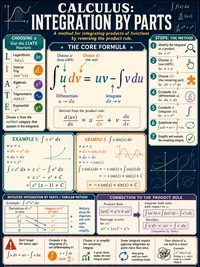
Integration by parts
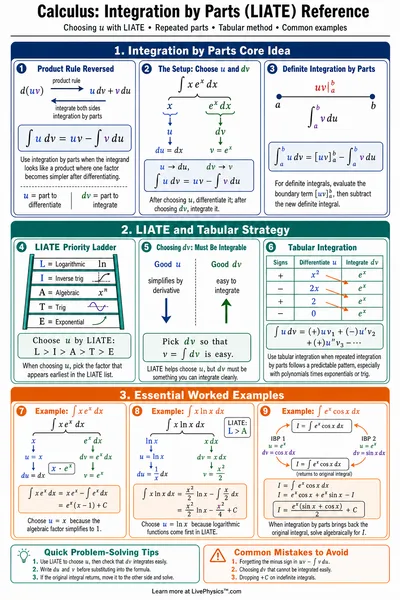
Integration by parts reverses the product rule. It turns a hard integral into a product term plus an easier integral.
You split the integrand into a part to differentiate () and a part to integrate (), then assemble .
Choosing u with LIATE
LIATE orders function types by how good a choice they are for . Pick the one that appears earliest in the list.
- L. Logarithmic, like ln(x).
- I. Inverse trig, like arctan(x).
- A. Algebraic, like x or x².
- T. Trigonometric, like sin(x).
- E. Exponential, like eˣ.
When the algebraic factor is a power of x, each pass of parts drops that power by one. Repeat parts until the remaining integral is elementary, as with .
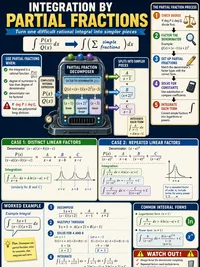
Partial fraction decomposition
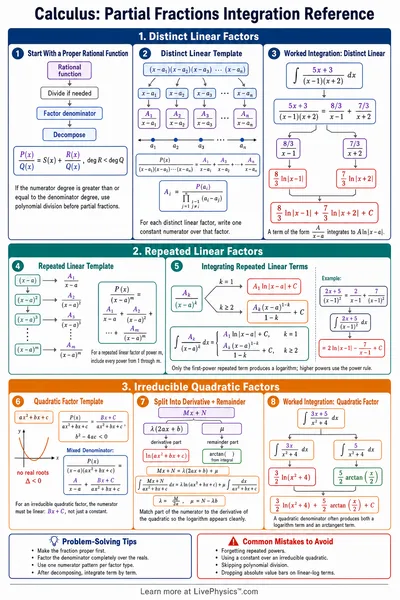
A rational function with distinct linear factors in the denominator splits into a sum of simpler fractions.
Clear the denominators to get a polynomial identity, then solve for the constants. The fastest route is to substitute the root of each factor, which zeroes out the other terms.
Integrating the pieces
Once decomposed, each piece integrates to a logarithm or an arctangent.
This tool verifies each antiderivative numerically with Simpson's rule, so you can watch the worked answer match the area under the curve.