Practice advanced integral techniques, including integration by parts, trigonometric substitution, improper integrals, parameter integrals, and applications.
Read each problem carefully. Show all important steps, including substitutions, limits, convergence checks, and simplifications.
Techniques, convergence, and applications of advanced integration
Calculus - Grade advanced
- 1
Evaluate the indefinite integral ∫ x^2 e^(3x) dx.
- 2
Evaluate the definite integral ∫ from 0 to 1 of ln(1 + x) dx.
- 3
Evaluate ∫ dx/(x^2 sqrt(x^2 - 9)) for x > 3.
- 4
Determine whether the improper integral ∫ from 1 to infinity of 1/(x(ln x)^2) dx converges or diverges. If it converges, find its value.
- 5
Evaluate the improper integral ∫ from e to infinity of 1/(x(ln x)^2) dx.
- 6
Evaluate ∫ from 0 to pi/2 of sin^5(x) cos^2(x) dx.
- 7
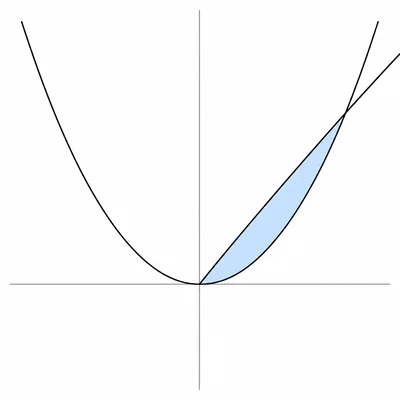
Find the area enclosed by y = x^2 and y = 2x from x = 0 to x = 2.
- 8
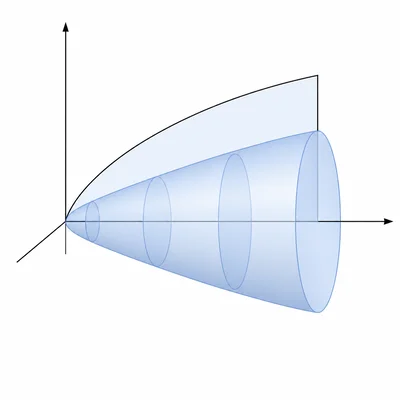
Compute the volume obtained by rotating the region bounded by y = sqrt(x), y = 0, and x = 4 about the x-axis.
- 9
Evaluate ∫ from 0 to infinity of e^(-2x) cos(3x) dx.
- 10
Evaluate the integral ∫ x/(x^2 + 4x + 13) dx.
- 11
Use partial fractions to evaluate ∫ (3x + 5)/(x^2 - x - 2) dx.
- 12
Evaluate ∫ from 0 to 1 of x^3 sqrt(1 - x^2) dx.
- 13
Find d/dx of F(x) = ∫ from x^2 to sin x of e^(t^3) dt.
- 14
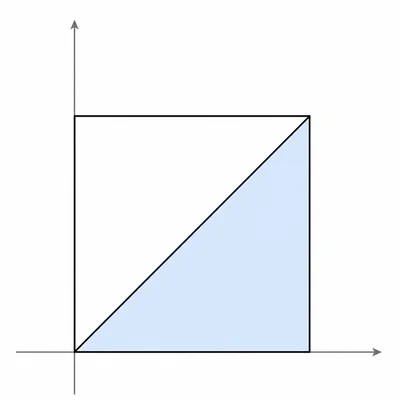
Evaluate ∫ from 0 to 1 of ∫ from y to 1 of e^(x^2) dx dy by reversing the order of integration.
- 15
Let I(a) = ∫ from 0 to infinity of e^(-ax) sin x dx for a > 0. Find I(a).