Analyze how glaciers and ice sheets form, move, melt, and affect global and local sea level.
Read each problem carefully. Use complete sentences and show calculations when needed.
How land ice, ocean water, and climate interact
Earth Science - Grade 9-12
- 1
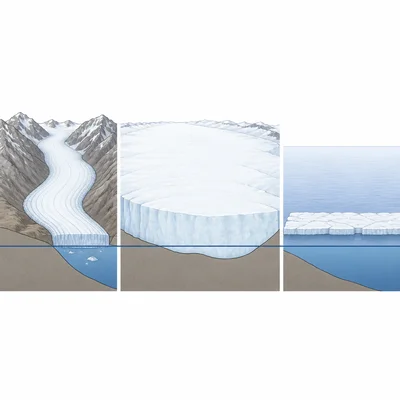
Explain the difference between a glacier, an ice sheet, and sea ice. Include which of these can directly raise global sea level when it melts.
- 2
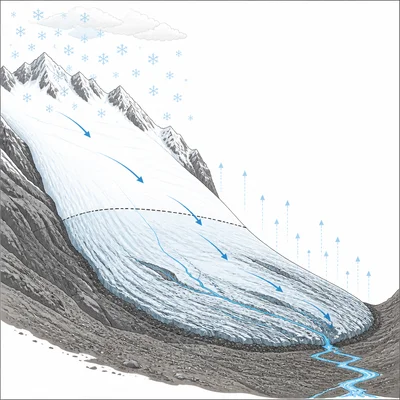
A glacier has an accumulation zone where snowfall adds ice and an ablation zone where melting and sublimation remove ice. If annual accumulation is 1.4 meters water equivalent and annual ablation is 1.9 meters water equivalent, what is the glacier's annual mass balance? State whether the glacier is gaining or losing mass.
- 3
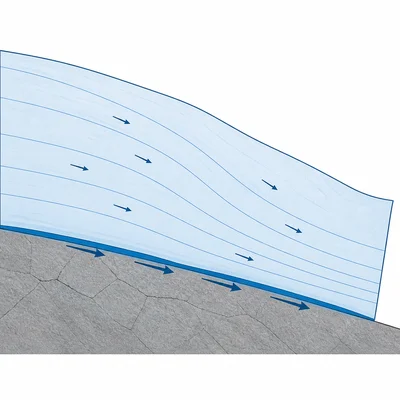
Describe two ways glaciers move. Your answer should include internal deformation and basal sliding.
- 4
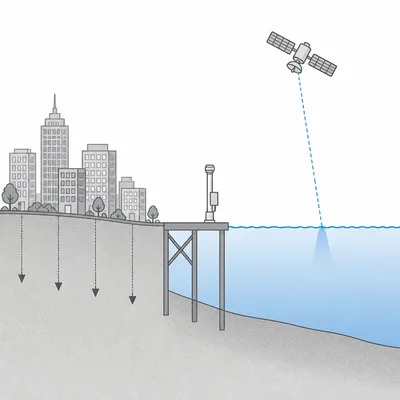
A tide gauge records that relative sea level at a coastal city is rising 6.0 millimeters per year. Satellite data show global mean sea level is rising 3.5 millimeters per year. What is the likely rate of local land subsidence or uplift at the city, and which one is it?
- 5
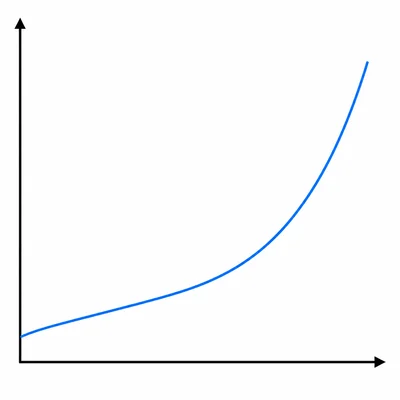
A graph shows global mean sea level rising slowly from 1900 to 1990 and rising more steeply from 1990 to the present. What does the steeper slope after 1990 indicate about the rate of sea level rise?
- 6
List three major contributors to modern global sea level rise and briefly explain how each one adds to sea level.
- 7
If 500 cubic kilometers of land ice melt and enter the ocean in one year, estimate the global mean sea level rise in millimeters. Use an ocean surface area of 361 million square kilometers and assume 1 cubic kilometer spread over 1 million square kilometers raises sea level by 1 millimeter.
- 8
Explain why melting of the Greenland Ice Sheet is especially important for future sea level, even though it does not cover the largest area of ice on Earth.
- 9
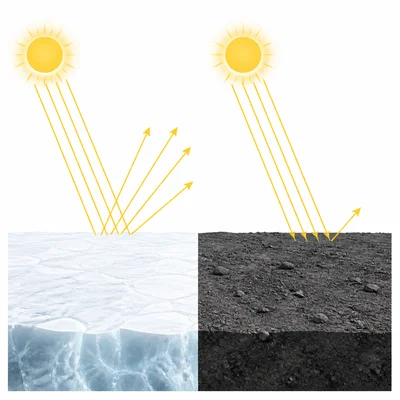
What is albedo, and how can a decrease in albedo accelerate glacier or ice sheet melting?
- 10
A glacier's terminus retreated 1.8 kilometers between 2005 and 2020. Calculate the average retreat rate in meters per year.
- 11
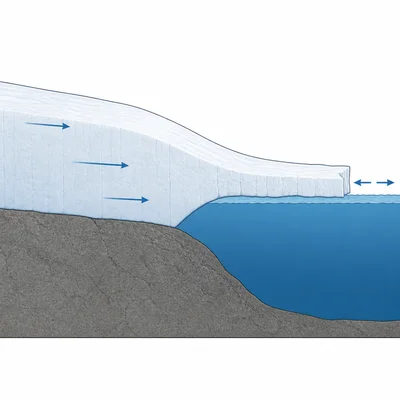
Study a diagram of an ice shelf attached to an ice sheet. Explain why collapse of a floating ice shelf does not directly raise sea level much, but can still lead to faster sea level rise later.
- 12
A coastal community is planning for future hazards. Identify two sea level rise impacts and one adaptation strategy for each impact.