Practice AP Physics C Mechanics problems involving center of mass, linear mass density, rotational inertia, the parallel-axis theorem, and composite rigid bodies.
Read each problem carefully. Show equations, substitutions, and units where appropriate. Use calculus when a continuous mass distribution is described.
Calculating centers of mass and rotational inertia for systems and continuous bodies
Physics - Grade 9-12
- 1
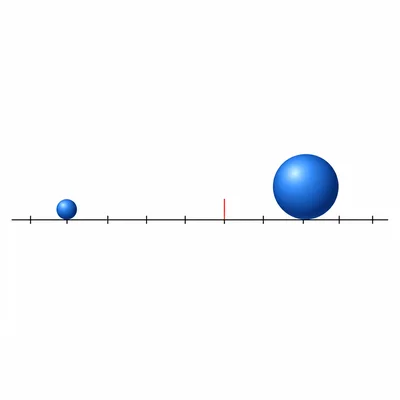
Two particles lie on the x-axis. A 2.0 kg particle is at x = 1.0 m, and a 6.0 kg particle is at x = 5.0 m. Find the x-coordinate of the center of mass.
- 2
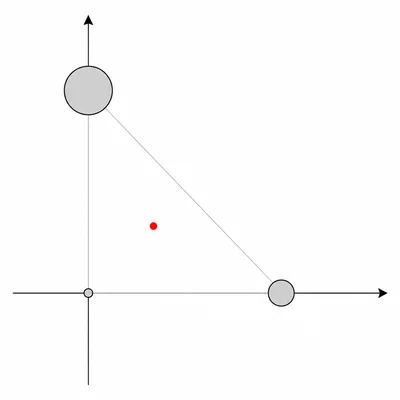
Three point masses form a triangle in the xy-plane: 1.0 kg at (0, 0), 2.0 kg at (3.0 m, 0), and 3.0 kg at (0, 4.0 m). Find the coordinates of the center of mass.
- 3
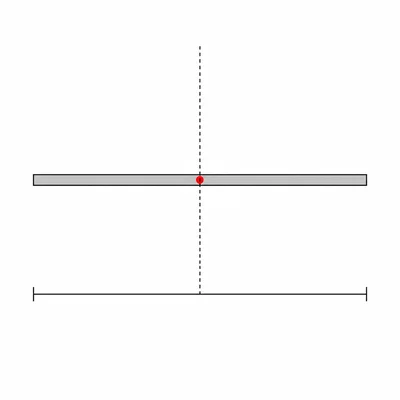
A uniform thin rod of length L lies along the x-axis from x = 0 to x = L. Use integration to find the x-coordinate of its center of mass.
- 4
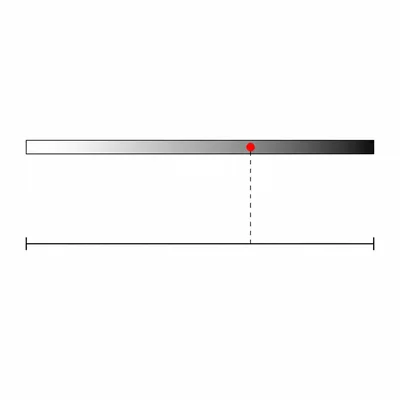
A nonuniform thin rod extends from x = 0 to x = L with linear density lambda(x) = kx, where k is a constant. Find the center of mass in terms of L.
- 5
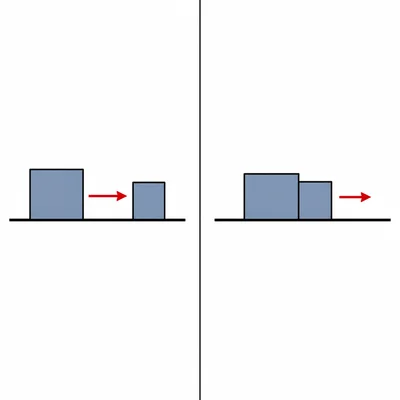
A 4.0 kg object moving at 3.0 m/s to the right sticks to a 2.0 kg object initially at rest on a frictionless track. Find the velocity of the center of mass before and after the collision.
- 6
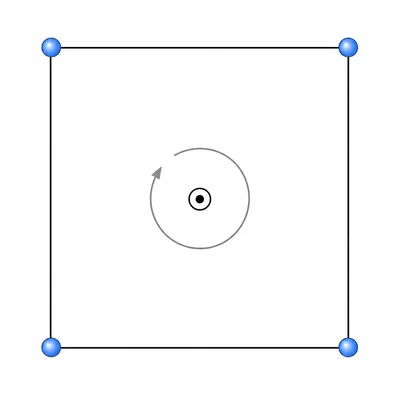
Four equal masses m are placed at the corners of a square of side length a. Find the moment of inertia of the system about an axis perpendicular to the square through its center.
- 7
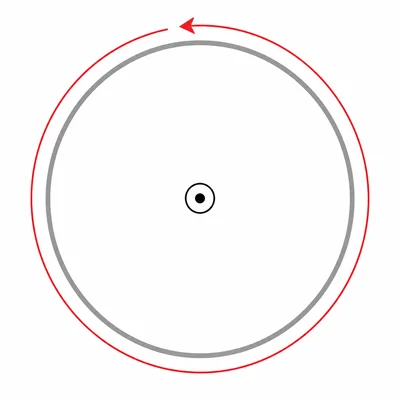
A thin hoop of mass M and radius R rotates about its central symmetry axis. Explain why its moment of inertia is MR^2.
- 8
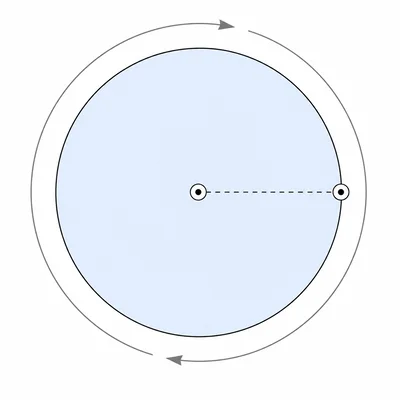
A uniform solid disk has mass M and radius R. Its moment of inertia about its central axis is I_cm = (1/2)MR^2. Use the parallel-axis theorem to find its moment of inertia about an axis perpendicular to the disk through a point on its rim.
- 9
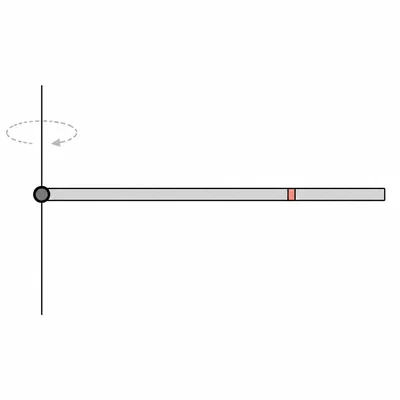
A uniform thin rod of mass M and length L rotates about an axis perpendicular to the rod through one end. Derive its moment of inertia using integration.
- 10
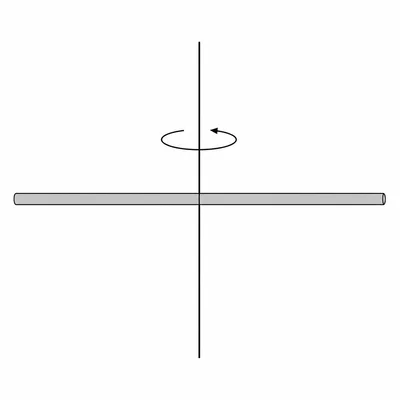
A uniform thin rod of mass 2.0 kg and length 1.5 m rotates about an axis perpendicular to the rod through its center. Find its moment of inertia.
- 11
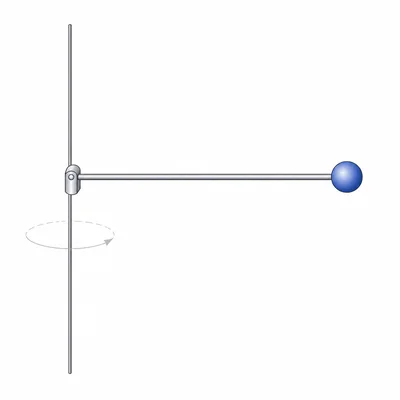
A composite object consists of a uniform thin rod of mass M and length L with a point mass M attached to one end. The object rotates about an axis perpendicular to the rod through the other end. Find the total moment of inertia.
- 12
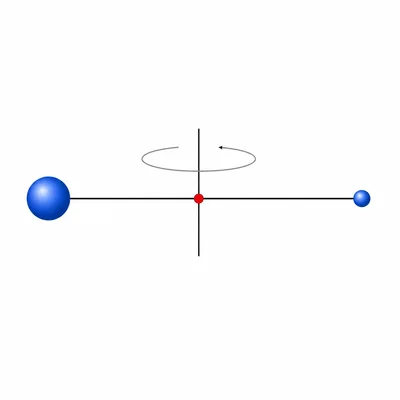
A rigid body consists of two point masses connected by a massless rod: 3.0 kg at x = 0 and 1.0 kg at x = 2.0 m. The body rotates about an axis perpendicular to the rod through its center of mass. Find the moment of inertia about this center-of-mass axis.