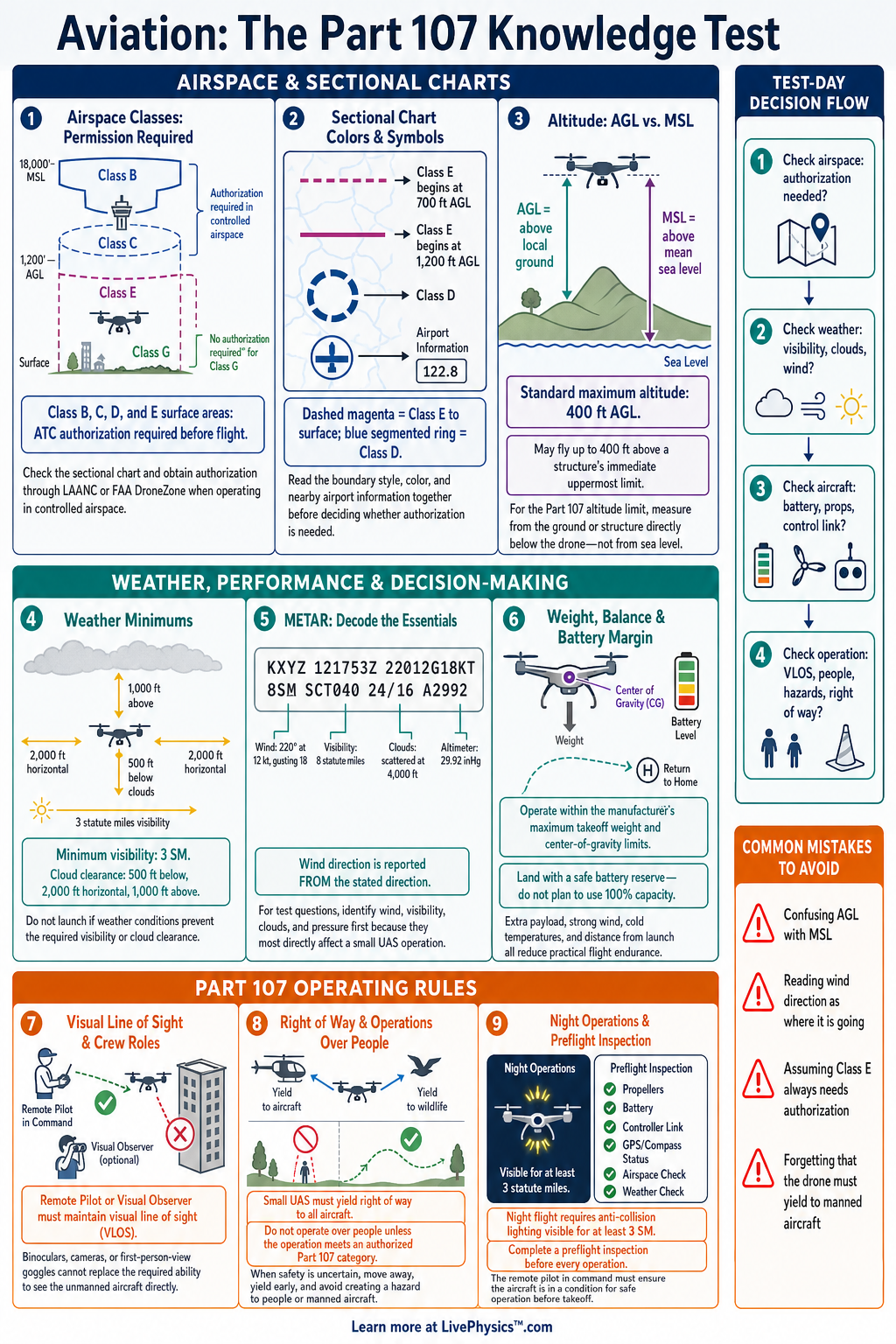
The Part 107 Knowledge Test measures whether a future remote pilot can operate a small unmanned aircraft safely in the National Airspace System. Students need this cheat sheet to organize the rules, chart information, weather limits, and decision-making skills tested by the FAA. The test includes questions about regulations, airspace, airport operations, emergency procedures, and crew resource management.
Passing the test is a required step toward earning a Remote Pilot Certificate.
Part 107 applies to many nonrecreational small drone operations in the United States. The most important limits include a maximum altitude of 400 feet above ground level, a maximum groundspeed of 100 miles per hour, and visual line of sight requirements. Pilots must understand when FAA airspace authorization is required and how weather affects safe flight.
They must also learn to read sectional charts, METAR reports, TAF forecasts, and airport information.
Key Facts
- The Part 107 Knowledge Test contains 60 multiple-choice questions, allows two hours, and requires a score of at least 70 percent to pass.
- A Part 107 remote pilot applicant must be at least 16 years old and must pass the FAA aeronautical knowledge test.
- A small unmanned aircraft under Part 107 must weigh less than 55 pounds at takeoff.
- The maximum normal operating altitude is 400 feet above ground level, or within 400 feet of a structure when flying near that structure.
- The maximum Part 107 groundspeed is 100 miles per hour, which equals 87 knots.
- Minimum weather visibility is 3 statute miles, and cloud clearance is 500 feet below and 2,000 feet horizontally from clouds.
- Flights in Class B, Class C, Class D, and surface Class E airspace require FAA authorization before operation.
- The remote pilot in command must keep the drone within visual line of sight and must yield right of way to all crewed aircraft.
Vocabulary
- Remote Pilot in Command
- The certified person who has final responsibility for the safety and legal compliance of a drone operation.
- Visual Line of Sight
- A condition in which the remote pilot or visual observer can see the unmanned aircraft without using devices other than corrective lenses.
- LAANC
- Low Altitude Authorization and Notification Capability is a system that can provide near real-time airspace authorization for eligible drone flights.
- Sectional Chart
- An aeronautical map that shows airspace, airports, obstacles, terrain, navigation information, and other flight hazards.
- METAR
- A coded aviation weather report that describes current weather conditions at or near an airport.
- Controlled Airspace
- Airspace where air traffic control manages aircraft activity and where drone operations may need FAA authorization.
Common Mistakes to Avoid
- Confusing 400 feet above ground level with 400 feet above sea level is wrong because Part 107 normally measures the altitude limit from the ground directly below the drone.
- Assuming all airspace near an airport requires the same approval is wrong because charted airspace classes and boundaries determine whether authorization is needed.
- Reading a METAR as a forecast is wrong because a METAR reports observed current weather, while a TAF provides expected future conditions.
- Treating visual line of sight as watching a live camera feed is wrong because the aircraft must be directly visible to the remote pilot or visual observer.
- Ignoring cloud clearance when visibility is good is wrong because Part 107 requires both at least 3 statute miles of visibility and the stated distance from clouds.
Practice Questions
- 1 A remote pilot plans to fly 450 feet above ground level in open Class G airspace. State whether this altitude is normally allowed under Part 107 and give the normal maximum altitude.
- 2 A drone is flying 150 feet above the top of a 600-foot-tall structure. Determine whether the flight meets the Part 107 structure altitude rule.
- 3 A METAR reports visibility of 2 statute miles. State whether a normal Part 107 operation may begin under this visibility condition.
- 4 Explain why a remote pilot should check a sectional chart and local airspace before flying even when the drone will remain below 400 feet above ground level.
Understanding The Part 107 Knowledge Test
The Part 107 Knowledge Test has 60 multiple-choice questions, and applicants receive two hours to complete it. A passing score is 70 percent or higher. The test is given at an FAA-approved knowledge testing center.
Applicants must be at least 16 years old, be able to read, speak, write, and understand English, and pass the required security screening. A remote pilot certificate shows that the holder understands the rules and risks of commercial small drone operations.
Regulations form a major part of the exam. Part 107 generally applies to unmanned aircraft weighing less than 55 pounds at takeoff. The remote pilot in command is responsible for deciding whether each flight can be completed safely.
Normal operations must stay within visual line of sight, use no more than 100 miles per hour of groundspeed, and remain at or below 400 feet above ground level. A drone may fly higher when it remains within 400 feet of a structure. The pilot must inspect the aircraft and operating area before takeoff and must stop the flight if an unsafe condition appears.
Airspace knowledge helps remote pilots avoid conflicts with crewed aircraft. Class B, Class C, Class D, and surface Class E airspace require FAA authorization before a Part 107 flight. Class G airspace usually does not require prior authorization, but every operation still must follow Part 107 rules.
Sectional charts show airspace boundaries, airport locations, obstacles, special use airspace, and maximum elevation figures. Students should practice identifying the chart legend symbols and reading altitude information carefully. Many real flights begin with a chart review and an authorization request through LAANC when controlled airspace is involved.
Weather questions test a pilot's ability to recognize conditions that reduce safety. Part 107 requires at least three statute miles of flight visibility from the control station. The drone must stay at least 500 feet below clouds and 2,000 feet horizontally from clouds.
METAR reports describe current airport weather, while TAF reports predict future weather conditions. Wind, gusts, temperature, visibility, and cloud cover can change the flight plan. A pilot should delay a mission when weather makes control, visibility, or aircraft performance uncertain.
The exam also emphasizes sound judgment. Remote pilots must yield to all crewed aircraft and must not create a hazard to people, property, or other aircraft. They need to understand emergency actions for lost link, flyaway risk, battery problems, and unexpected aircraft traffic.
Operations over people, moving vehicles, and at night have additional requirements. Good study habits include taking timed practice tests, using the FAA study guide, and explaining each rule in plain language. Memorization helps, but safe remote pilots also understand why each rule exists.