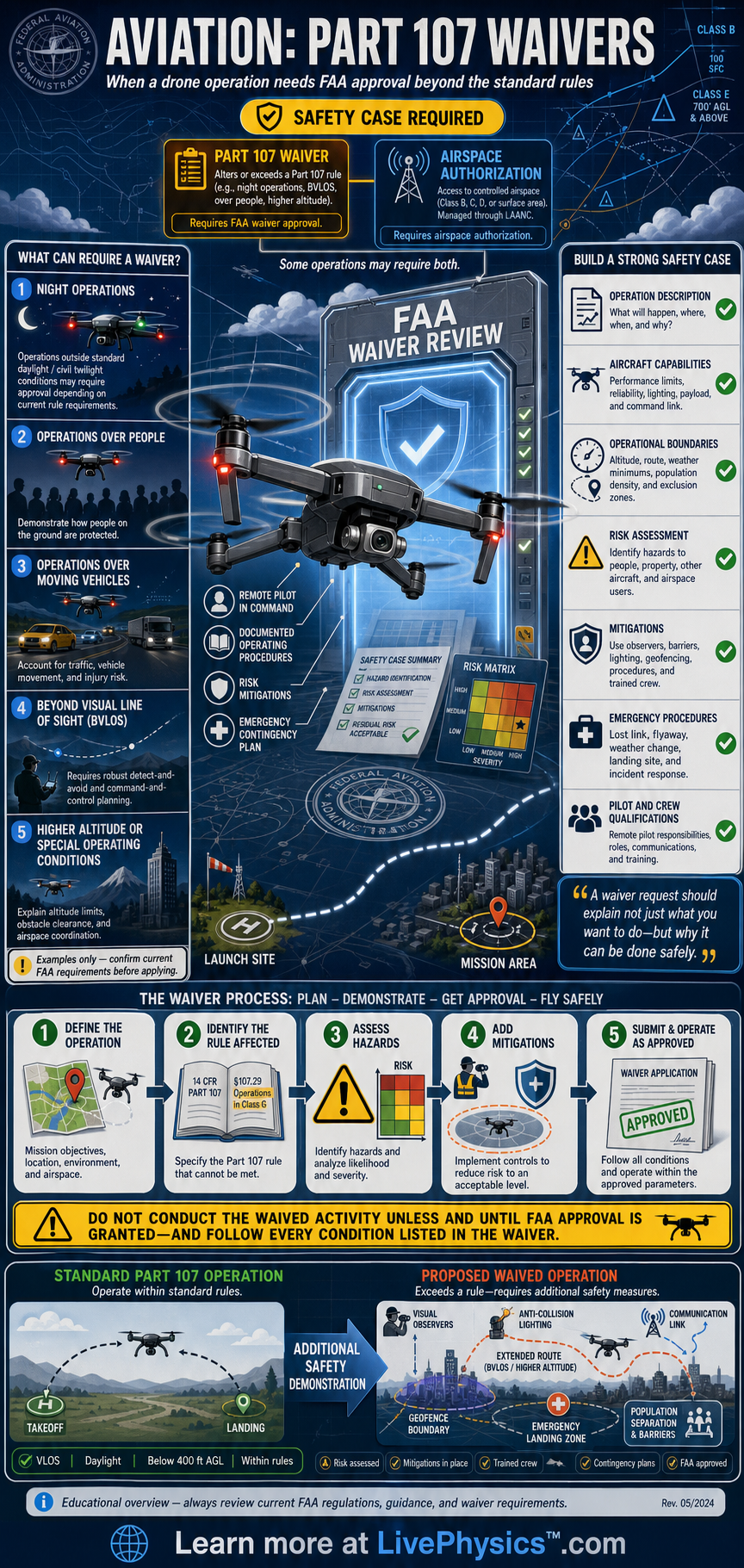
A Part 107 waiver is FAA approval for a small drone operation that does not meet one or more normal operating rules in 14 CFR Part 107. It matters because the rules protect people, other aircraft, and property on the ground. A waiver is not automatic permission to take greater risks.
The applicant must demonstrate that the operation can be conducted safely under specific conditions.
Waiver applications are built around a safety case. The operator identifies the rule they need to deviate from, explains the operation, identifies hazards, and describes controls that reduce risk. The FAA may approve the request with detailed limits on the location, crew, aircraft, weather, time of day, or procedures.
A waiver does not replace other requirements, such as airspace authorization or a qualified remote pilot when those requirements apply.
Understanding Aviation, Part 107 Waivers
A Part 107 waiver is not a general permission slip. It is a formal FAA decision that lets a named person or organization depart from one identified operating rule for a defined small unmanned aircraft operation. The legal standard is safety.
The applicant must show that the proposed operation can be conducted safely under the waiver terms. This creates a safety case rather than a request based only on convenience. The safety case explains what makes the operation unusual, what could go wrong, and why the planned controls reduce risk to an acceptable level.
Strong applications describe the whole operation in practical detail. This includes the aircraft, its weight, command link, crew roles, launch site, landing site, flight area, planned altitude, and expected weather. The applicant identifies hazards such as loss of control, a battery failure, a person entering the area, or conflict with manned aircraft.
Each hazard needs a control. Controls can include trained visual observers, site barriers, emergency landing areas, aircraft inspections, communication plans, and clear stop procedures. The FAA needs evidence that these controls work in the real operating environment.
A waiver can include strict conditions that become part of the approval. It may limit the waiver to certain locations, dates, visibility levels, equipment, crew qualifications, or flight procedures. Operators must follow every condition, not just the Part 107 rule named in the waiver.
A waiver for visual line of sight, for example, needs a credible method for maintaining awareness of the aircraft and nearby air traffic. A waiver does not automatically grant access to controlled airspace. Airspace authorization may still be required for a flight near an airport or within controlled airspace.
Students often meet waiver ideas through drone photography, infrastructure inspection, mapping, construction, emergency support, and research. A company may want to perform work that goes beyond a standard operating limit, but the benefit of the work does not prove that it is safe. The important learning skill is separating the mission goal from the safety evidence.
Read the exact rule first. Then define the operating area, list credible failures, choose controls, and explain how the crew will verify those controls before flight. Good aviation planning is specific because vague promises cannot manage real hazards.
Key Facts
- 14 CFR 107.200 describes the FAA waiver policy for certain Part 107 operating rules.
- 14 CFR 107.205 identifies the Part 107 provisions that may be waived.
- Risk score = likelihood × consequence.
- Safety case = hazard identification + risk controls + verification.
- Baseline maximum groundspeed = 100 mph under 14 CFR 107.51.
- Airspace authorization ≠ Part 107 waiver. A waiver does not replace required controlled-airspace approval.
Vocabulary
- Part 107 waiver
- FAA approval to conduct a specific small UAS operation that deviates from an identified Part 107 rule under approved conditions.
- Safety case
- A structured explanation with evidence showing how an operation can be conducted at an acceptable level of safety.
- Mitigation
- A procedure, piece of equipment, or operational limit used to reduce a hazard or its consequences.
- Visual line of sight
- The ability of the remote pilot or visual observer to see the unmanned aircraft well enough to know its location, direction, and hazards around it.
- Airspace authorization
- FAA permission to operate a drone in controlled airspace when Part 107 requires that permission.
Common Mistakes to Avoid
- Treating a waiver as permission for every unusual flight is wrong because approval applies only to the cited rule, operating area, procedures, and conditions. Match each planned flight to the exact waiver terms.
- Requesting a waiver without identifying hazards is wrong because the FAA needs a safety argument, not just a business reason. List credible failures and connect each one to a specific mitigation.
- Confusing a waiver with controlled-airspace approval is wrong because a waiver does not remove the need for airspace authorization. Check the airspace requirements for every planned location.
- Using vague claims such as trained crew or safe aircraft is wrong because those claims do not show how safety will be achieved. State the training standard, equipment checks, crew duties, and emergency actions.
Practice Questions
- 1 A drone mission over flat terrain is planned at 520 feet above ground level. If the normal Part 107 maximum is 400 feet above ground level, by how many feet does the plan exceed the normal limit, and what type of FAA approval should the operator evaluate?
- 2 A risk worksheet assigns likelihood a value of 3 and consequence a value of 4. Using risk score = likelihood × consequence, calculate the score. If a mitigation lowers likelihood to 2, calculate the new score.
- 3 An operator wants to fly beyond visual line of sight for a pipeline inspection. Explain why a detailed procedure for detecting other aircraft, handling lost communications, and responding to an emergency is more useful in a waiver application than simply stating that the pilot is experienced.