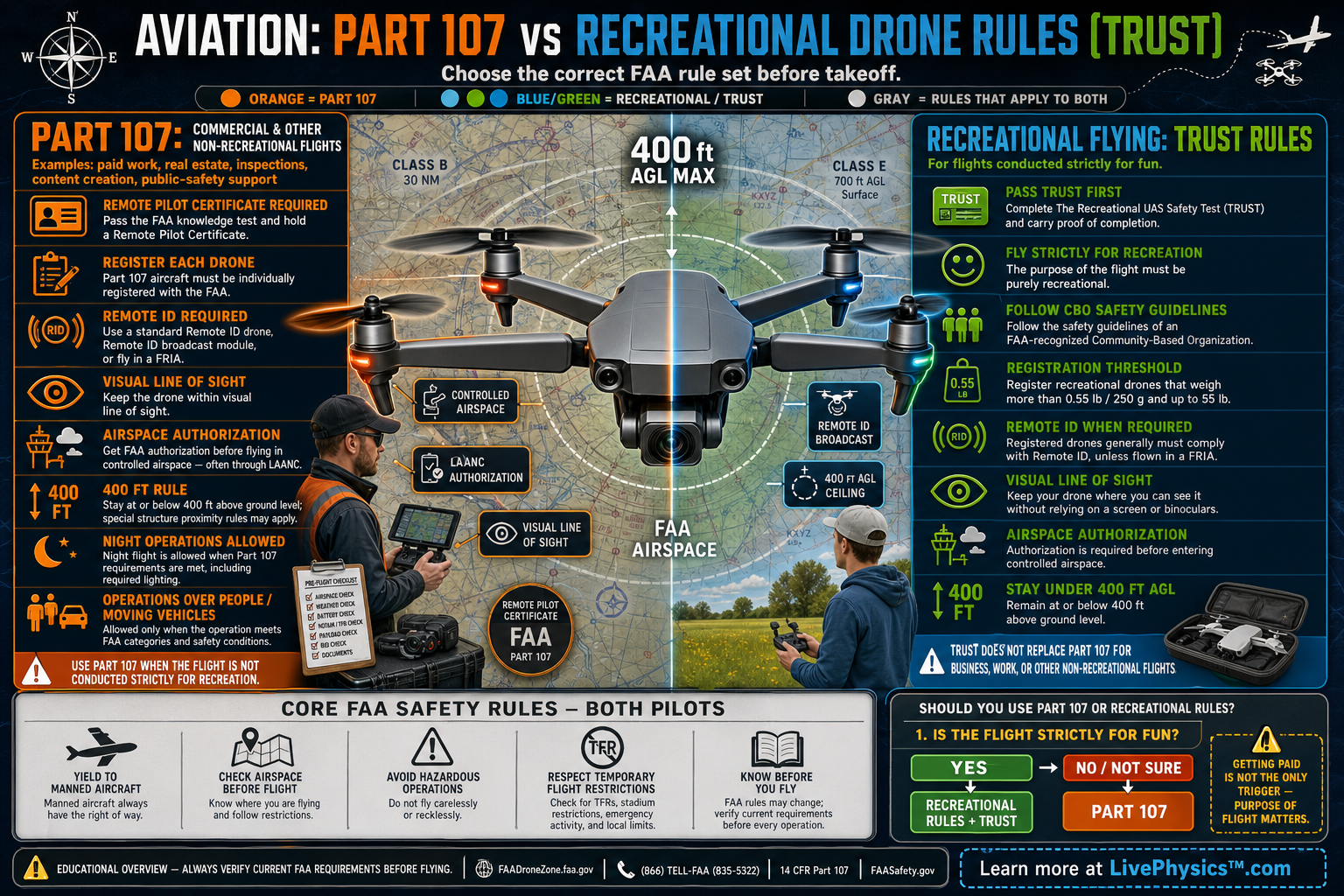
Small drones share the same airspace as helicopters, airplanes, and emergency aircraft. The Federal Aviation Administration uses different rule paths based mainly on why a drone is being flown. Part 107 covers most flights that are not purely recreational, while the recreational exception applies only to flights done for personal enjoyment.
Knowing the correct path helps a pilot protect people, avoid airspace conflicts, and follow federal law.
Part 107 requires a Remote Pilot Certificate and places the pilot in command in charge of the operation. Recreational pilots must complete TRUST, the Recreational UAS Safety Test, and follow the conditions for recreational flying. Both groups must respect airspace rules, keep the drone in visual line of sight, and use Remote ID when required.
The purpose of a flight matters more than whether someone receives payment for it.
Understanding Aviation, Part 107 vs Recreational Drone Rules (TRUST)
The FAA separates drone flights by the purpose of the operation. Part 107 covers civil small unmanned aircraft flights that are not conducted solely for recreation. This includes work for a business, school, government agency, or client.
Payment is a strong sign that Part 107 applies, but it is not the only test. A flight can require Part 107 even if no money changes hands when its purpose is not personal enjoyment.
Recreational flying uses a separate legal exception. The pilot must fly only for enjoyment and meet every condition of that exception.
TRUST means The Recreational UAS Safety Test. It teaches basic safety topics such as airspace awareness, airport hazards, weather, and respect for people on the ground. A recreational pilot must pass TRUST and carry proof of completion while flying.
The pilot must follow the safety guidelines of an FAA recognized Community Based Organization. TRUST does not authorize commercial activity.
It does not replace the need for airspace authorization. Recreational pilots must still obtain authorization before entering controlled airspace.
A Part 107 pilot must earn a Remote Pilot Certificate by passing the FAA knowledge test. The remote pilot in command is responsible for deciding whether conditions are safe before each flight. Part 107 requires visual line of sight, safe aircraft operation, and compliance with airspace limits.
Controlled airspace near many airports requires FAA authorization, often requested through the LAANC system. Some operations outside normal Part 107 limits need a waiver. Examples include certain nighttime conditions, operations beyond visual line of sight, or other higher risk activities.
Registration and Remote ID are important for both pathways. Drones weighing more than zero point five five pounds must usually be registered with the FAA. Part 107 registration is tied to each individual aircraft.
Recreational registration can cover multiple drones owned by one person. Most drones that must be registered must comply with Remote ID. Remote ID broadcasts identifying and location information during flight, which helps the FAA and public safety agencies manage the airspace.
Altitude rules show why pilots must understand the setting around a flight. A common limit is four hundred feet above ground level. Under Part 107, a drone may fly higher near a structure when it stays within four hundred feet horizontally of that structure and remains no more than four hundred feet above it.
Pilots should check the airspace, local restrictions, temporary flight restrictions, and nearby people before takeoff. The most useful learning habit is to identify the flight purpose first. Then check the drone, the location, and the rules that apply.
Key Facts
- Part 107 applies to drone flights that are not conducted solely for recreation.
- TRUST = The Recreational UAS Safety Test.
- Drones weighing more than 0.55 lb, about 250 g, must usually be registered.
- Normal altitude limit = 400 ft above ground level.
- 400 ft + 120 ft structure height = 520 ft above ground level when the Part 107 structure rule applies.
- Remote ID is required for most drones that are required to be registered.
Vocabulary
- Part 107
- The FAA rule section that governs most nonrecreational small drone operations.
- TRUST
- The Recreational UAS Safety Test required for pilots flying only for recreation.
- Remote Pilot Certificate
- An FAA certificate required for the person in command of a Part 107 drone operation.
- Controlled airspace
- Airspace around many airports where drone pilots need FAA authorization before flying.
- Remote ID
- A system that broadcasts a drone's identification and location information during flight.
Common Mistakes to Avoid
- Treating TRUST as a commercial drone license. TRUST is only for flights conducted solely for recreation and does not qualify a pilot for Part 107 work.
- Assuming an unpaid flight is automatically recreational. The purpose of the flight determines the rule path, so a business, school, or organizational task can require Part 107 without payment.
- Flying near an airport without checking airspace. Controlled airspace often requires FAA authorization before takeoff, even for recreational pilots.
- Believing the 400 foot limit always means 400 feet from the launch point. The limit is generally measured above ground level, and Part 107 has a specific exception for operations near structures.
Practice Questions
- 1 A recreational drone weighs 0.72 lb. Determine whether it is above the usual FAA registration threshold of 0.55 lb.
- 2 A Part 107 drone is operating within 400 ft horizontally of a 150 ft tall structure. Calculate the highest altitude above ground level allowed by the structure rule.
- 3 A student flies a drone to collect photos for a school club's event report, receives no payment, and plans to post the images for the club. Explain why the student should examine whether Part 107 rather than the recreational exception applies.