Sign in to save

Bookmark this page so you can find it later.

Sign in to save

Bookmark this page so you can find it later.

Math middle-school May 24, 2026

Why Are Some Decimals Endless but Others Stop?

How fractions turn into decimal patterns
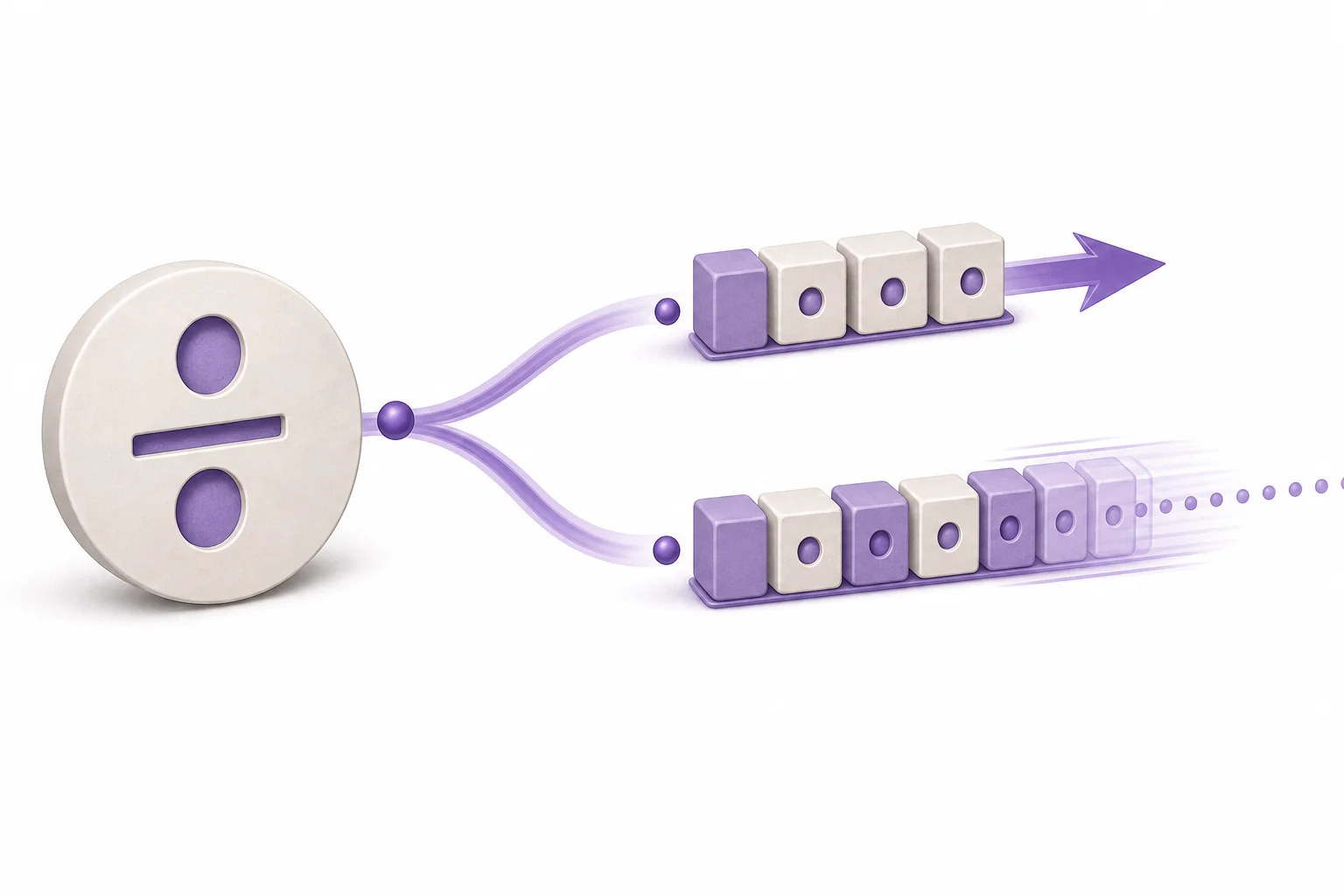
A fraction bar connected to three decimal paths, one ending, one repeating, and one continuing without a visible pattern

Some decimals stop because the fraction can be split exactly into tenths, hundredths, thousandths, or smaller place values. Some decimals repeat because the division gets the same leftover number again. Some decimals never stop or repeat because they are not fractions at all.

Big Idea. Common Core 7.NS.A.2d and 8.NS.A.1 connect fraction division, repeating decimals, and rational versus irrational numbers.

Decimals are another way to write numbers. Some are short, like $0.75$. Some seem to go on forever, like $0.3333...$. Others keep going with no repeating block, like the decimal for $\pi$. The reason comes from division and place value. When you write a fraction such as $\frac{1}{8}$ as a decimal, you are asking how many tenths, hundredths, or thousandths fit into it. Sometimes the division finishes with no leftover. Sometimes a leftover appears again, so the digits cycle. Middle-school math gives this pattern a clear rule. For fractions, the bottom number matters. If its only prime factors are 2s and 5s, the decimal stops. If another prime factor is left, the decimal repeats. Irrational numbers are different. They are not fractions, so their decimals do not settle into a repeating pattern.

Decimals are division
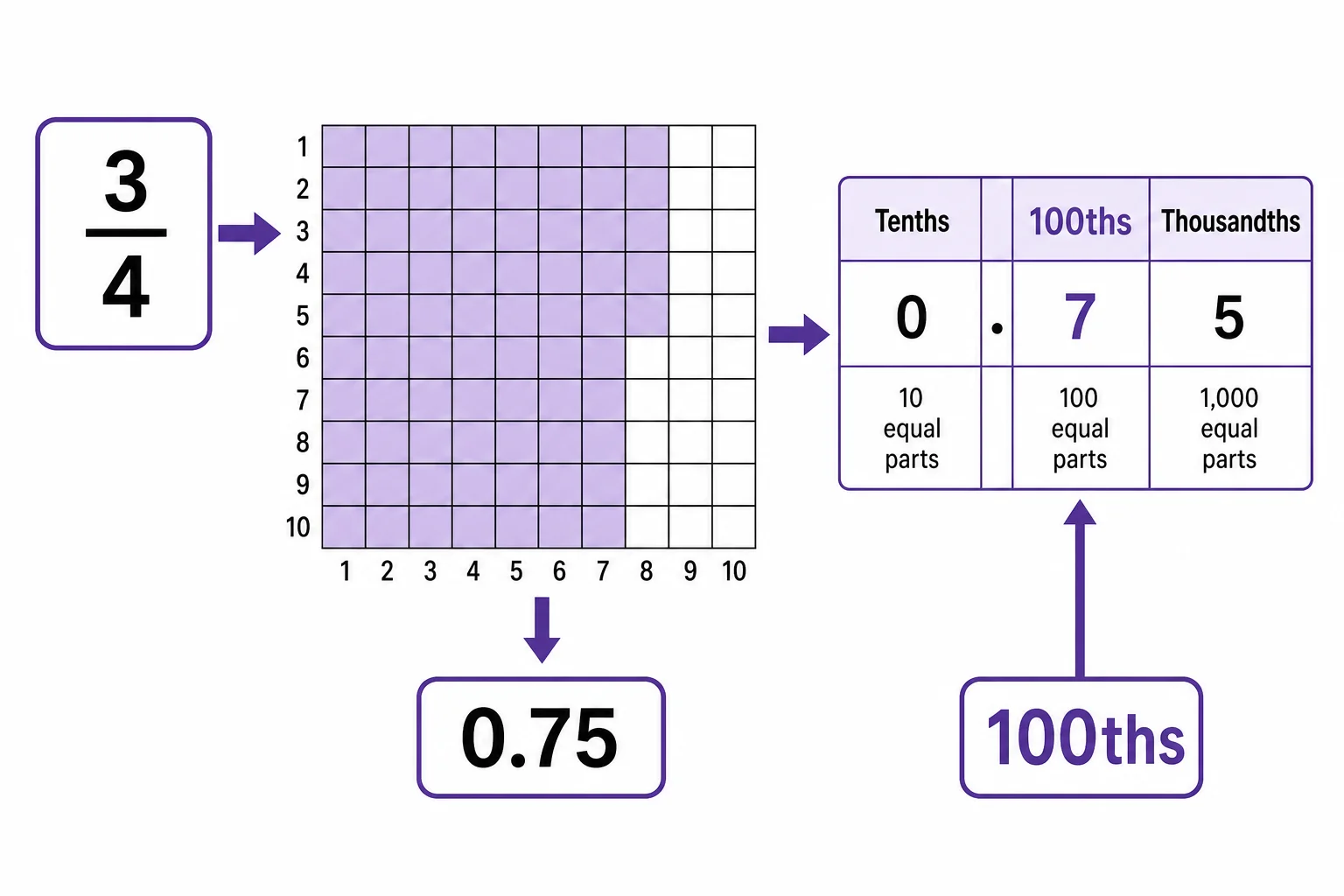
A place value chart showing tenths, hundredths, and thousandths connected to the fraction three fourths and the decimal 0.75
A stopping decimal lands exactly on a place value
A decimal is not a new kind of number. It is a way to show a number using place value. The first place after the decimal point is tenths. Then come hundredths, thousandths, and so on. A fraction asks for division. The fraction $\frac{3}{4}$ means 3 divided by 4. If you divide 3 by 4, you get $0.75$. That decimal stops because the division ends with no remainder. The number $0.75$ also means 75 hundredths. This fits the fraction exactly, since $75$ hundredths is the same as $\frac{75}{100}$, and that simplifies to $\frac{3}{4}$. Every terminating decimal can be written as a fraction with a denominator of 10, 100, 1000, or another power of 10. This is why place value is the key to understanding which decimals stop.

A terminating decimal is a fraction that fits exactly into base ten place value.

Why 2 and 5 matter
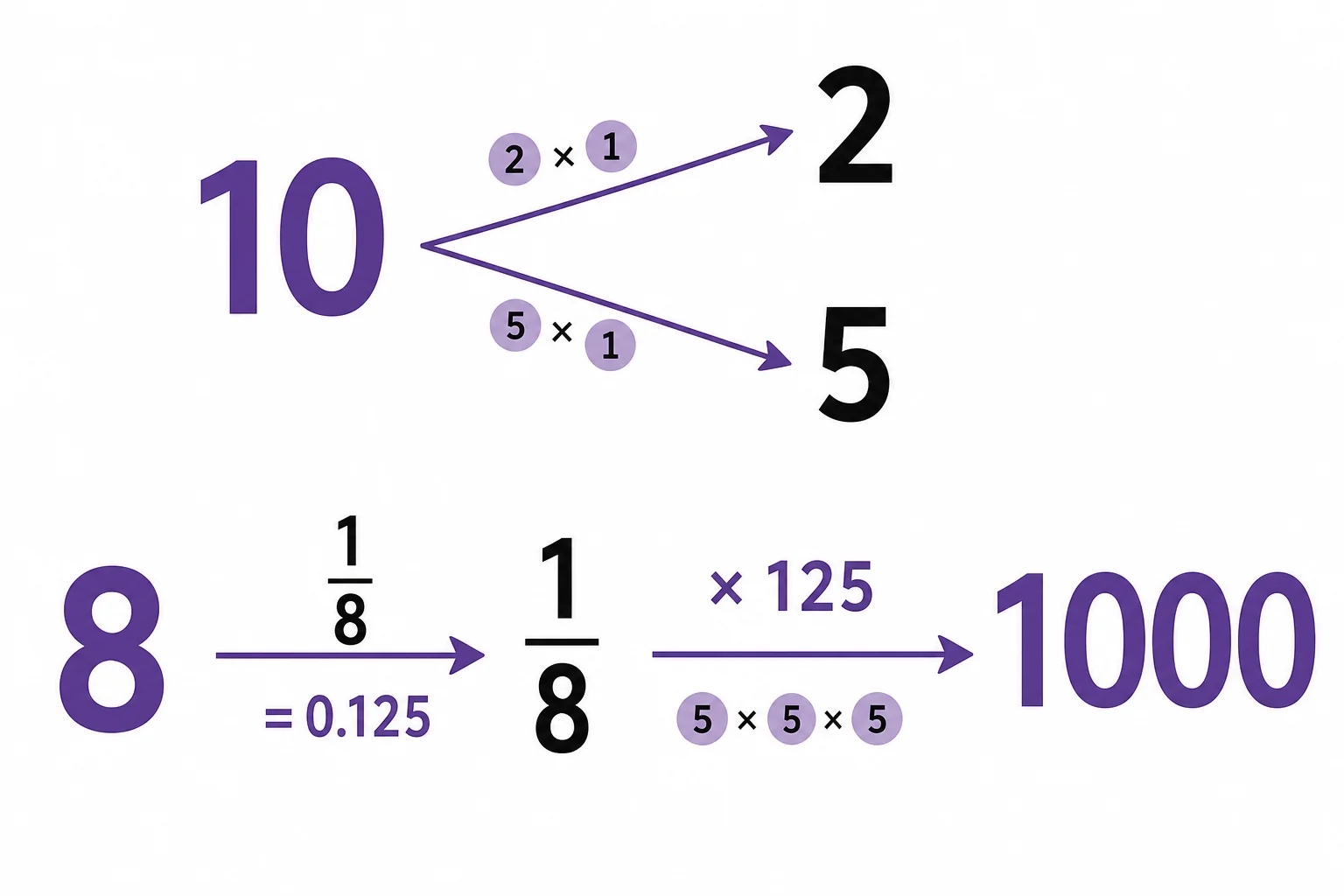
A factor tree for ten showing two and five, with fractions one eighth and three twentieths connected to powers of ten
Only 2s and 5s can build powers of 10
Our decimal system is based on 10. That matters because 10 breaks into the prime factors 2 and 5. Powers of 10 work the same way. The number 100 is $2 \times 2 \times 5 \times 5$. The number 1000 is $2 \times 2 \times 2 \times 5 \times 5 \times 5$. A fraction can become a terminating decimal when its denominator can be changed into a power of 10. The fraction $\frac{1}{8}$ stops because 8 is $2 \times 2 \times 2$. Multiply the bottom by 125, and it becomes 1000. Do the same to the top, and $\frac{1}{8}$ becomes $\frac{125}{1000}$, which is $0.125$. The fraction $\frac{3}{20}$ also stops because 20 only uses 2s and 5s. The rule works after the fraction is simplified.

A simplified fraction stops when the denominator has only 2s and 5s as prime factors.

Remainders can repeat
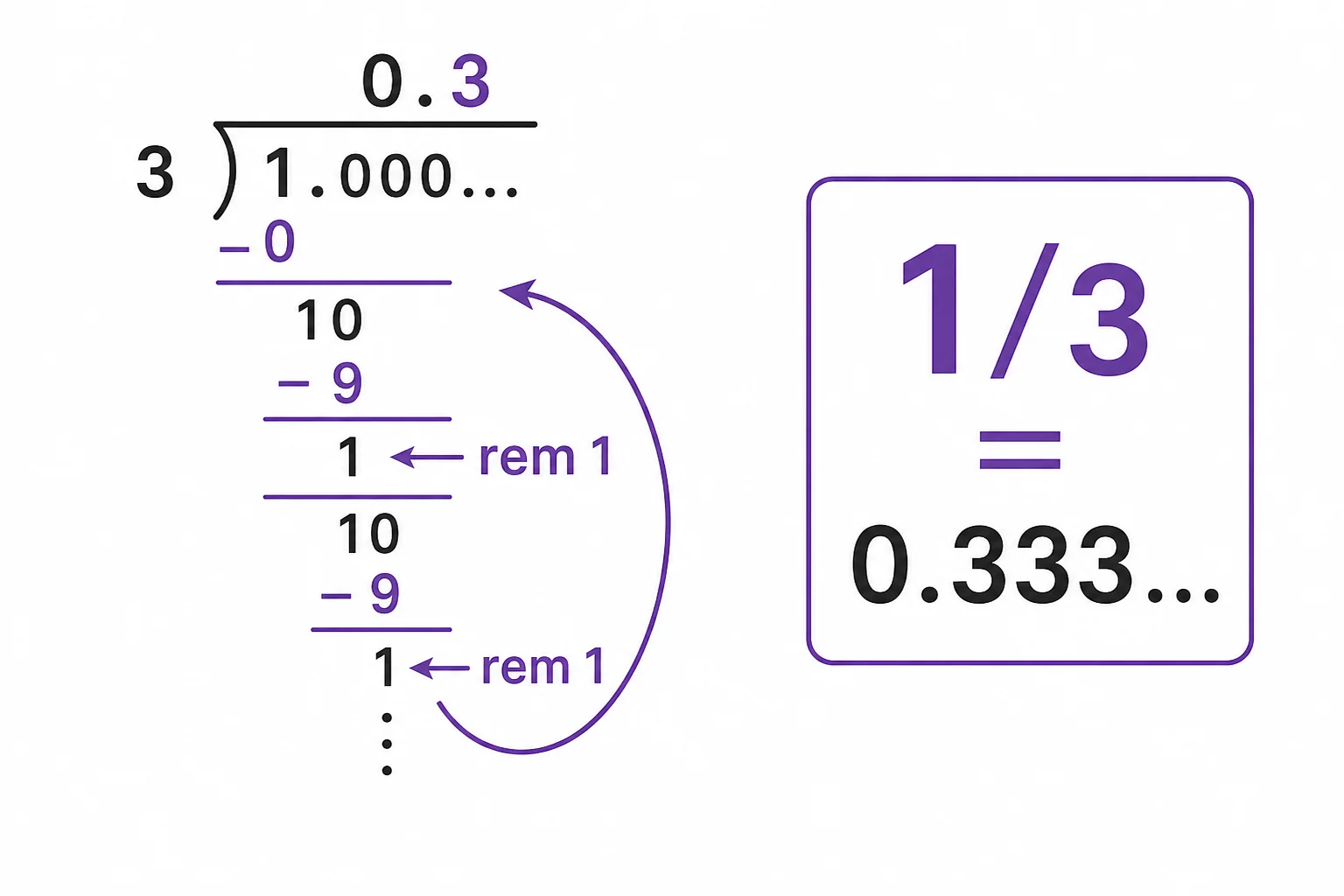
A long division setup for one third showing the remainder one returning each step and producing repeating threes
A repeated remainder makes repeated digits
Now try $\frac{1}{3}$. Long division gives $0.3333...$ because the same remainder comes back again and again. After 1 divided by 3, there is a remainder of 1. Bring down a zero and divide 10 by 3. The quotient digit is 3, and the remainder is 1 again. Nothing new can happen, so the digit 3 repeats forever. The same idea works for fractions with longer cycles. For $\frac{1}{7}$, the digits repeat as $0.142857142857...$. The repeating block is 142857. A repeating decimal is still exact. The dots or a bar over the repeating digits show that the pattern continues without end. Repeating decimals happen because division has only a limited set of possible remainders. Once a remainder repeats, the decimal digits must repeat too.

Repeating decimals come from repeated remainders.

Rational and irrational decimals
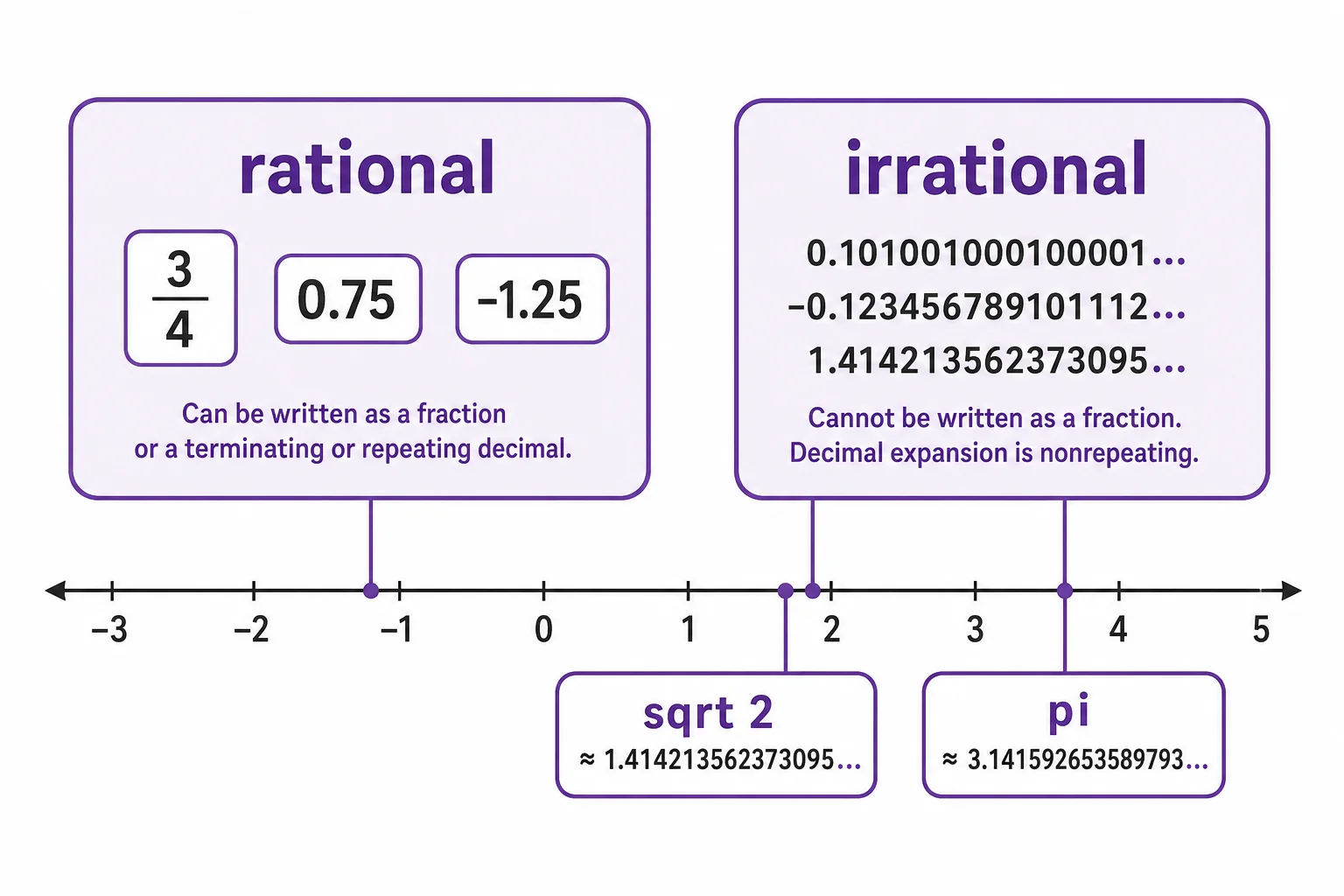
A number line with rational examples grouped separately from irrational examples pi and square root of two
Fractions stop or repeat, irrational decimals do not
A rational number is any number that can be written as a fraction of two integers, with a nonzero denominator. Every rational number has a decimal that either stops or repeats. That includes whole numbers, terminating decimals, and repeating decimals. The number 2 is rational because it is $\frac{2}{1}$. The decimal $0.6$ is rational because it is $\frac{6}{10}$. The decimal $0.777...$ is rational because it equals $\frac{7}{9}$. Irrational numbers are different. They cannot be written as a fraction of two integers. Their decimals do not stop and do not repeat. Famous examples include $\pi$ and $\sqrt{2}$. Their digits continue forever, but not in a repeating block. In grade 8, this distinction helps students compare numbers and place them on a number line.

Fractions have decimals that stop or repeat. Irrational numbers do not.

Test a fraction
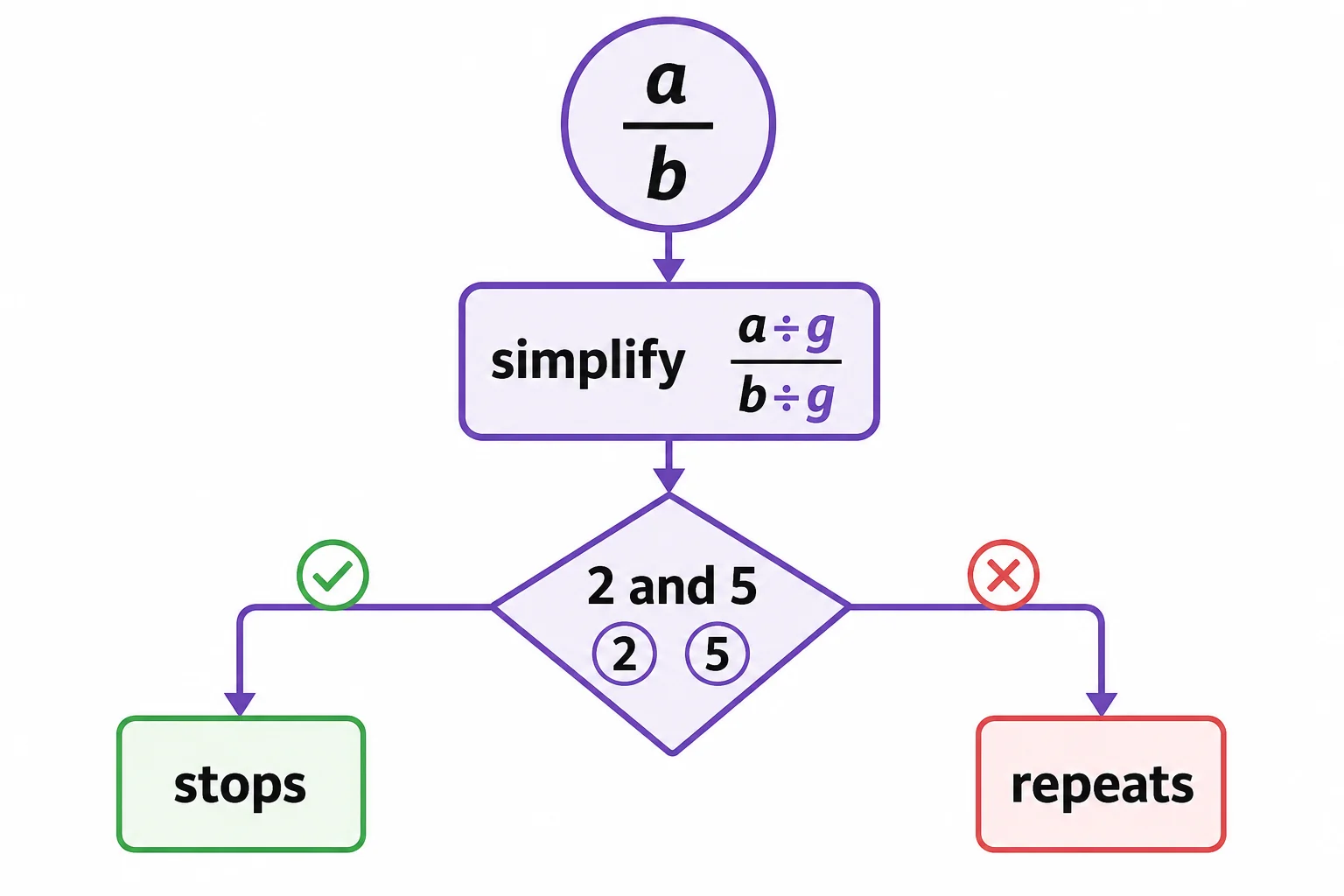
A decision flowchart for a simplified fraction asking whether the denominator has only factors two and five
Simplify first, then check the denominator
There is a reliable test for fractions. First simplify the fraction. This step is important because common factors can hide the pattern. The fraction $\frac{6}{12}$ simplifies to $\frac{1}{2}$, so it has a terminating decimal. Next factor the denominator. If the denominator has only 2s and 5s, the decimal stops. If it has any other prime factor, the decimal repeats. For example, $\frac{7}{40}$ stops because 40 is $2 \times 2 \times 2 \times 5$. The fraction $\frac{5}{12}$ repeats after simplifying because 12 has a factor of 3. The fraction $\frac{9}{14}$ repeats because 14 has a factor of 7. This test does not tell you the decimal digits right away. It tells you what kind of decimal you should expect before doing the division.

The denominator test works only after the fraction is in simplest form.

Vocabulary

Terminating decimal
A decimal that ends after a certain number of digits, such as 0.125.
Repeating decimal
A decimal with a digit or block of digits that repeats forever, such as 0.333...
Prime factor
A prime number that multiplies with other numbers to make a given number.
Rational number
A number that can be written as a fraction of two integers, with a denominator that is not zero.
Irrational number
A number that cannot be written as a fraction of two integers and has a decimal that never stops or repeats.

In the Classroom

Denominator Sort

20 minutes | Grades 6-8

Give students fraction cards such as 1/8, 5/12, 3/20, 7/30, and 9/25. Students simplify, factor the denominator, and sort each card into terminating or repeating before checking by division.

Remainder Loop Lab

25 minutes | Grades 7-8

Students use long division to convert 1/3, 1/6, 1/7, and 2/11 into decimals. They circle each repeated remainder and connect it to the repeating digit pattern.

Number Line Mix

30 minutes | Grades 8

Students place rational and irrational numbers on a number line, including 0.75, 0.333..., pi, and square root of 2. Then they explain which decimals stop, repeat, or do neither.

Key Takeaways

  • A terminating decimal ends because the division finishes with no remainder.
  • A repeating decimal happens when a remainder appears again during division.
  • A simplified fraction terminates only when its denominator has no prime factors except 2 and 5.
  • Every rational number has a decimal that stops or repeats.
  • Irrational numbers have decimals that never stop and never repeat.