Sign in to save

Bookmark this page so you can find it later.

Sign in to save

Bookmark this page so you can find it later.

Physics high-school May 21, 2026

How Do Noise-Canceling Headphones Work?

Using one sound to reduce another
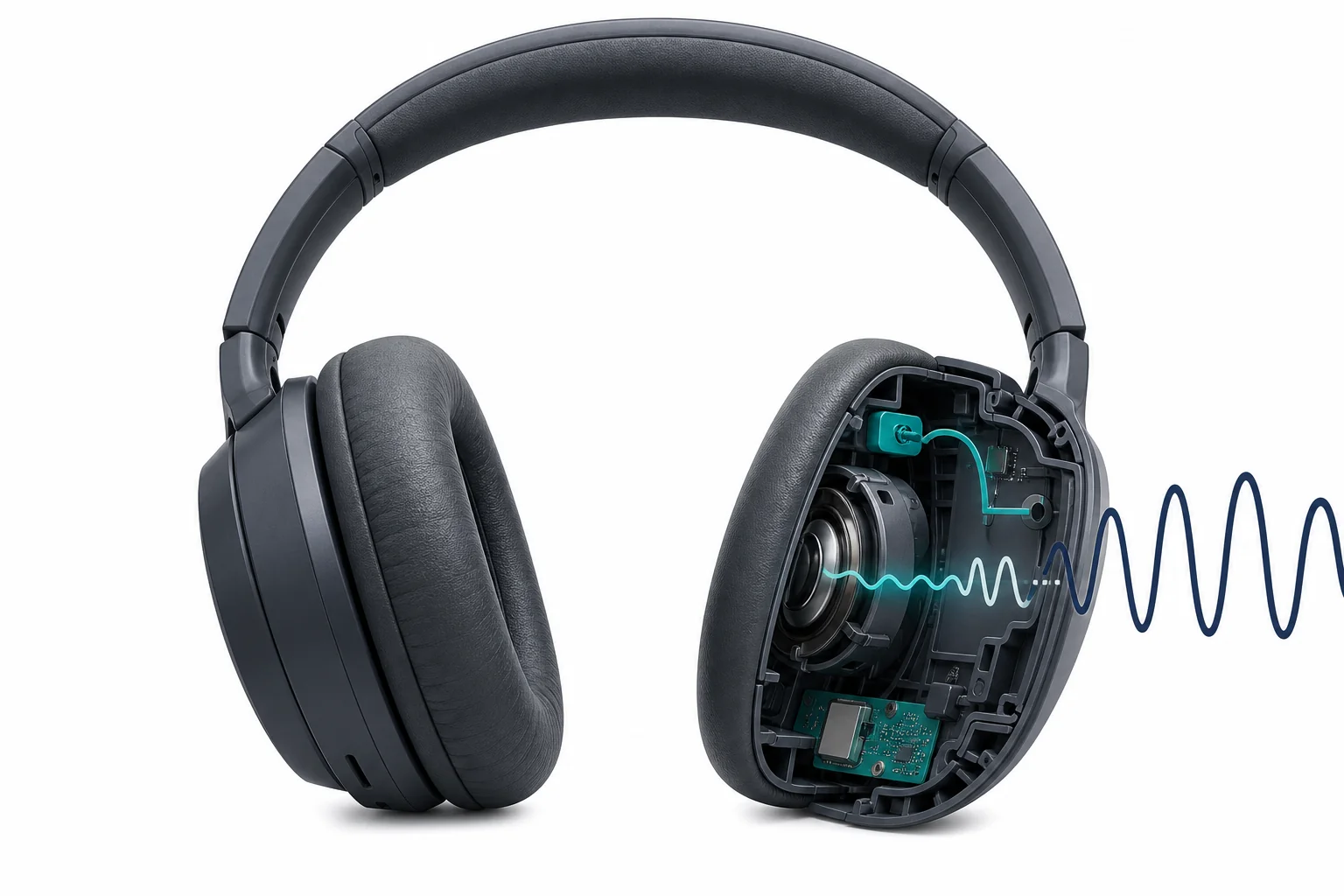
Diagram of headphones using microphones and a speaker signal to reduce incoming sound waves near an ear

Noise-canceling headphones listen to nearby sound with tiny microphones. A chip makes a matching sound that pushes air the opposite way, so part of the outside sound is reduced. They work best on steady, low sounds like engines, and less well on sudden voices.

Big Idea. NGSS HS-PS4-3 connects wave behavior to devices that use interference to send, store, or control information.

Noise-canceling headphones are a small wave lab that fits over your ears. They do not make the world silent. They reduce some outside sound by measuring it, processing it, and playing a carefully timed sound through the headphone speaker. This works because sound is a pressure wave in air. At your ear, two waves can add together or partly cancel, depending on how their high and low pressure parts line up. Engineers use that idea to reduce the sound from airplane cabins, bus engines, fans, and other steady sources. The physics is the same wave superposition students study in class, but the device has to act fast. It must sample the sound, predict what will reach your ear, and drive the speaker before the next part of the wave arrives. The result is not perfect silence. It is active control of air pressure near your eardrum.

Sound is pressure in motion
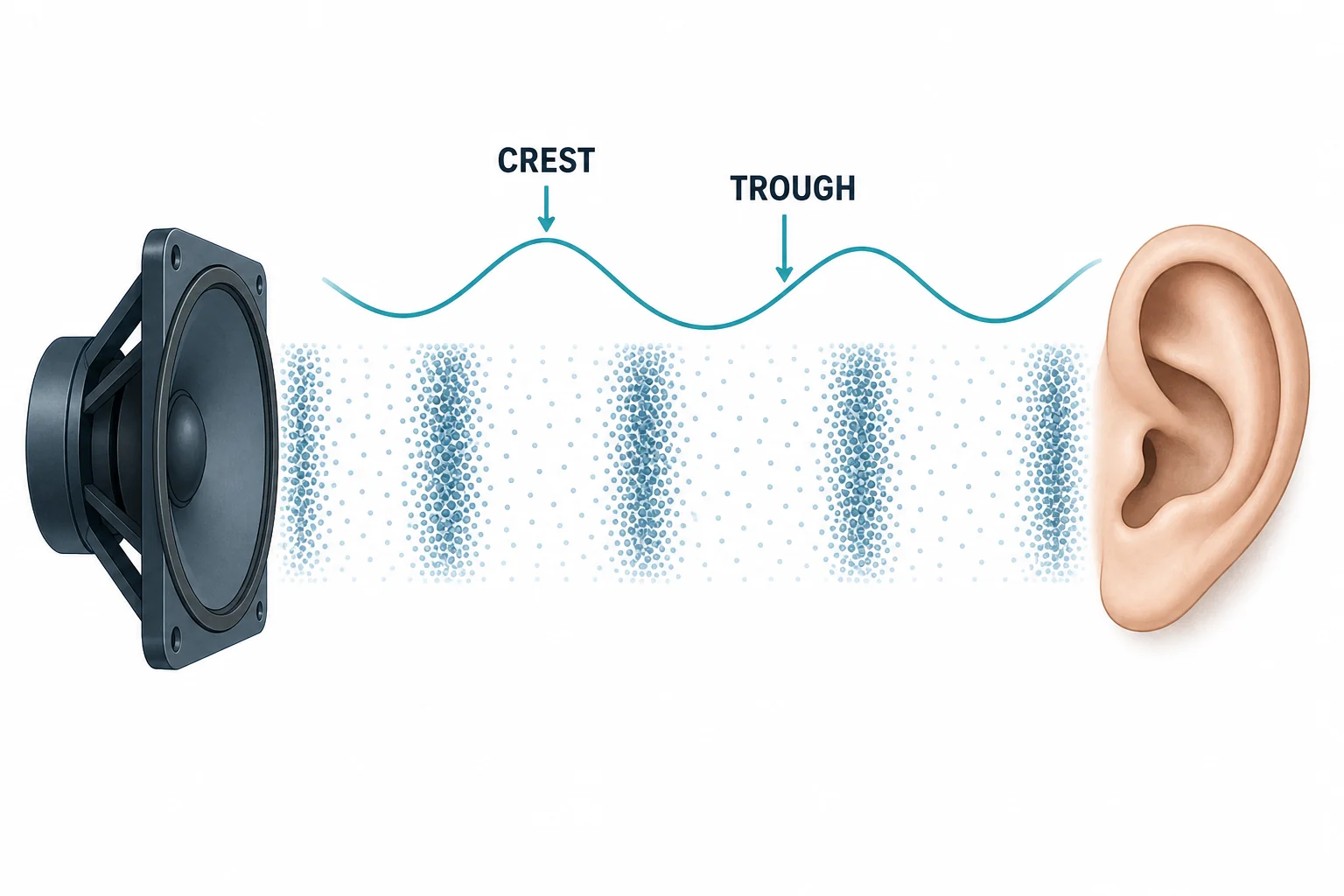
A speaker creates alternating high pressure and low pressure regions that travel through air toward an ear
Sound is a traveling pressure wave.
Sound travels through air as a pattern of changing pressure. A speaker cone moves forward and backward, which squeezes and spreads the nearby air. Those pressure changes move outward as a wave. When the wave reaches your ear, it pushes on the eardrum. Your brain reads the motion as sound. A simple tone has a repeating pattern with crests and troughs. A crest is a region of higher pressure. A trough is a region of lower pressure. Real noise is usually many waves mixed together. Traffic, engines, and classroom chatter all contain many frequencies at once. Noise-canceling headphones do not erase sound in the room. They try to control the pressure wave at one small place, close to your ear. That small target area matters because a wave can look different at different points in space.

Headphones can only cancel sound by changing the pressure wave that reaches the ear.

Waves can cancel
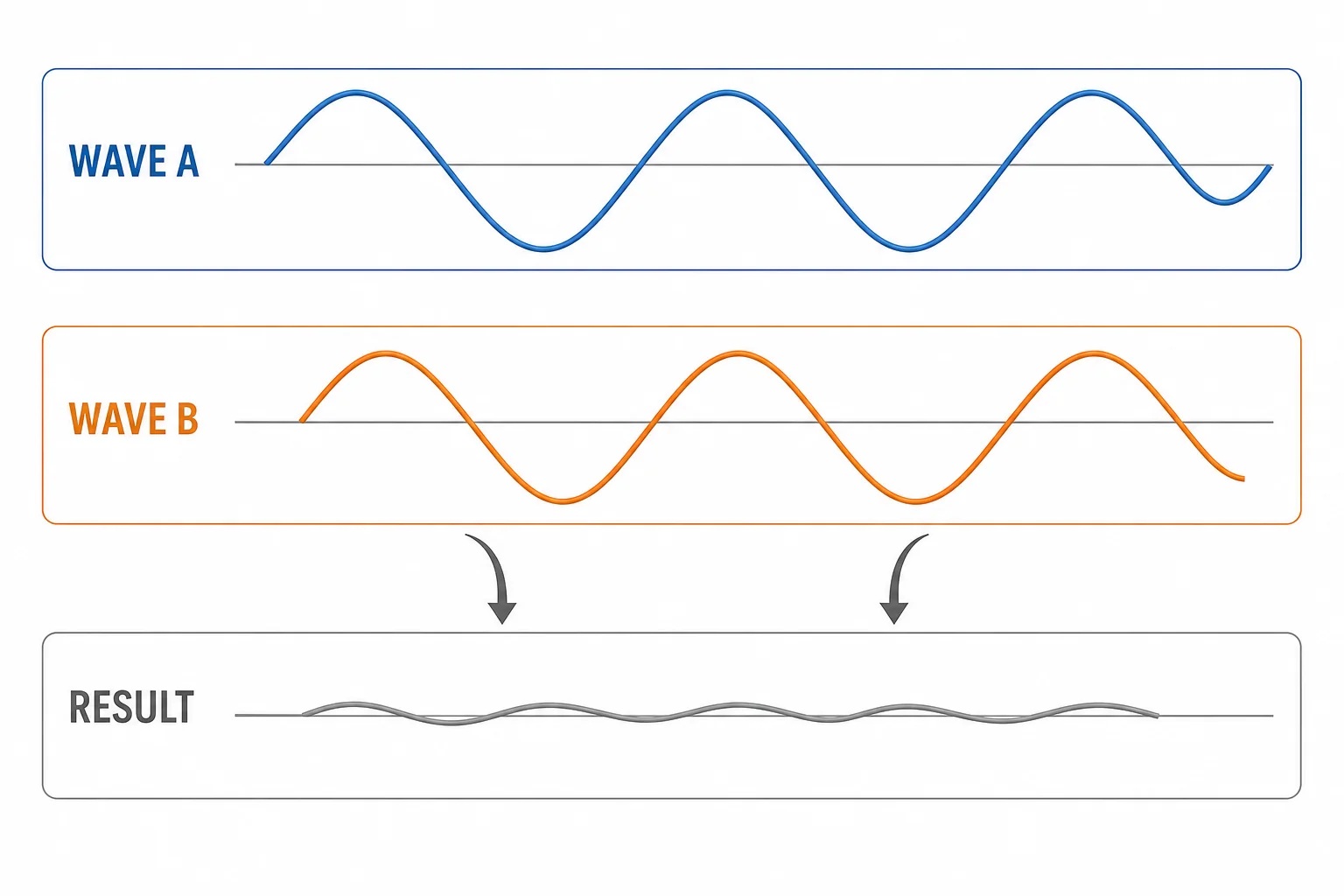
Two opposite sound waves overlap and produce a smaller combined wave
Opposite pressure changes can reduce the total wave.
When two sound waves meet, the air does not choose one wave or the other. The pressure changes add together. This rule is called superposition. If two matching waves arrive in step, their crests line up and the sound gets louder. If one wave is shifted by half a cycle, a crest lines up with a trough. Then the pressure changes partly cancel. This is destructive interference. For a single pure tone, a perfect opposite wave could make the pressure change close to zero at one point. Real life is harder. Noise has many frequencies, reflections, and changing directions. The headphone must create a changing anti-phase signal that matches the incoming noise at the ear. Even when the match is not perfect, the pressure variation can be smaller. Smaller pressure variation means quieter sound.

Cancellation happens when opposite pressure changes meet at the same place and time.

Microphones listen first
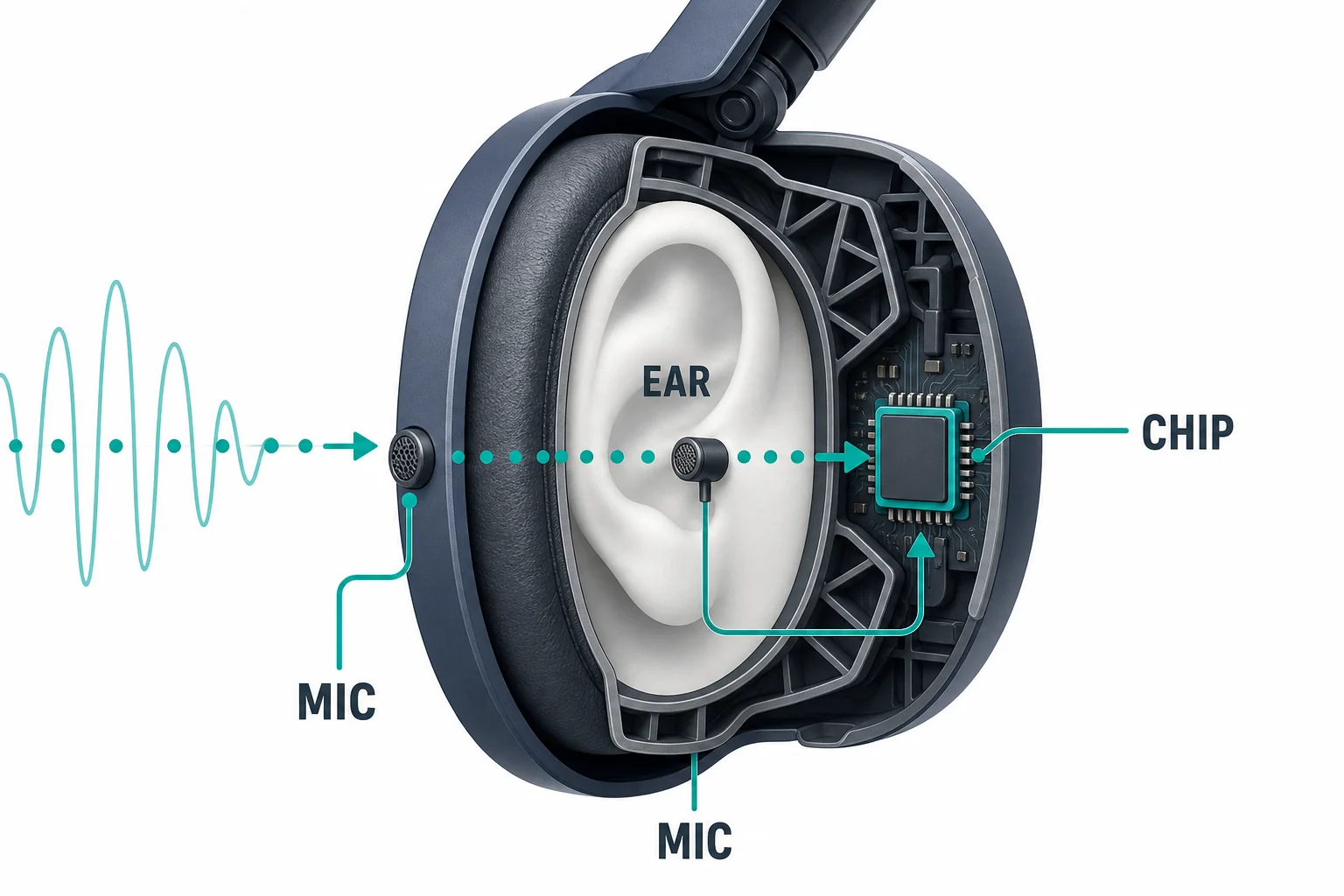
Headphone microphones measure outside noise and inside ear-cup sound before a processor sends a correction signal
Microphones give the headphones data about the noise.
Active noise cancellation starts with microphones. Many headphones have microphones outside the ear cup. These measure incoming sound before it passes through the cushion. This setup is called feedforward control. Some headphones also place microphones inside the ear cup. These check what sound remains near the ear. This setup is called feedback control. The microphone signal is not sound cancellation by itself. It is a measurement that the processor can use. The processor samples the signal many times per second. Each sample records the air pressure pattern at that moment. The device then estimates what opposite speaker motion is needed. Timing is critical. If the opposite wave arrives too early or too late, it can fail to cancel. In some cases, it can even add to the noise.

The device must measure the noise before it can make the cancelling sound.

The speaker makes the anti-noise
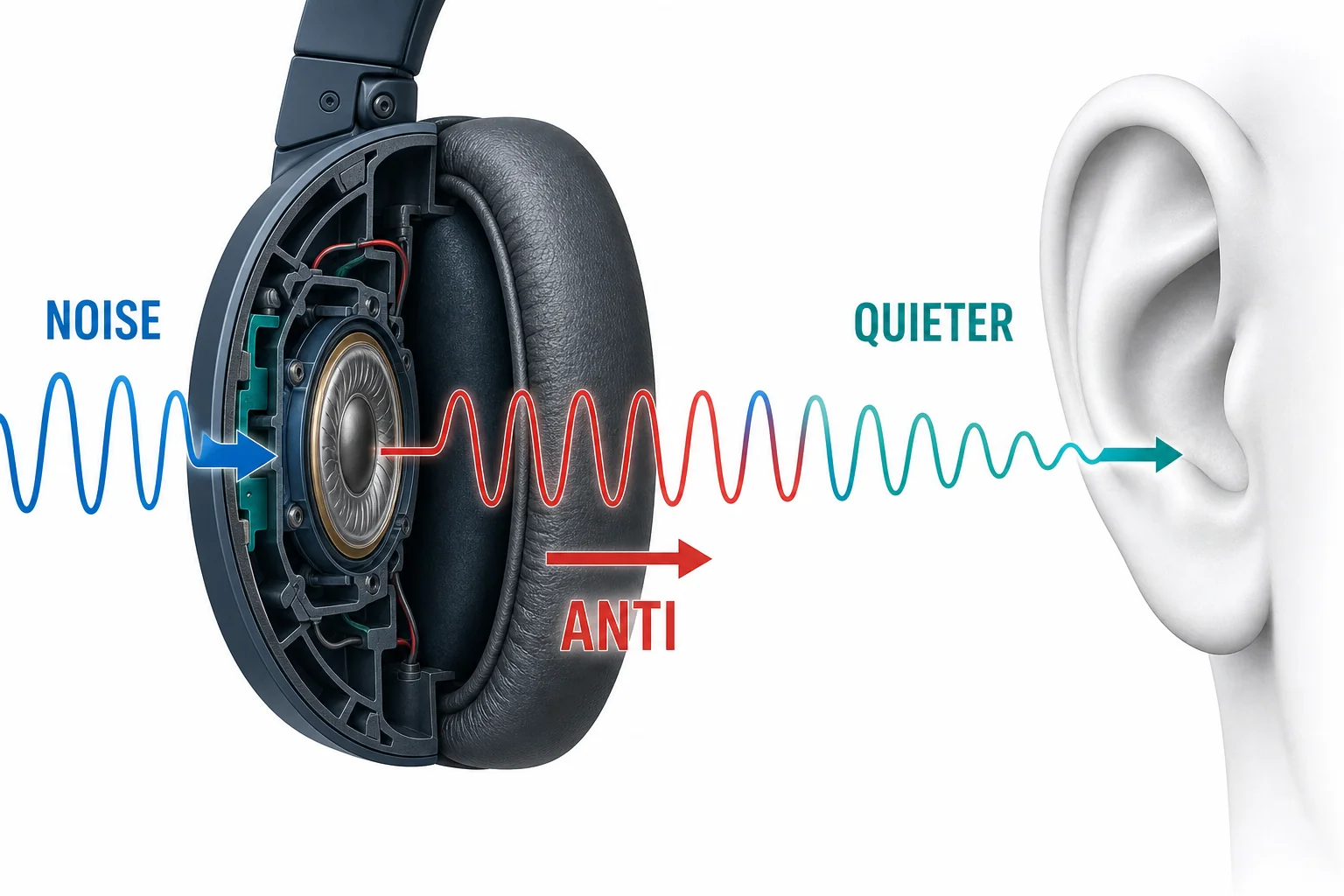
A headphone speaker produces an opposite wave that meets incoming noise near the ear
The speaker plays a carefully timed opposite wave.
After the processor estimates the needed correction, the headphone speaker moves. It makes a sound wave that is nearly opposite to the incoming noise at the ear. People often call this anti-noise. The word can sound strange, but it is still ordinary sound. It is a pressure wave made by the speaker. The trick is its timing and shape. For a low engine hum, the wave changes slowly enough for the electronics to keep up. For a quick clap or a sudden consonant in speech, the wave changes much faster. The device may not predict it in time. The ear cup also helps by blocking some sound passively. Soft cushions reduce higher-frequency sound by absorbing and reflecting it. Active and passive reduction work together, but they solve different parts of the noise problem.

Anti-noise is still sound, but it is shaped to reduce the pressure change at the ear.

Why silence is not perfect
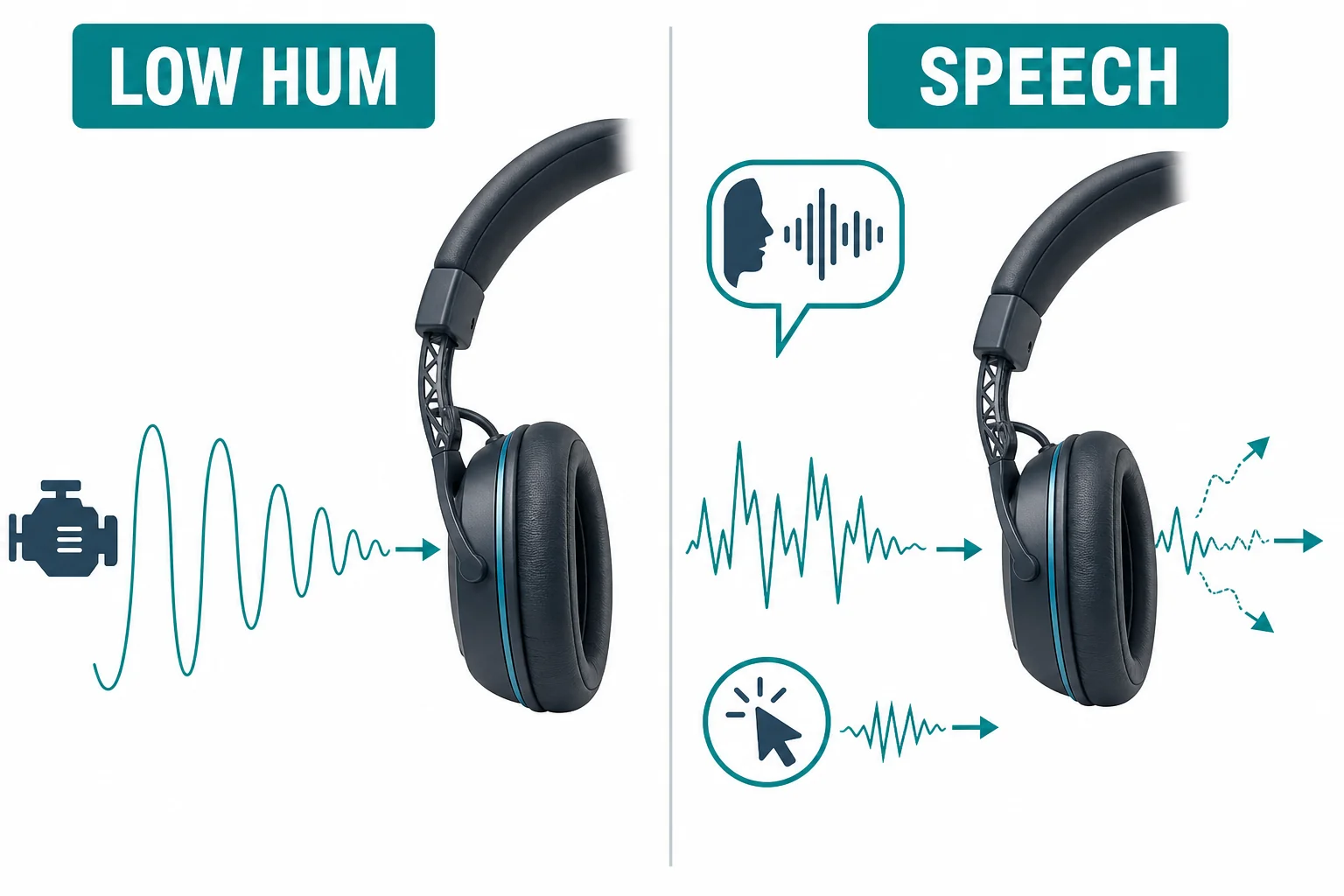
Comparison showing strong reduction for low steady engine noise and weaker reduction for sudden speech and clicks
Low steady noise is easier to reduce than sudden sound.
Noise cancellation is strongest when the noise is steady and low in pitch. Airplane cabin rumble, bus engines, and fans often fit that pattern. These sounds have longer wavelengths and repeat in a predictable way. The headphone can sample them, process them, and respond before the wave changes too much. Higher-frequency sounds are harder. Their wavelengths are shorter, so the sound field changes a lot over small distances. A wave that cancels at one spot may not cancel a centimeter away. Sudden sounds are also difficult because the device has little time to react. Human voices contain many fast changes, so they may be reduced but not removed. This is why headphones can make a commute calmer while still letting some announcements, clicks, and nearby speech through.

Active cancellation works best when the wave is predictable.

Vocabulary

Sound wave
A traveling pattern of pressure changes in a material such as air.
Superposition
The rule that overlapping waves add their effects at the same place and time.
Destructive interference
A wave interaction where opposite parts of waves overlap and reduce the total size of the wave.
Anti-phase signal
A signal shifted so that its high points line up with another wave's low points.
Sampling
Measuring a changing signal at many separate moments so electronics can process it.
Passive noise reduction
Sound reduction caused by physical blocking, absorbing, or sealing, without powered electronics.

In the Classroom

Wave overlap with graph paper

20 minutes | Grades 9-12

Students draw two matching sine waves, then shift one by half a cycle. They add the wave heights point by point to model destructive interference.

Phone microphone noise survey

25 minutes | Grades 9-12

Students use a sound level app to compare steady fan noise, speech, and sudden claps. They discuss which sounds would be easier for active cancellation and why timing matters.

Passive versus active design debate

30 minutes | Grades 9-12

Students compare earplugs, sealed headphones, and active noise-canceling headphones. Each group explains which physics idea is used and what limits the design.

Key Takeaways

  • Noise-canceling headphones reduce sound by controlling pressure waves near the ear.
  • Destructive interference happens when matching waves arrive with opposite pressure changes.
  • Microphones sample the noise so a processor can estimate the needed correction.
  • The speaker plays an anti-phase sound wave, often called anti-noise.
  • Active cancellation works best for steady, low-frequency sounds and less well for sudden or high-frequency sounds.