
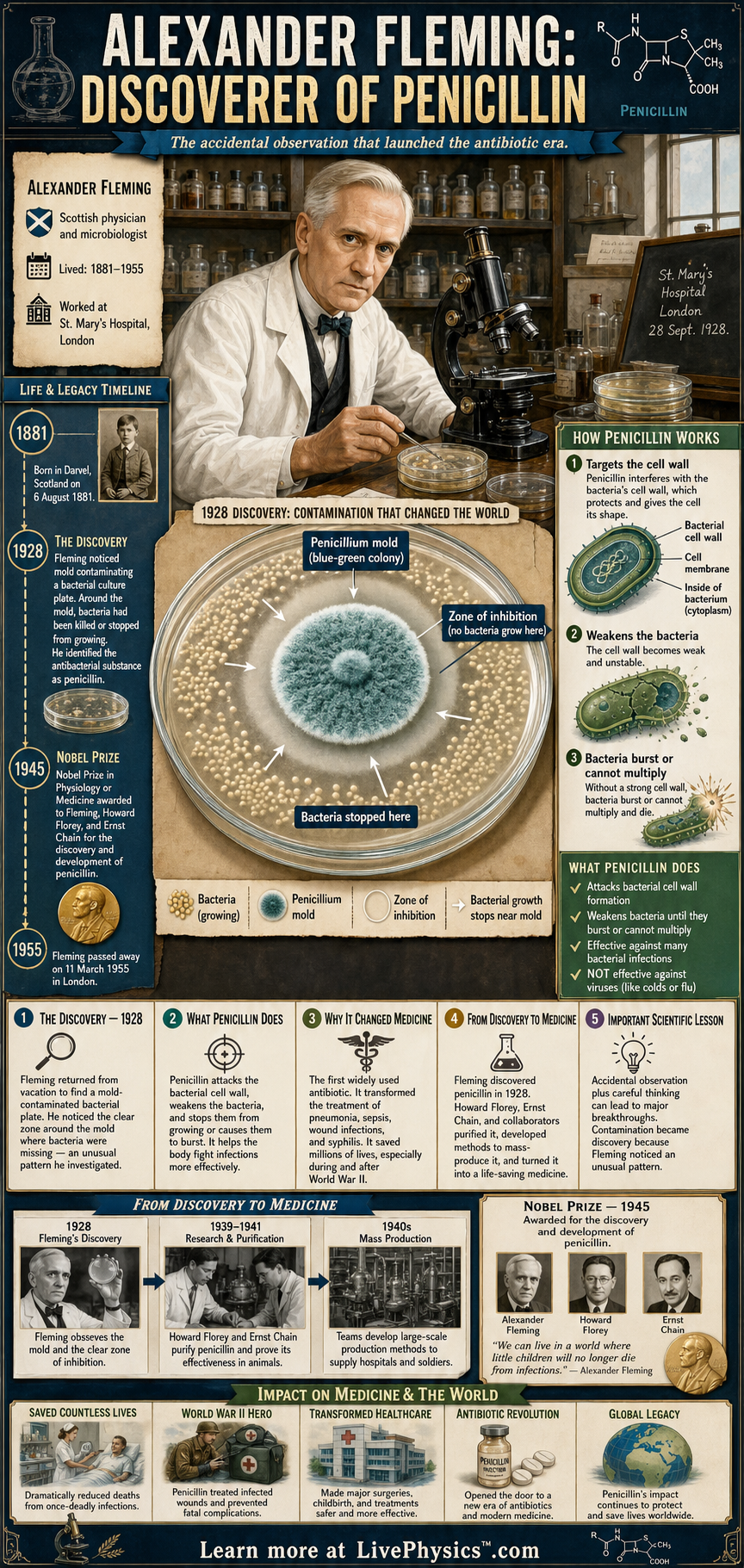
Alexander Fleming was a Scottish physician, microbiologist, and pharmacologist whose careful observation changed medicine. In 1928, he noticed that a mold contaminating a Petri dish had killed nearby bacteria instead of ignoring it as a failed experiment. That mold, Penicillium, led to the first widely used antibiotic, penicillin.
His discovery mattered because it gave doctors a powerful way to treat many deadly bacterial infections.
Understanding Alexander Fleming, Discoverer of Penicillin
Penicillin works by attacking a structure that bacteria need for survival. Many bacteria are surrounded by a tough cell wall. The wall prevents water pressure from making the cell swell and burst.
As a bacterium grows and divides, it must build new sections of this wall. Penicillin blocks enzymes that join the wall materials together. The weakened wall can then break, especially in rapidly dividing bacteria.
Human cells do not have cell walls, so this target makes penicillin much less harmful to people than to bacteria. This difference is called selective toxicity. It is a central idea in antibiotic treatment.
The useful substance was not simply the visible mold itself. It was a chemical released by the mold into its surroundings. In nature, microbes compete for food and space.
Some fungi make chemicals that slow nearby bacteria, giving the fungi an advantage. A clear region around a microbe can be an important clue in a laboratory culture. Scientists must then test whether the effect is real, repeatable, and caused by one particular substance.
They compare cultures with and without the substance, measure bacterial growth, and check whether different bacterial species respond in the same way. Careful controls turn an interesting observation into reliable evidence.
Finding a useful chemical is only one stage of making a medicine. Penicillin was difficult to obtain in a pure, stable form because early cultures produced very small amounts. Researchers had to grow the mold in large tanks, separate the active chemical from the liquid, and protect it from breaking down.
They tested its safety and found doses that could reach infected parts of the body. Large scale production became especially important during the Second World War, when wound infections could become deadly. This work shows why medical advances often depend on teams with different skills, including biology, chemistry, engineering, and clinical medicine.
Antibiotics do not treat every infection. They work against bacteria, not viruses such as those that cause most colds and flu. Different bacterial species have different defenses, so one antibiotic may work well for one illness but fail against another.
Resistance develops through natural selection. A few bacteria may carry traits that help them survive a drug. If treatment kills the more vulnerable bacteria, the survivors reproduce and pass on those traits.
Using antibiotics only when they are needed, taking them exactly as prescribed, and preventing infections through hygiene and vaccination all help slow this process. When studying this topic, pay close attention to the difference between discovering a substance, proving how it works, and developing it into safe treatment.
Key Facts
- Alexander Fleming lived from 1881 to 1955 and worked as a physician and microbiologist in Britain.
- In 1928, Fleming observed that Penicillium mold prevented the growth of Staphylococcus bacteria on a Petri dish.
- Penicillin is an antibiotic, meaning it kills bacteria or stops them from growing.
- Fleming did not mass-produce penicillin himself, but Howard Florey and Ernst Chain helped purify and develop it for medical use.
- Fleming, Florey, and Chain shared the 1945 Nobel Prize in Physiology or Medicine for penicillin.
- Antimicrobial resistance can develop when bacteria survive drug exposure and pass on resistance traits to later generations.
Vocabulary
- Antibiotic
- A medicine that kills bacteria or slows their growth.
- Penicillin
- An antibiotic originally derived from Penicillium mold that is effective against many bacterial infections.
- Penicillium
- A group of molds that includes species able to produce the antibiotic penicillin.
- Bacterial inhibition
- The slowing or stopping of bacterial growth, often seen as a clear zone around an antibiotic source on a culture plate.
- Antimicrobial resistance
- The ability of microbes such as bacteria to survive medicines that once killed them or stopped their growth.
Common Mistakes to Avoid
- Thinking Fleming invented all antibiotics is wrong because he discovered penicillin, while many other antibiotics were found or developed later by other scientists.
- Saying penicillin kills viruses is wrong because antibiotics act on bacteria, not viruses such as influenza or the common cold.
- Ignoring Florey and Chain is wrong because they played a major role in purifying, testing, and scaling up penicillin for medical treatment.
- Using antibiotics for every illness is wrong because unnecessary use increases selection for resistant bacteria and can make future infections harder to treat.
Practice Questions
- 1 Fleming discovered penicillin in 1928 and shared the Nobel Prize in 1945. How many years passed between the discovery and the Nobel Prize?
- 2 Alexander Fleming lived from 1881 to 1955. How old was he when he died, and how old was he in 1928 when he made the penicillin observation?
- 3 A Petri dish has a circular clear zone around a Penicillium colony where bacteria did not grow. Explain what this clear zone suggests about the mold and why Fleming's interpretation was scientifically important.