
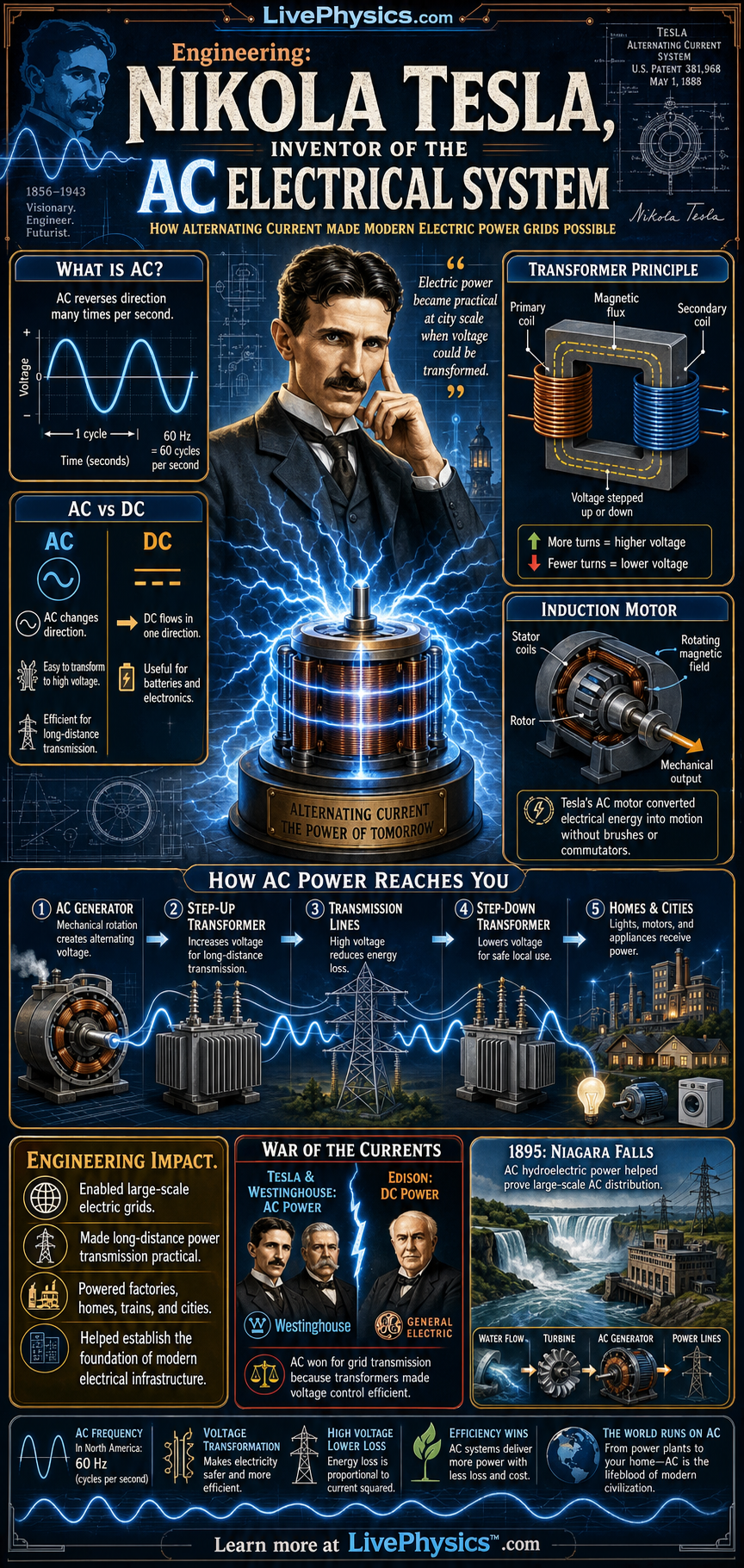
Nikola Tesla, 1856 to 1943, was a Serbian-American inventor and electrical engineer whose work helped make large-scale electric power practical. His most important contribution was the development and promotion of alternating current, or AC, systems for generating, transforming, transmitting, and using electricity. AC power matters because it can be sent over long distances efficiently when its voltage is raised for transmission and lowered for safe use.
Tesla's ideas helped shape the modern electric grid used in homes, schools, factories, and cities.
Tesla's AC work centered on changing electric currents and magnetic fields. In an induction motor, a polyphase AC supply creates a rotating magnetic field that makes the rotor turn without brushes or direct electrical contact. Transformers use changing magnetic flux to step voltage up or down, which reduces power loss in transmission lines.
Tesla also built high-frequency resonant devices such as the Tesla coil, explored wireless energy transfer, and became a central figure in the historical rivalry between AC power systems and Thomas Edison's direct current systems.
Understanding Nikola Tesla, Pioneer of AC Electricity
The key physical idea behind Tesla's motor work is electromagnetic induction. A changing magnetic field can create an electric effect in a nearby conductor. In a polyphase motor, several coils around the stator receive alternating currents that reach their peaks at slightly different times.
Their combined magnetic field does not merely grow and shrink. It moves around the inside of the motor like an invisible rotating handle. The metal rotor experiences this moving field.
Currents are induced within the rotor, and these currents create their own magnetic fields. The interaction produces a turning force called torque.
The rotor normally turns a little slower than the rotating magnetic field. This small difference is called slip. Slip is necessary because if the rotor caught up exactly, there would be no changing magnetic field relative to it.
Without that change, no current would be induced in the rotor and the torque would disappear. The motor adjusts naturally when its load changes. A fan that meets more air resistance slows slightly.
Its slip increases, induced currents become stronger, and the motor produces more torque. This simple behavior made induction motors useful for pumps, machine tools, elevators, washing machines, and many other devices.
A working power grid needs more than a way to move energy over distance. Generators across a region must keep nearly the same frequency. In many countries the supply changes direction fifty times each second.
In others it changes direction sixty times each second. If a large generator falls out of step, it can disturb the shared system. Grid operators therefore balance generation with demand every moment.
Demand rises when people cook meals, run air conditioners, or switch on lights after school or work. Large transmission networks help because one area can support another when local demand or equipment problems change suddenly.
Tesla's work is often presented as a simple contest in which one type of current defeated another. The real story is more detailed. Direct current remains important in batteries, phones, solar panels, electronic circuits, and some long distance transmission links.
Alternating current became dominant for ordinary distribution because transformers provided a practical way to change voltage levels. When studying this topic, keep separate the ideas of voltage, current, power, and energy. Voltage is the electrical push.
Current is the flow of charge. Power is the rate of energy transfer. Energy is the total amount used over time.
Confusing these quantities makes electricity seem harder than it is. It is equally important to remember that high voltage equipment is dangerous even when current is alternating, so classroom models and diagrams are safer places to explore these principles.
Key Facts
- Alternating current changes direction periodically, often as V(t) = Vmax sin(2πft).
- Electrical power is P = IV, so raising voltage V can lower current I for the same transmitted power.
- Resistive line loss is Ploss = I^2R, which is why high-voltage transmission is more efficient.
- A transformer approximately follows Vs/Vp = Ns/Np, where V is voltage and N is number of coil turns.
- An induction motor uses a rotating magnetic field made by polyphase AC to produce torque on a rotor.
- Tesla's AC system competed with Edison's DC system during the War of Currents in the late 1800s.
Vocabulary
- Alternating current
- Alternating current is electric current that repeatedly reverses direction and changes magnitude with time.
- Direct current
- Direct current is electric current that flows in one direction with nearly constant polarity.
- Transformer
- A transformer is a device that uses changing magnetic flux to increase or decrease AC voltage.
- Induction motor
- An induction motor is an electric motor in which a changing magnetic field induces currents in a rotor to create motion.
- Polyphase power
- Polyphase power is an AC system with two or more voltage waves offset in phase to produce smoother power delivery and rotating magnetic fields.
Common Mistakes to Avoid
- Thinking AC means electricity is weaker than DC. AC can deliver large amounts of power, and its main advantage is that its voltage can be transformed easily.
- Forgetting that lower current reduces heating loss. Since Ploss = I^2R, cutting current by a factor of 10 cuts line loss by a factor of 100.
- Assuming a transformer works with steady DC. A transformer requires changing magnetic flux, so steady DC does not continuously induce voltage in the secondary coil.
- Confusing a Tesla coil with a normal power transformer. A Tesla coil is a resonant high-voltage, high-frequency device, not a standard grid transformer for efficient power distribution.
Practice Questions
- 1 A power line transmits 100000 W at 1000 V. What current flows in the line, using P = IV?
- 2 A transformer has 200 turns on the primary coil and 2000 turns on the secondary coil. If the primary voltage is 120 V, what is the secondary voltage?
- 3 Explain why Tesla's polyphase AC system made long-distance electric power distribution more practical than Edison's early DC systems.