RC Circuit Charge Discharge Lab
Watch a capacitor charge through a resistor and discharge again. Adjust the resistance, capacitance, and source voltage. Read the time constant tau, the voltage and current at any instant, and the energy stored on the capacitor.
Guided ExperimentVerify tau = R · C
If tau = R · C, doubling the resistance while holding the capacitance fixed should double the time required for the capacitor to reach 63% of the source voltage. Predict what tau will be for R = 1000 Ω, R = 2000 Ω, and R = 5000 Ω when C = 100 μF.
Write your hypothesis in the Lab Report panel, then click Next.
Controls
Circuit
Computed Values
Record a Data Point
With current settings, τ = 100.00 ms. Record a row at the most useful time points.
Data Table
(0 rows)| # | Mode | R(Ω) | C(μF) | V0(V) | t(s) | V(t)(V) | I(t)(mA) | Q(t)(μC) |
|---|
Reference Guide
Capacitors and Resistors in Series
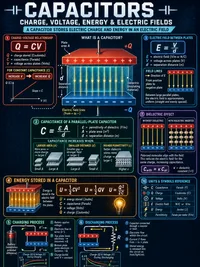
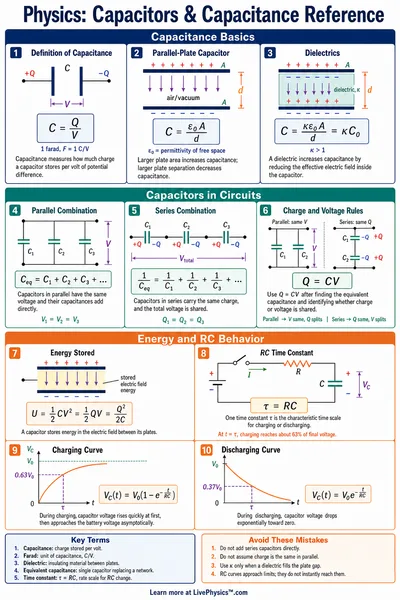
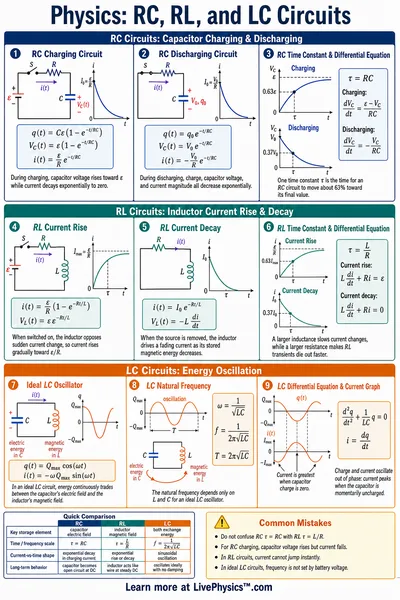
A capacitor stores electric charge on two plates separated by an insulator. A resistor restricts the flow of charge. Connect them in series with a voltage source and the capacitor charges through the resistor over time.
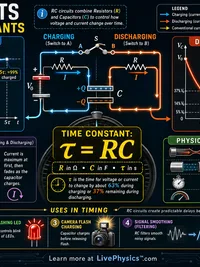
- Charging. Current flows from the source through R into C. Voltage on C grows from 0 toward V0.
- Discharging. The source is removed. C drives current backward through R. Voltage on C decays from V0 toward 0.
- Steady state. Current stops when the capacitor voltage equals the source voltage.
The Time Constant
The product τ = R · C is called the time constant. It has units of seconds. Larger R or larger C means a slower circuit.
- At t = τ. Charging voltage reaches about 63.2% of V0; discharging voltage falls to 36.8%.
- At t = 5τ. About 99.3% of full charge or decay. Most engineers treat this as fully charged or fully discharged.
- R = 1 kΩ, C = 100 μF. τ = 0.1 s. R = 10 kΩ, C = 100 μF gives τ = 1 s.
Exponential Voltage and Current
The defining equations of an RC circuit are first-order exponentials. Voltage and current share the same time constant.
- Charging. V(t) = V0 · (1 − e−t / τ); I(t) = (V0 / R) · e−t / τ.
- Discharging. V(t) = V0 · e−t / τ; I(t) has the same magnitude with opposite sign.
- Charge. Q(t) = C · V(t). The capacitor stores Q = C · V0 at full charge.
Energy Stored
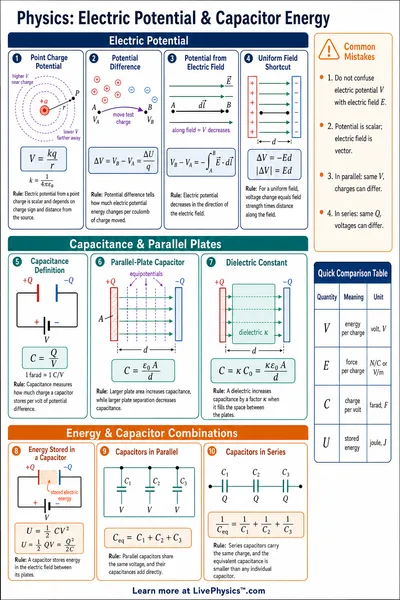
A charged capacitor holds energy in its electric field. The stored energy is U = ½ C V², measured in joules.
- Quadratic in V. Doubling the voltage stores four times the energy.
- Linear in C. Doubling the capacitance doubles the energy at the same voltage.
- Example. C = 100 μF charged to 9 V stores 0.5 · 100×10−6 · 81 = 4.05 mJ.