
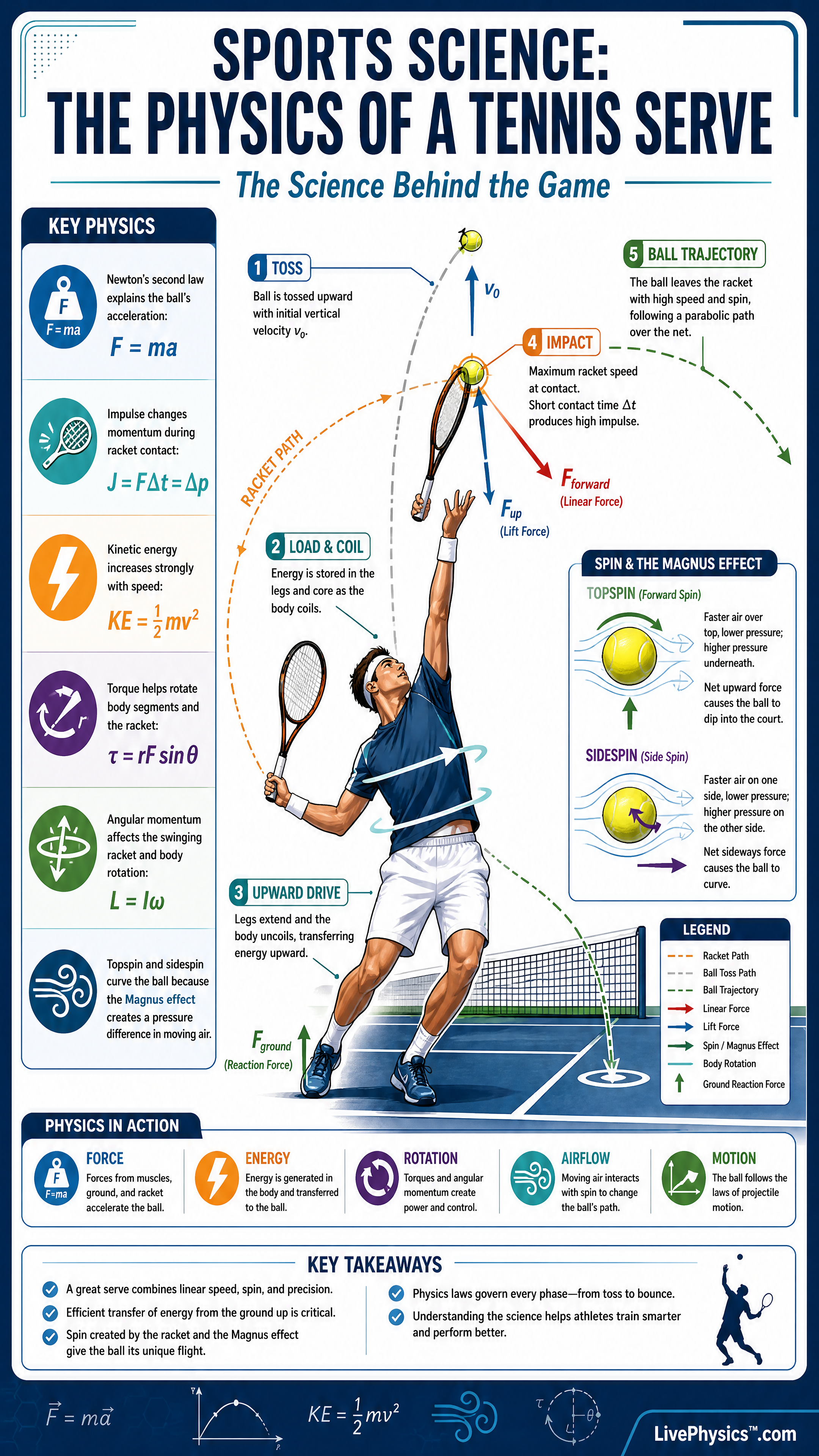
A tennis serve is one of the fastest and most skillful motions in sports, and it is packed with physics. The player turns chemical energy from muscles into motion of the legs, torso, arm, racket, and ball. Forces, torques, momentum, and spin all work together in less than a second.
Understanding the science helps athletes serve faster, place the ball better, and reduce injury risk.
The serve begins with a push from the ground, then energy moves upward through the body in a kinetic chain. The legs, hips, shoulders, elbow, wrist, and racket each add speed when timed well. At impact, the racket applies a large force over a very short time, changing the ball’s speed, direction, and spin.
Statistics such as serve speed, percentage in, and spin rate help players connect physics ideas to real performance.
Understanding Sports Science, The Physics of a Tennis Serve
The ball does not behave like a hard, perfectly rigid object at contact. Tennis strings stretch, the ball squashes, and both return toward their original shapes. This brief deformation stores energy for a moment before releasing part of it into the outgoing ball.
Some energy becomes heat, sound, and vibration, so no racket can transfer every bit of its motion to the ball. The effective hitting area, often called the sweet spot, matters because off-centre contact twists the racket in the hand.
That twist wastes energy and makes the ball harder to control. A player may feel this as a harsh shock even when the serve still lands in.
Racket-head speed is more important than arm strength alone. A long racket acts like a rotating lever, so the tip can move much faster than the hand holding the handle. This creates a trade-off.
A longer distance from the hand gives more possible speed, but it takes more control to bring the strings squarely to the ball. Before impact, skilled servers often allow the racket to lag behind the forearm. The arm then rotates rapidly, and the racket catches up.
Forearm pronation, which turns the palm outward through contact, helps direct the string bed and add racket-head speed. The exact timing matters more than forcing every body part to move as fast as possible.
The path of the toss sets important limits on the serve. A toss placed farther into the court encourages forward motion and can help produce a flatter serve. A toss more above the player can make upward brushing easier, which supports spin.
The ball begins high above the net, so it has extra time to fall into the service box. Topspin makes this downward bend stronger during flight. It can let a player swing upward and still send the ball down into the court.
After the bounce, topspin makes the ball jump higher and move forward sharply. Sidespin changes the sideways path, which is useful for serving wide or pulling an opponent away from the centre of the court.
Serve speed is useful, but it does not tell the full story. A very fast ball that misses the box has little value, while a slower serve placed near a line can create a difficult return. Players and coaches can compare first-serve percentage, average speed, spin rate, landing position, and how often each target is hit.
These numbers reveal patterns over many serves, not just one memorable attempt. When learning, pay attention to a repeatable toss, balanced landing, smooth acceleration, and relaxed grip pressure.
Pain in the shoulder, elbow, or lower back is not a normal sign of progress. Repeated high-speed serving places large loads on these joints, especially when timing or technique breaks down.
Key Facts
- Newton’s second law explains the ball’s acceleration, F = ma.
- Impulse changes momentum during racket contact, J = FΔt = Δp.
- Kinetic energy increases strongly with speed, KE = 1/2 mv^2.
- Torque helps rotate body segments and the racket, τ = rF sinθ.
- Angular momentum affects the swinging racket and body rotation, L = Iω.
- Topspin and sidespin curve the ball because the Magnus effect creates a pressure difference in moving air.
Vocabulary
- Kinetic chain
- A sequence of body movements that transfers energy from larger body parts to smaller, faster-moving parts.
- Impulse
- The product of force and contact time that changes an object’s momentum.
- Torque
- A twisting effect of a force that can cause an object or body part to rotate.
- Magnus effect
- The sideways or downward force on a spinning ball caused by differences in air pressure around it.
- Center of mass
- The average location of an object’s mass, often used to describe balance and motion.
Common Mistakes to Avoid
- Thinking only arm strength creates a fast serve. This is wrong because most serve speed comes from coordinated force transfer from the legs, hips, trunk, shoulder, arm, and wrist.
- Ignoring contact time in impact problems. This is wrong because the same change in momentum can require different average forces depending on how long the racket and ball stay in contact.
- Assuming a heavier racket always makes the serve faster. This is wrong because a heavier racket may have more momentum, but it can also be harder to swing quickly and control.
- Treating spin as just decoration on the ball. This is wrong because spin changes the ball’s flight path, bounce, and ability to land inside the service box.
Practice Questions
- 1 A 0.057 kg tennis ball leaves the racket at 45 m/s after starting nearly at rest. What is its kinetic energy just after impact?
- 2 A racket applies an average force of 900 N to a 0.057 kg ball for 0.005 s. What impulse is delivered, and what speed change does it produce if the ball starts from rest?
- 3 A player wants more serve speed without swinging only harder with the arm. Explain how improving the kinetic chain can increase racket speed and reduce injury risk.