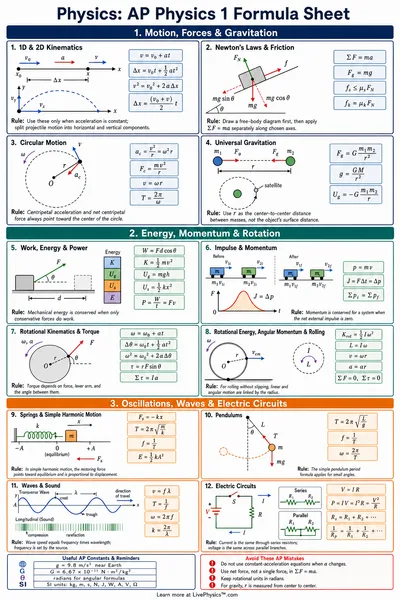
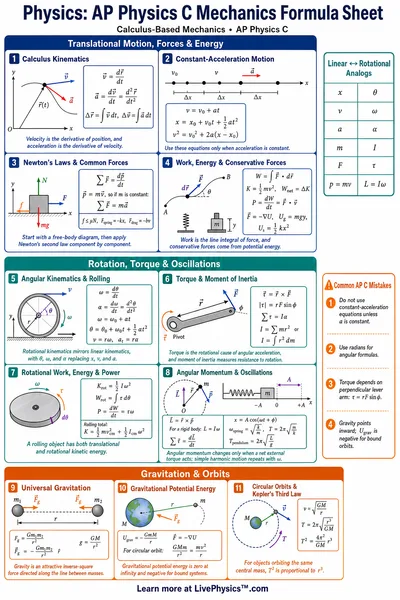
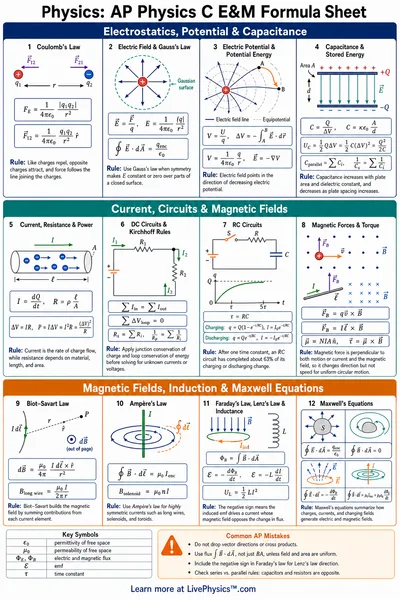
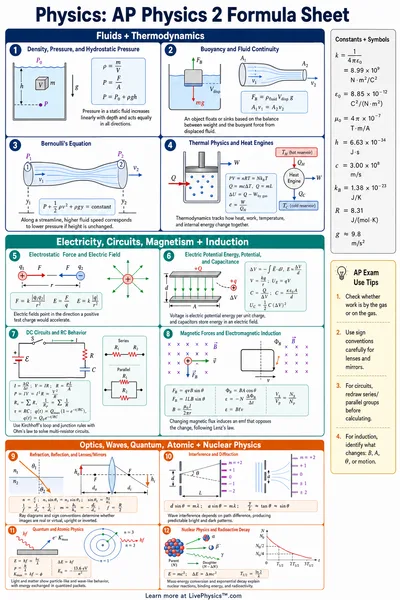
AP Physics FRQ Simulator
Eight multi-part free-response questions modelled after AP Physics 1, 2, and C exam stems. Type answers into each sub-part, click Grade, and read point-by-point rubric feedback with model answers.
Projectile Launched from a Cliff
A ball is launched horizontally from the top of a cliff with initial speed v₀ = 20 m/s. The cliff is 45 m tall. Air resistance is negligible. Use g = 9.8 m/s².
Calculate the time the ball spends in the air, in seconds.
Calculate the horizontal distance the ball travels before hitting the ground, in meters.
Determine the magnitude of the velocity at the instant the ball strikes the ground, in m/s.
If air resistance were significant, describe how the horizontal range and time of flight would change. Explain in terms of forces.
How grading works
- Numeric parts accept any value within tolerance, units optional.
- Explain parts score on physics vocabulary matches, partial credit applies.
- Reveal hints anytime. No score penalty.
- Model answers and rubric show after you grade.
How to Use This Tool
Anatomy of an AP FRQ
Each FRQ opens with a stem that describes a physical scenario, then breaks into 3 to 5 sub-parts. Sub-parts mix numeric calculations, derivations, and short explanations.
- Numeric parts grade against the expected value within a stated tolerance, with units optional.
- Explain parts grade on physics vocabulary matches and award partial credit.
- Each part has its own point value, totalling the FRQ score.
Rubric-Style Grading
On real AP exams, graders use a check-mark rubric. One point per criterion, correct equation set up, correct substitution, correct numeric answer with units, valid physical reasoning.
The grader here mirrors that pattern. Reveal hints freely, then write a final number with units on the last line. Setting up the equation correctly earns credit even if the arithmetic slips.
Score Bands
The displayed AP score band is a rough conversion from your percentage of total points
| Percentage | Band |
|---|---|
| 85% and up | 5 |
| 70 to 84% | 4 |
| 55 to 69% | 3 |
| 40 to 54% | 2 |
| Below 40% | 1 |
Actual cutoffs vary by exam form, but practice scoring close to these targets is a useful benchmark.
Pacing Strategy
On AP Physics 1 and 2, expect about 25 minutes per FRQ. Allocate time to each sub-part by point value, not by length.
- Read all parts before starting. Later parts often hint at the method for earlier ones.
- State a clear equation symbolically before plugging in numbers.
- Always carry units through. Track of significant figures only on the final answer.
- If you get stuck on a numeric part, write what you know so the grader can award setup credit.