Graph Analysis Lab
Slope tells you the rate of change. Area tells you the accumulation. Intercepts tell you the boundary conditions. Probe five physics graphs to see exactly what those quantities mean in context, with live numeric readouts and units.
Controls
What Graphs Mean in Physics
Slope = derivative (rate of change)
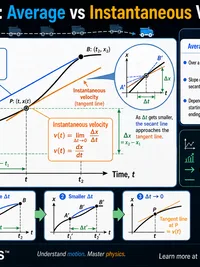
The slope between two points on a curve is the average rate of change over that interval. As the two points move closer together, the slope approaches the instantaneous derivative.
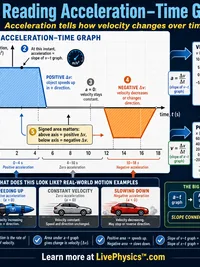
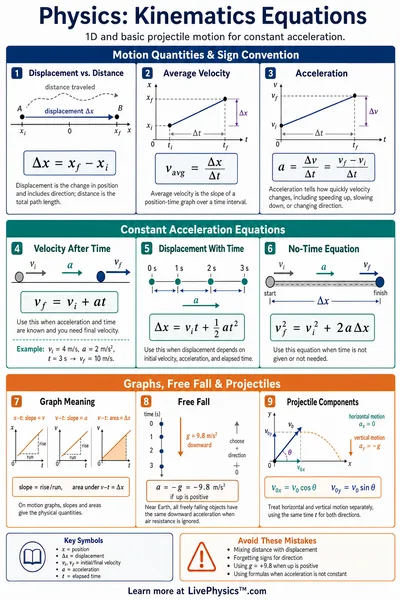
- v-t graph slope is acceleration.
- x-t graph slope is velocity.
- F-x graph slope is spring constant k for a linear spring.
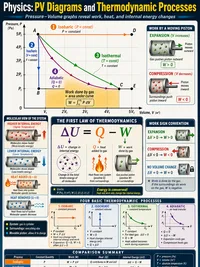
- p-V graph slope is the inverse compressibility (not always useful).
On the AP exam, when a question asks for the meaning of the slope, answer with the physical quantity and its units, then justify the choice with a derivative argument.
Area = integral (accumulation)
The area between the curve and the x-axis is the accumulation of the y-quantity over the x-range. The units of the area are (y-units) times (x-units).
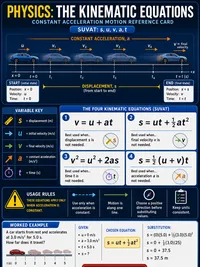
- v-t area is displacement.
- a-t area is the change in velocity.
- F-x area is work done by the force.
- P-V area is work done by the gas.
- I-t area is total charge transferred.
Always check that the area's units make physical sense. If they do not, you have the wrong axes or the wrong interpretation.
Intercepts = initial conditions
The y-intercept is the value of the dependent variable at x = 0. In physics it almost always represents an initial or zero-state condition.
- v-t y-intercept is initial velocity v₀.
- x-t y-intercept is initial position x₀.
- F-x y-intercept is the force at zero stretch (often zero).
- I-t y-intercept for a discharging capacitor is the initial current I₀.
The x-intercept is where the y-quantity equals zero. For a thrown projectile this is the time of flight back to the ground.
How AP graders score these questions
AP physics free-response questions frequently include a graph-reading sub-part. The rubric typically awards
- One point for stating the correct physical quantity (acceleration, displacement, work, charge).
- One point for correct units.
- One point for a numeric value derived from the graph features (when asked).
- One point for a written justification tied to the derivative or integral meaning.
Always include units. A bare number with no unit is usually worth zero on AP rubrics.