Understanding Projectile Motion Calculator
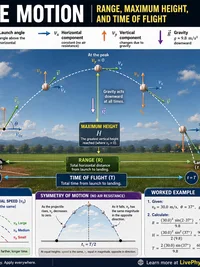
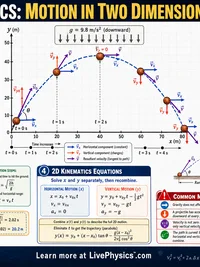
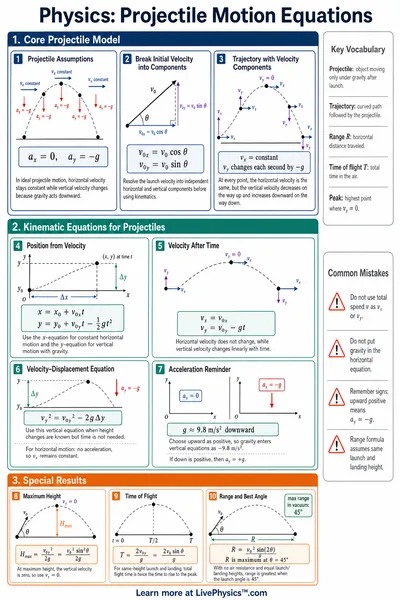
A launched object has two motions happening at once. Its horizontal motion is steady in the ideal model, while gravity continually changes its vertical motion. This separation is the main reason a curved path can be predicted so reliably.
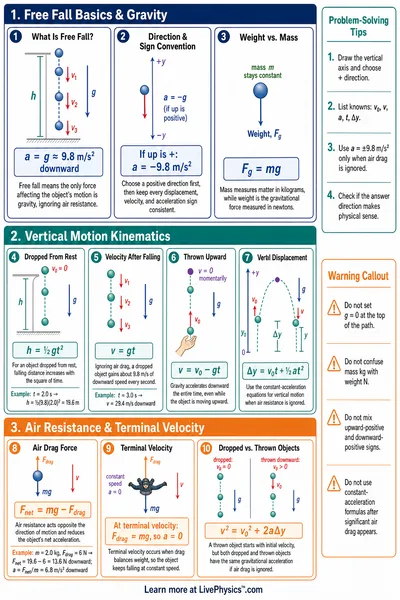
Air resistance is usually left out of beginner calculations. That makes the path a perfect parabola, but real objects such as feathers, footballs, and paper planes slow down because air pushes against them. A calculator using the ideal model is most accurate for dense, compact objects moving at moderate speeds.
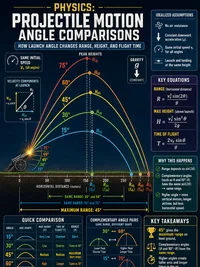
The launch angle controls how the starting velocity is shared between directions. A low angle gives a large horizontal part and a small upward part. A steep angle gives more upward motion, so the object stays in the air longer but may travel less far.
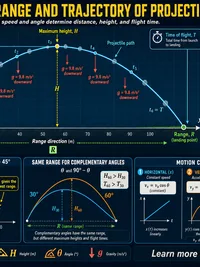
For launches and landings at the same height, angles that add to ninety degrees give the same range in the ideal model. For example, thirty degrees and sixty degrees send an object the same horizontal distance when the launch speed is unchanged. Their flight times and maximum heights are very different.
The horizontal velocity does not disappear at the top of the path. Only the vertical velocity becomes zero for one instant there. The object is still moving sideways, which is why it does not stop in midair before falling.
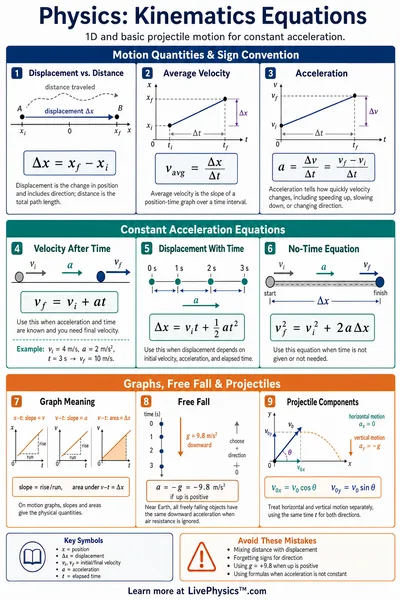
Gravity changes vertical velocity by the same amount during each equal time interval. On the way up, the vertical speed becomes smaller. On the way down, it becomes larger in the downward direction, assuming air resistance is ignored.
An initial height changes the result in an important way. A ball thrown from a balcony has extra time to travel horizontally before it reaches the ground. The path still curves in the same basic way, but it is not symmetric around its highest point if it lands below its release point.
The range is not always the best measure of a successful launch. In basketball, the release angle must help the ball clear defenders and enter the hoop. In firefighting water streams, the required height can matter more than the farthest possible distance.
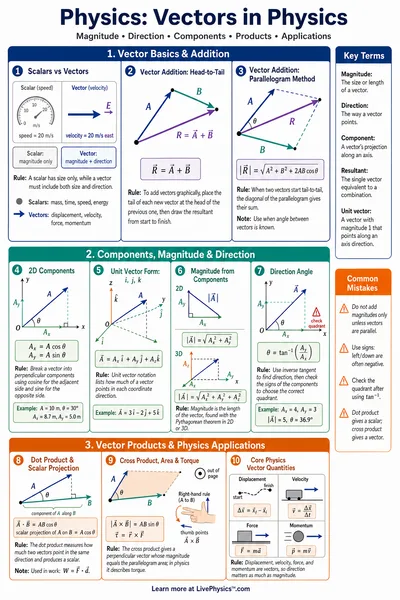
Velocity vectors show direction as well as speed. Near the start, the vector points upward and forward. Later it becomes level at the highest point, then points downward and forward as gravity changes the vertical part.
Energy provides another useful check on the motion. As an object rises, kinetic energy decreases while gravitational potential energy increases. In the ideal model, the total stays constant, so speed at a given height is the same on the upward and downward parts of the path.
Units are a common source of mistakes. Speed should use metres per second, time should use seconds, and angles must match the calculator setting. Mixing kilometres per hour with metres per second can produce answers that look reasonable but are physically wrong.
When studying a trajectory graph, pay attention to the starting and ending conditions. Identify the launch height, landing height, direction of positive vertical motion, and whether air resistance is included. These details determine which simplified relationships are valid for the situation.