When to use it
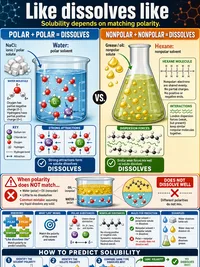
Use it when predicting whether a solute will dissolve in a given solvent, by comparing the polarity of each.
Example
Water (polar) dissolves table salt (ionic/polar) but does not dissolve oil (nonpolar). Hexane (nonpolar) dissolves grease (nonpolar).
Common mistake
Assuming any liquid will dissolve any solid. The rule only works when polarity matches, so mixing a polar solute with a nonpolar solvent produces little to no dissolution.