Count, Compare & Order Numbers
Practice three key number skills in one place. Count a group of animals and write how many, choose whether a number is greater than, less than, or equal to another, and put three numbers in order from smallest to largest.
How many 🐸 do you see?
Tap your answer
Reference Guide
Counting Objects
When you count a group, touch or point to each object one time. Say one number word for each object.
- One-to-one. Each object gets exactly one number.
- Stable order. The counting words always go 1, 2, 3, 4, 5.
- Cardinality. The last number you say tells how many total.
The last number you say when counting is the answer. You do not need to count again.
Comparing Numbers
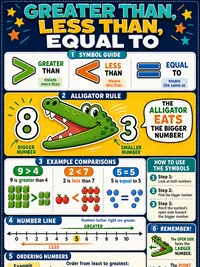
Use three symbols to show how two numbers relate to each other.
- Greater than (>). The first number is bigger than the second.
- Less than (<). The first number is smaller than the second.
- Equal to (=). Both numbers are the same size.
A helpful trick is that the open mouth of the symbol always faces the bigger number, like a hungry animal eating the larger group.
Ordering Numbers
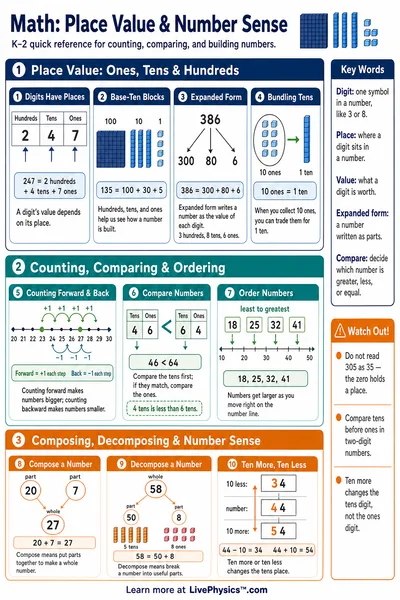
When you order numbers, you arrange them so the amounts go in a clear direction.
- Smallest to largest. Start with the least and count up.
- Largest to smallest. Start with the most and count down.
- Finding the smallest. Ask which group has the fewest objects.
A number line can help. Numbers on the left are smaller and numbers on the right are larger.
Number Words
Every digit has a matching word. Knowing both helps you read, write, and talk about numbers.