Count, Compare & Order Lab
Pick two numbers from 0 to 20 and decide which is bigger. Record your pairs in a table. Then shuffle a set of numbers and line them up from smallest to largest to find the patterns.
Guided ExperimentComparing and Ordering Numbers Investigation
Do you think it is always easier to compare small numbers than big numbers? Write your prediction. Think about which pairs feel harder and why.
Write your hypothesis in the Lab Report panel, then click Next.
Pick Two Numbers
Compare
- Symbol. <
- Larger number. 8
- Smaller number. 3
- Difference. 5
Controls
Reference Guide
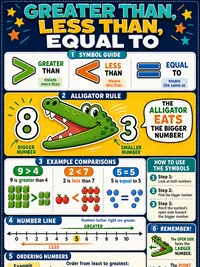
Greater, Less, and Equal
Three symbols help us compare two numbers. The symbol opens toward the larger number, like a hungry mouth eating the bigger one.
When two numbers are equal, both symbols point at each other and we use the equals sign instead.
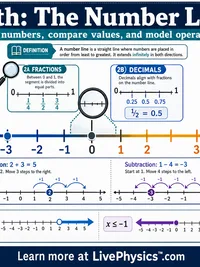
Using a Number Line
A number line is a great way to compare numbers. Small numbers live on the left. Big numbers live on the right.
The difference between two numbers tells us how many steps apart they are on the number line.
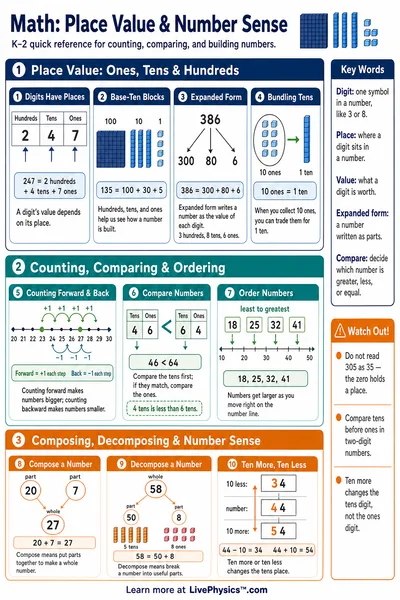
Ordering Numbers
When we put numbers in order from smallest to largest, every next number is bigger than the one before it.
To sort a set, find the smallest number first, then the next smallest, and keep going until you reach the largest.
Why Comparing Helps
Comparing numbers shows up everywhere. Who scored more points, which stack of blocks is taller, which pile of coins is worth more.
Ordering numbers is the first step toward reading charts, reading rulers, and lining up data in a table.