Understanding Order of Operations (PEMDAS) Solver
An expression is more like a set of instructions than a sentence read from left to right. The order of operations gives every person and calculator the same route to one answer.
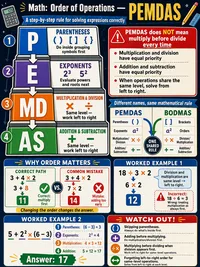
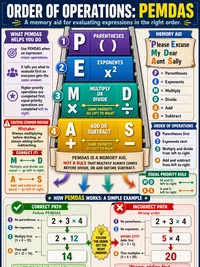
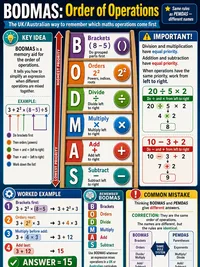
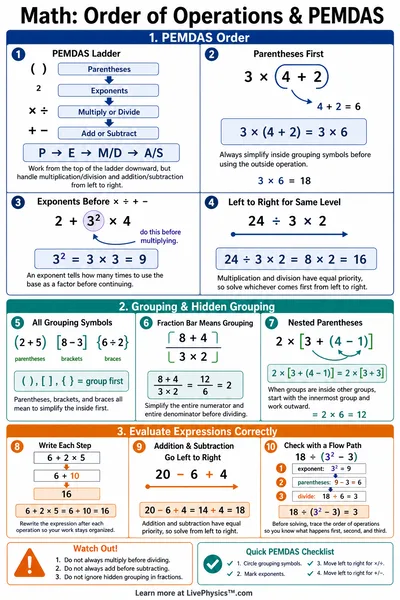
Grouping symbols create a smaller job inside the larger expression. Brackets, braces, and parentheses can all act as grouping symbols, and the innermost group must be handled before the surrounding work.
An exponent tells how many times a base is used as a factor. For example, two to the third power means two multiplied by itself three times, so its value is eight.
A negative number needs careful attention near exponents. Negative two squared usually means the opposite of two squared, while negative two inside parentheses and then squared has a positive value.
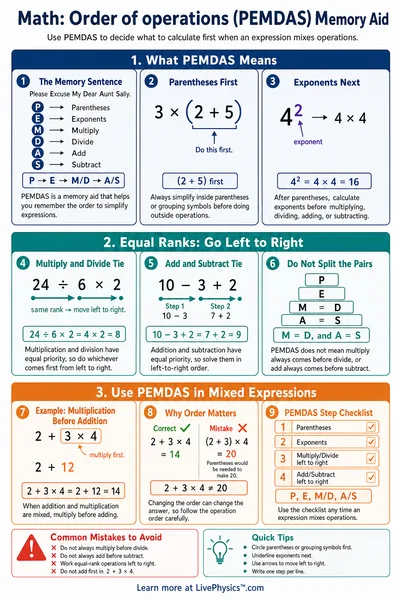
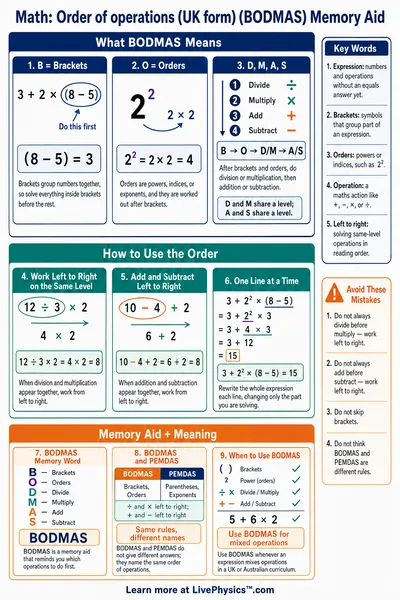
Multiplication and division have equal priority. When both appear in one line, work from the left toward the right rather than treating multiplication as automatically first.
Addition and subtraction follow the same left to right rule. This matters because subtraction is not interchangeable, so changing the order can change the result completely.
A fraction bar acts like a strong grouping symbol. Everything above the bar belongs together, and everything below it belongs together before the division is completed.
Students meet operation order when calculating shopping discounts, recipes, unit conversions, and spreadsheet formulas. A missing pair of parentheses in a formula can produce a believable but wrong answer.
Calculators do not all handle typed expressions in exactly the same way. Basic calculators may perform operations as they are entered, while scientific calculators usually follow standard operation order.
Writing one line for each change makes errors easier to locate. Copy every number and operation carefully, since losing a negative sign or a parenthesis can alter the entire calculation.
Checking an answer does not always require repeating every step. Estimation can reveal trouble, such as getting a huge result when the numbers in the expression suggest a small one.
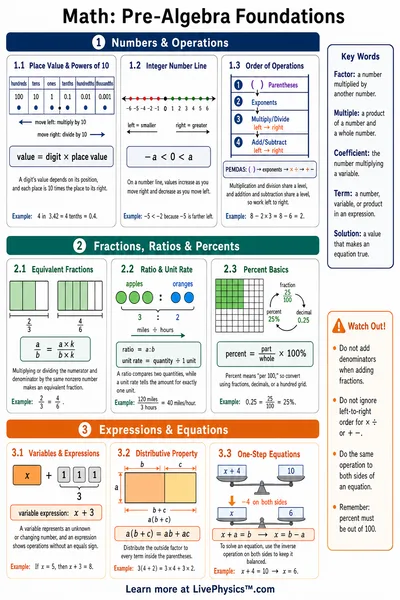
Practice should include expressions with several operation types, negatives, fractions, and nested groups. The main goal is not to memorize a word, but to recognize which parts must be simplified before the next operation can be done.