L'Hopital's Rule & Indeterminate Forms Explorer
Pick a limit that produces an indeterminate form. The tool identifies the form, applies L'Hopital's rule one differentiation at a time, and confirms the answer with a numeric estimate and a plot of the function near the limit point.
Choose a limit
Pick a preset limit. The tool detects its indeterminate form and applies L'Hopital's rule step by step.
Behavior near the limit point
The blue curve is f(x). The dashed amber line marks the numerically estimated limit value, confirming the symbolic result.
Worked solution
- 1
- 2
- 3
Reference Guide
What is an indeterminate form
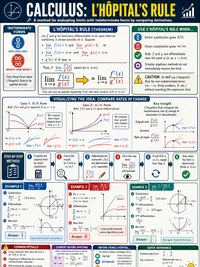
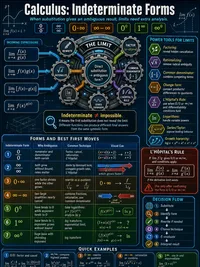
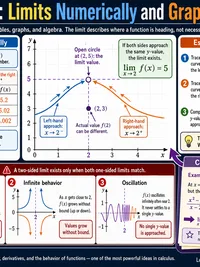
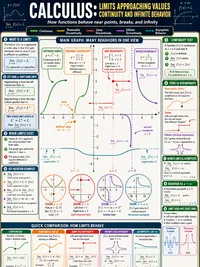
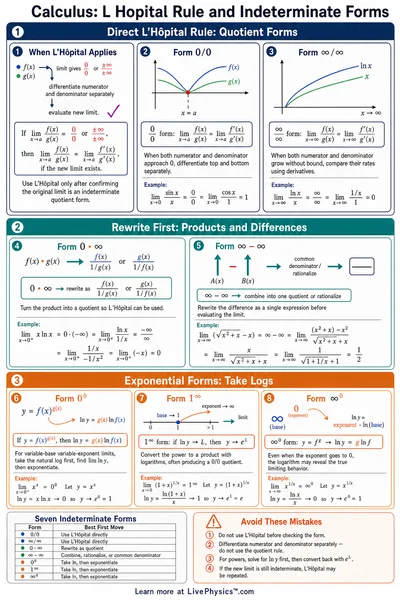
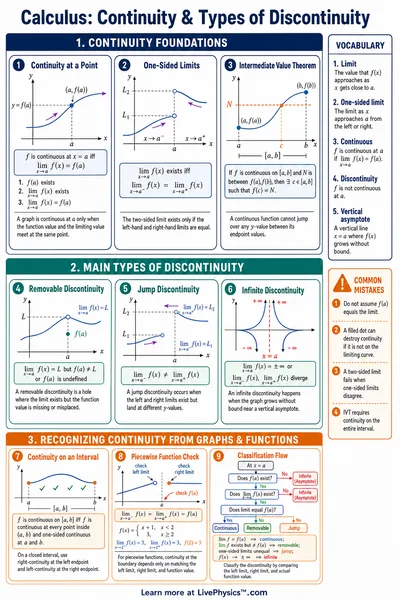
An indeterminate form appears when direct substitution into a limit gives an expression whose value cannot be decided from the form alone. The two basic quotient forms are 0/0 and ∞/∞. The limit may still exist, but you need more work to find it.
L'Hopital's rule and its conditions
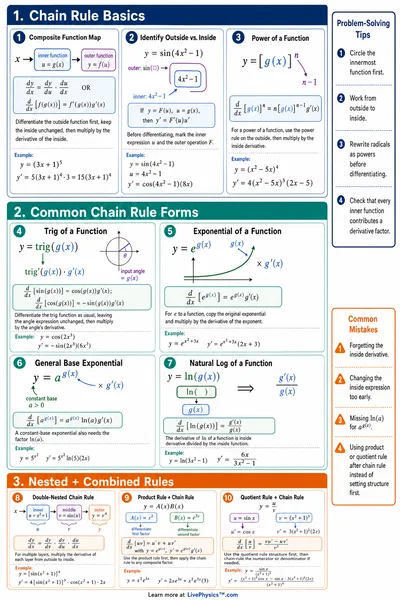
If f and g are differentiable near a point, g prime is nonzero near it, and the limit of f over g gives 0/0 or ∞/∞, then the limit of f over g equals the limit of f prime over g prime, provided that second limit exists. You differentiate the numerator and denominator separately, not as a quotient.
The 0/0 and ∞/∞ cases
L'Hopital's rule applies directly to both 0/0 and ∞/∞. If one application still leaves an indeterminate form, you may apply the rule again, repeating until the form becomes determinate. The numeric estimate in the tool confirms each final value by sampling the function close to the limit point.
Converting the other forms
Five more forms reduce to 0/0 or ∞/∞ first. For 0 times ∞, write one factor as a reciprocal to make a fraction. For ∞ minus ∞, combine over a common denominator. For 1 to the ∞, 0 to the 0, and ∞ to the 0, take the natural log, evaluate the resulting product limit, then exponentiate the result.
Common mistakes
Do not apply L'Hopital's rule to a determinate form such as 2/5 or 3/0, since the conclusion would be wrong. Do not use the quotient rule on f over g; differentiate top and bottom separately. Always recheck the form after each application, and stop once it is no longer indeterminate.
Where this fits
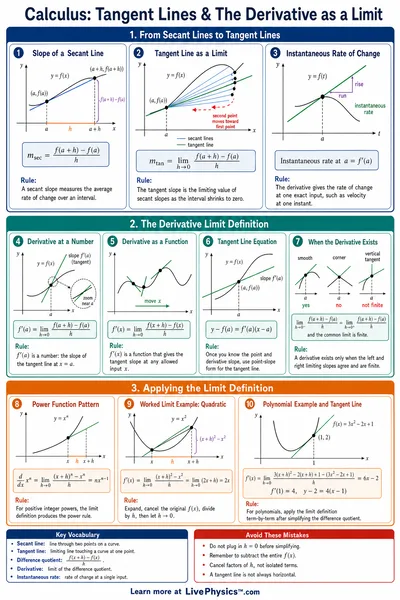
L'Hopital's rule is a standard topic in first-year calculus and AP Calculus. It connects derivatives back to limits and underlies growth-rate comparisons, such as why an exponential beats any polynomial as x grows without bound.