Derivative Rules Step-by-Step
Pick any function from the library and watch the full differentiation unfold step by step. Every rule is labeled, every transition explained, with formulas rendered in LaTeX.
Rule Category
Select a Function
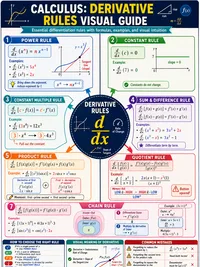
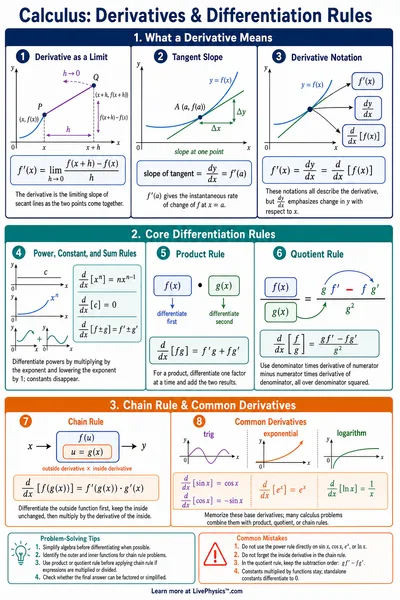
The function has the form x^n where n is a constant.
Final Answer
Multiply by the exponent, then reduce the exponent by 1. Works for any real number n.
Reference Guide
The Six Core Differentiation Rules
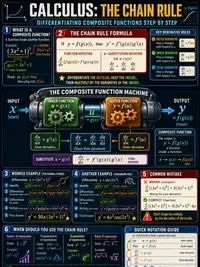
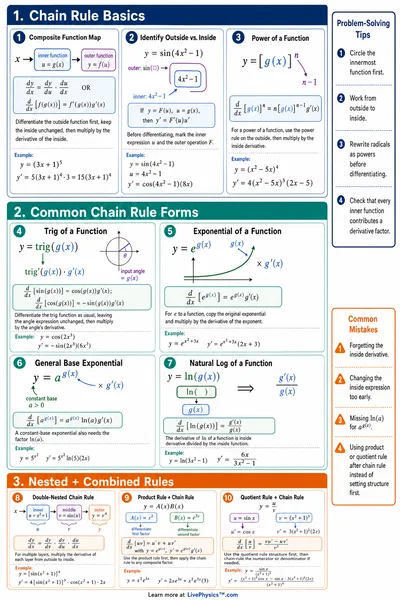
Chain Rule Strategy
The chain rule applies whenever you differentiate a composition .
- Identify the outer and inner functions. For , the outer is and the inner is .
- Differentiate the outer function, leaving the inner function unchanged inside.
- Multiply by the derivative of the inner function.
For nested compositions, apply the chain rule repeatedly, working from the outermost layer inward.
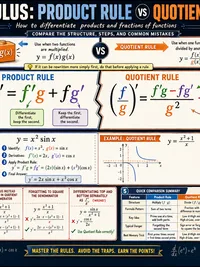
Product vs Quotient Rule
Both rules handle functions made by combining two differentiable pieces.
Mnemonic, derivative of the first times the second, plus the first times derivative of the second.
Mnemonic, low d-high minus high d-low, all over low squared. The denominator is always , never alone.
Avoid the quotient rule when possible, rewriting as lets you use the simpler power rule instead.
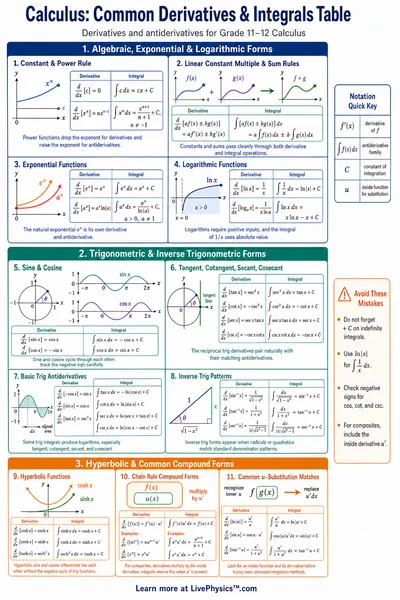
Trig and Exponential Quick Reference
| f(x) | f'(x) |
|---|---|
These standard derivatives are derived from first principles and should be memorized. Combined with the chain rule, they handle all compositions of these forms.