Practice finding derivatives using limits, power rules, product and quotient rules, chain rule, and real-world interpretations.
Read each problem carefully. Show your work in the space provided. Simplify your answers when possible.
Finding and interpreting rates of change
Calculus - Grade 9-12
- 1
Use the limit definition of the derivative to find f'(x) for f(x) = x^2.
- 2
Find the derivative of f(x) = 7x^5 - 3x^2 + 9x - 4.
- 3
Find dy/dx if y = 4x^-3 + 6sqrt(x). Write your answer using exponents or radicals.
- 4
At x = 2, find the slope of the tangent line to the curve f(x) = x^3 - 4x + 1.
- 5
Find the equation of the tangent line to f(x) = x^2 + 3x at x = 1.
- 6
Find the derivative of g(x) = (2x^3 - x)(5x^2 + 1).
- 7
Find the derivative of h(x) = (x^2 + 1)/(x - 3).
- 8
Find the derivative of f(x) = (3x - 2)^5.
- 9
Find the derivative of y = sin(x) + 4cos(x) - 2tan(x).
- 10
Find the derivative of y = e^x ln(x), where x is greater than 0.
- 11
A car's position is given by s(t) = t^3 - 6t^2 + 9t, where s is in meters and t is in seconds. Find the car's velocity function.
- 12
For the car in the previous problem, find the acceleration function.
- 13
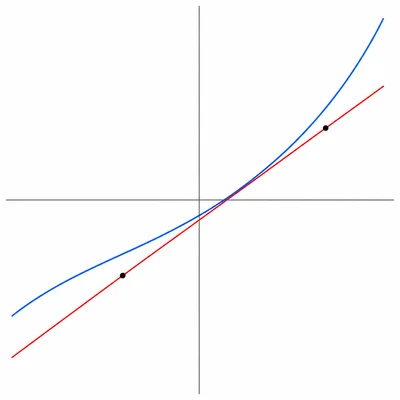
The graph of f(x) is shown. Estimate f'(2) from the tangent line. The tangent line appears to pass through the points (1, 3) and (3, 7).
- 14
A function has derivative f'(x) = 3x^2 - 12x + 9. Find the x-values where the graph of f has horizontal tangent lines.
- 15
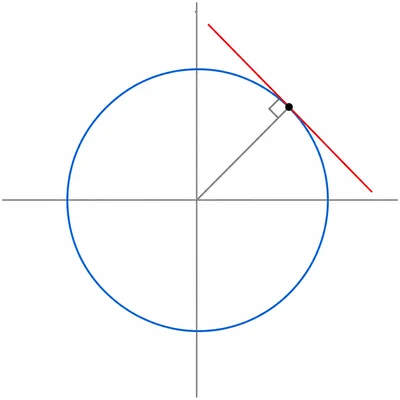
Use implicit differentiation to find dy/dx for x^2 + y^2 = 25.