Teen Numbers Builder
Teen numbers like 13 are really just 10 plus 3 more. Use ten-rods and ones blocks to see why every number from 11 to 19 is made of one ten and some ones.
Score 0
Streak 0
Choose a level
Mode
13
Hint 13 = 10 + ?
10
+
0 ones
0
Tap the amber squares to add or remove ones blocks, then check your answer.
Reference Guide
What Are Teen Numbers?
- Teen numbers are 11 through 19.
- Every teen number = one ten + some ones.
- Example, 14 = 10 + 4 (one ten-rod and 4 unit squares).
- Understanding this is the first step toward place value.
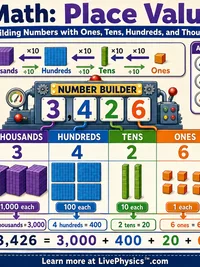
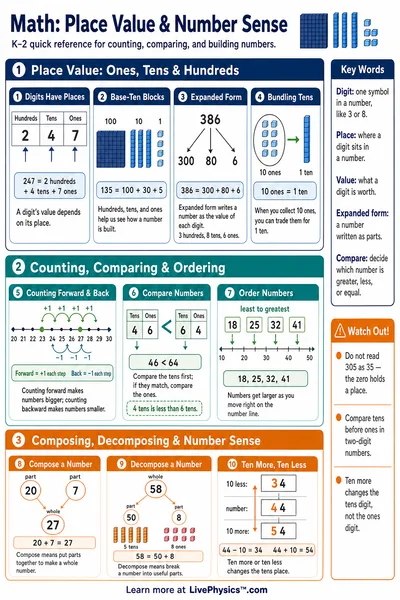
Place Value Preview
- The tens place tells how many groups of 10.
- The ones place tells how many leftovers.
- For 17, tens digit = 1, ones digit = 7.
- Building with blocks makes the abstract concrete.
Three Learning Modes
- Build. See the number, add ones squares to match it.
- Identify. See the blocks, type the matching number.
- Decompose. See the number, fill in the ones to complete the equation.
Standards Covered
- K.NBT.1 - Compose and decompose numbers 11 to 19.
- 1.NBT.2 - Understand that teen numbers are 10 + ones.
- Use the Learn level for introduction and guided hints.
- Use Challenge mode for timed, independent practice.
Related Content
Visual Explainers
Related Tools
MAP Growth Grade 3 Math Practice
Original independent MAP Growth Grade 3 Math skill practice with explanations, adjustable difficulty and first-attempt progress; no official RIT score.
MAP Growth Grade 4 Math Practice
Original independent MAP Growth Grade 4 Math skill practice with explanations, adjustable difficulty and first-attempt progress; no official RIT score.
MAP Growth Grade 5 Math Practice
Original independent MAP Growth Grade 5 Math skill practice with explanations, adjustable difficulty and first-attempt progress; no official RIT score.
MAP Growth Grade 6 Math Practice
Original independent MAP Growth Grade 6 Math skill practice with explanations, adjustable difficulty and first-attempt progress; no official RIT score.
Related Labs
Teen Numbers Lab
Decompose every teen number from 11 to 19 into one ten and some ones. Investigate the place-value pattern behind numbers like thirteen, fourteen, and nineteen. Grades K-1.
Number Bonds & Fact Families Lab
Decompose numbers into two parts and discover all four related addition and subtraction facts. Record your findings and explore patterns. Grades K-3.
Count, Compare & Order Lab
Compare pairs of numbers and put sets of numbers in order. Record differences and look for patterns in how we decide which numbers are bigger. Grades K-1.
Number Path & Hop Count Lab
Hop forward and backward along a number path from 0 to 20. Discover how adding and subtracting relate as opposite hops on the same path. Grades K-1.