Number Bonds & Fact Families Lab
Pick a whole number and split it into two parts. Discover all four related addition and subtraction facts, record your number bonds in a table, and find patterns in how numbers can be decomposed.
Guided ExperimentNumber Bonds Investigation
Pick a number like 7. How many different ways do you think you can split it into two parts? Write your prediction.
Write your hypothesis in the Lab Report panel, then click Next.
Build a Number Bond
Number Bond Diagram
Fact Family
Controls
Reference Guide
What Is a Number Bond
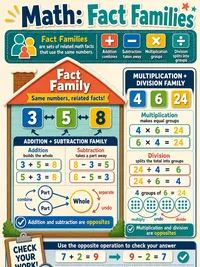
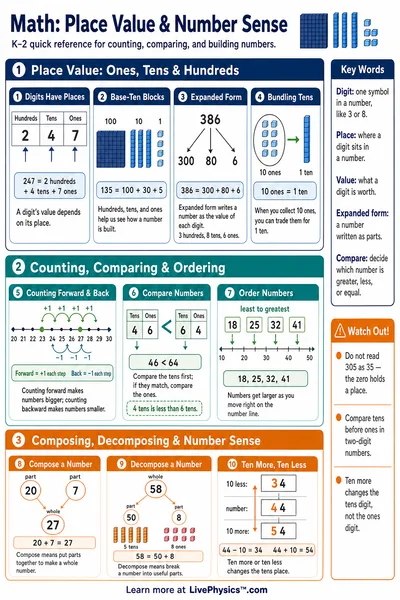
A number bond shows how a whole number is made from two smaller parts. The whole sits at the top, and the two parts branch off below.
Any whole number can be split into many different pairs of parts. The number 7 can be split as 1+6, 2+5, 3+4, and more.
Fact Families
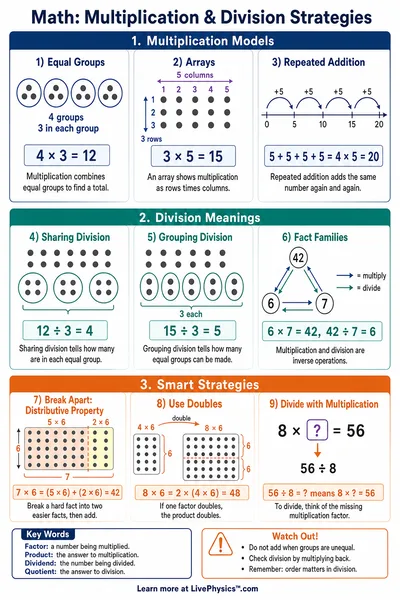
Every number bond gives you four related equations called a fact family. Two are addition facts and two are subtraction facts.
All four facts use the same three numbers. Knowing one fact in the family makes the others easier to remember.
Part-Part-Whole
Every addition or subtraction problem has a part-part-whole relationship. The two parts combine to make the whole.
If you know the whole and one part, you can always find the missing part by subtracting.
Why Fact Families Help
Learning fact families means you only need to memorize one bond to know four facts. Addition and subtraction are opposite, or inverse, operations.
Fact families also help with missing-number problems. If 5 + ? = 12, you can use 12 - 5 = 7 to find the answer.