Practice applying Hubble's Law, interpreting redshift, and explaining how galaxy observations support the idea of an expanding universe.
Read each problem carefully. Show your work for calculation problems and write complete explanations for concept questions. Use H0 = 70 km/s/Mpc unless a problem gives a different value.
Using galaxy velocities and distances to understand cosmic expansion
Astronomy - Grade 9-12
- 1
State Hubble's Law in words and as an equation. Identify what each variable represents.
- 2
A galaxy is 100 Mpc away. Using H0 = 70 km/s/Mpc, calculate its expected recession velocity.
- 3
A galaxy has a measured recession velocity of 14,000 km/s. Using H0 = 70 km/s/Mpc, calculate its distance in megaparsecs.
- 4
The table shows four galaxies. Galaxy A is 50 Mpc away, Galaxy B is 120 Mpc away, Galaxy C is 250 Mpc away, and Galaxy D is 400 Mpc away. Rank the galaxies from slowest to fastest expected recession velocity.
- 5
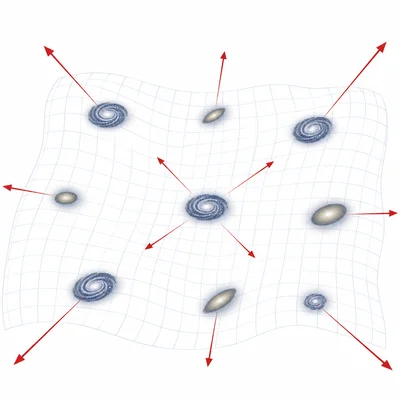
Explain why Hubble's Law is evidence that the universe is expanding.
- 6
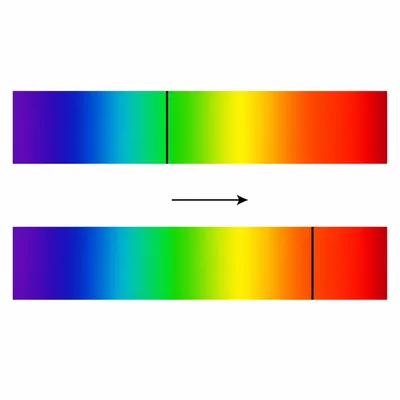
A galaxy has a spectral line that normally appears at 500 nm in a laboratory. In the galaxy's spectrum, the line appears at 525 nm. Is the galaxy redshifted or blueshifted, and what does that mean about its motion?
- 7
Calculate the redshift z for a spectral line that shifts from a rest wavelength of 400 nm to an observed wavelength of 420 nm. Use z = (observed wavelength - rest wavelength) / rest wavelength.
- 8
For small redshifts, recession velocity can be estimated with v = zc, where c = 300,000 km/s. If a galaxy has z = 0.03, estimate its recession velocity.
- 9
Using your answer from the previous problem and H0 = 70 km/s/Mpc, estimate the galaxy's distance.
- 10
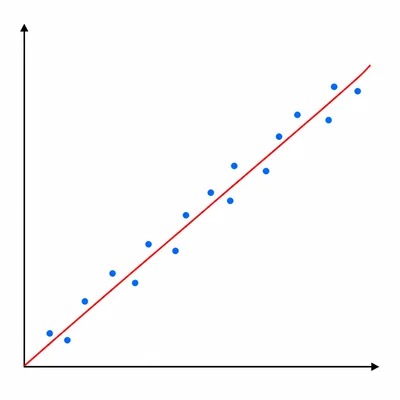
A graph of galaxy recession velocity versus distance has a best-fit line through the origin. What does the slope of this line represent?
- 11
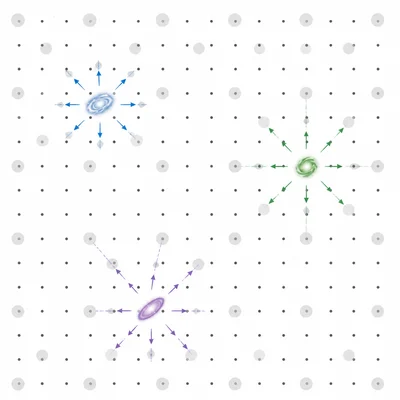
Two students make claims about expansion. Student 1 says, "The Milky Way is at the exact center of the universe because all distant galaxies move away from us." Student 2 says, "Observers in other galaxies would also see most distant galaxies moving away." Which student is more accurate, and why?
- 12
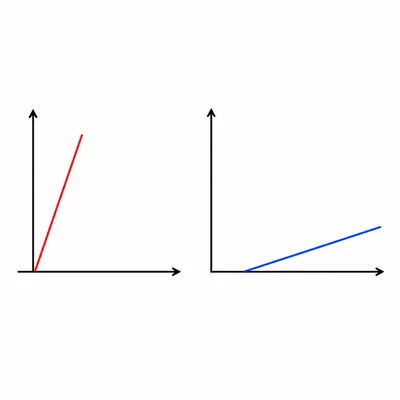
The age of the universe can be roughly estimated by 1/H0, but H0 must be converted into consistent units. Conceptually, explain why a larger value of H0 would imply a younger universe, while a smaller value of H0 would imply an older universe.