Practice explaining how the James Webb Space Telescope uses infrared astronomy to study stars, galaxies, exoplanets, and the early universe.
Read each problem carefully. Use complete sentences and show calculations when needed.
Exploring the universe with infrared light
Astronomy - Grade 9-12
- 1
The James Webb Space Telescope observes mostly infrared light rather than visible light. Explain two reasons infrared observations are useful for studying space.
- 2
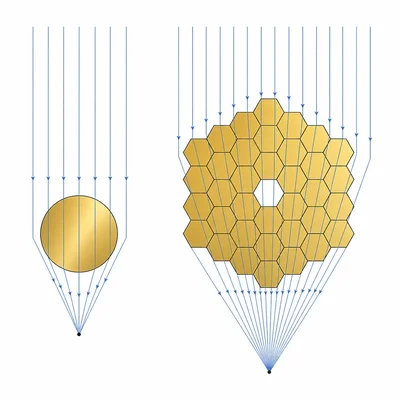
JWST has a large segmented primary mirror about 6.5 meters across. Explain why a larger telescope mirror improves astronomical observations.
- 3
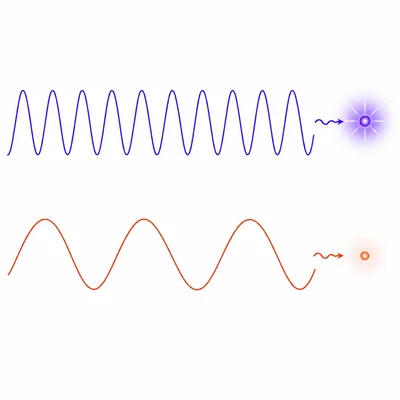
Infrared wavelengths are generally longer than visible wavelengths. If a photon has a longer wavelength, how does its energy compare to a shorter-wavelength photon? Explain using the relationship between energy and wavelength.
- 4
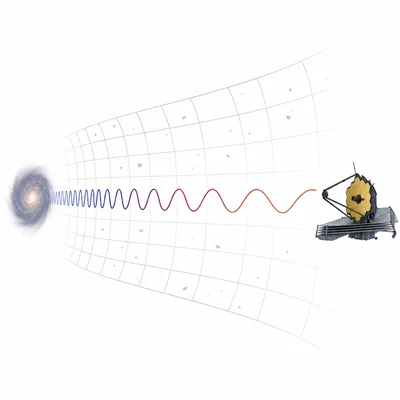
A galaxy emitted ultraviolet light when the universe was young, but JWST detects that light today in the infrared. Explain what happened to the light as it traveled through space.
- 5
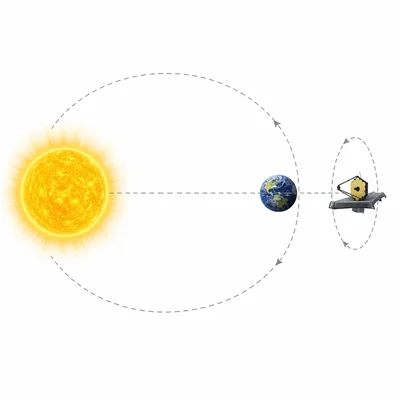
JWST orbits near the Sun-Earth L2 point instead of orbiting close to Earth like the Hubble Space Telescope. Give one advantage of placing JWST near L2.
- 6
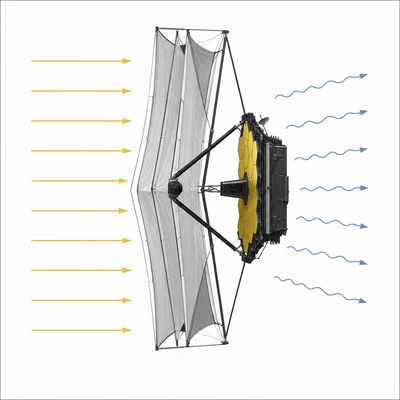
Explain why JWST needs a large sunshield and very cold operating temperatures to observe infrared light.
- 7
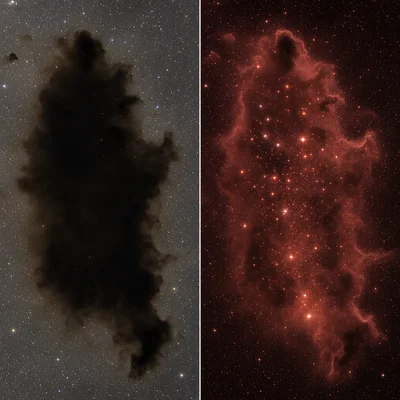
A star-forming region contains thick clouds of gas and dust. Visible-light images show mostly dark patches, but infrared images reveal many young stars. Explain why the two images look different.
- 8
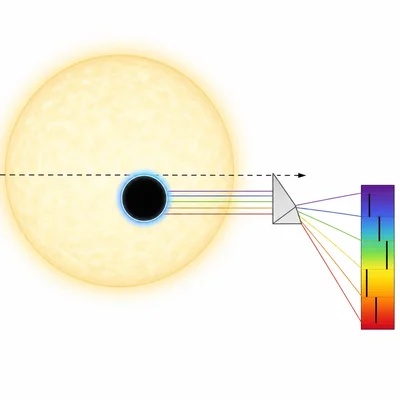
JWST can study exoplanet atmospheres using transit spectroscopy. During a transit, a planet passes in front of its star. Explain how astronomers can learn about gases in the planet's atmosphere from the starlight.
- 9
A spectrum from a distant object shows a strong hydrogen feature at 1.6 micrometers, but the same feature is normally measured at 0.4 micrometers in the object's rest frame. Calculate the redshift z using z = observed wavelength divided by rest wavelength minus 1.
- 10
Compare JWST and Hubble in terms of the main wavelengths they observe and the kinds of objects or processes they are especially good at studying.
- 11
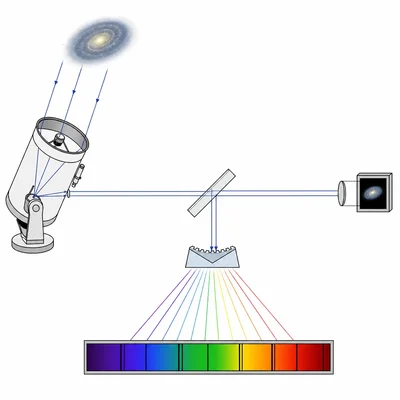
JWST's instruments include cameras and spectrographs. Describe the difference between an image and a spectrum, and explain why both are valuable in astronomy.
- 12
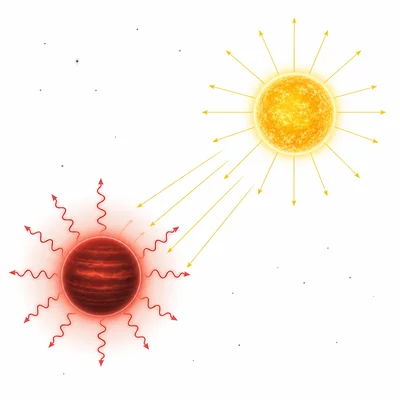
Some objects in space, such as brown dwarfs and newly forming planets, are relatively cool compared with stars like the Sun. Explain why infrared astronomy is well suited for studying these objects.