Practice the purpose, steps, components, controls, and data interpretation involved in PCR and gel electrophoresis.
Read each problem carefully. Show your work in the space provided and explain your reasoning when asked.
Amplifying DNA and analyzing fragment sizes
Biology - Grade 9-12
- 1
Explain the main purpose of PCR in biotechnology.
- 2
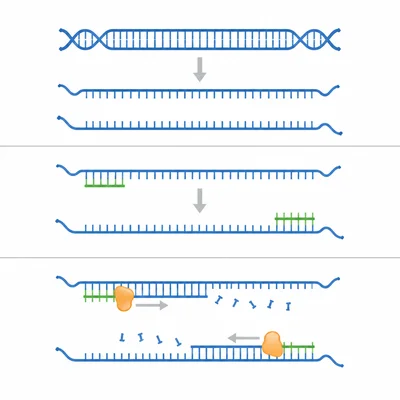
A PCR cycle has three main temperature steps: denaturation, annealing, and extension. Describe what happens during each step.
- 3
If PCR starts with 1 copy of a target DNA sequence and doubles perfectly each cycle, how many copies will there be after 6 cycles?
- 4
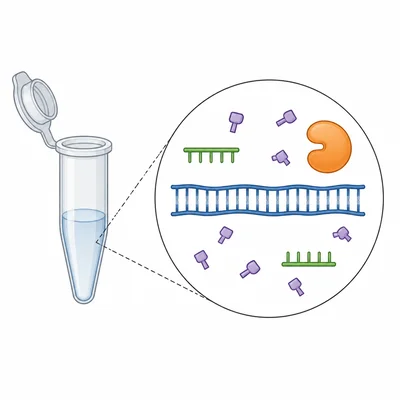
List four important ingredients in a PCR reaction and explain the role of each one.
- 5
Why is Taq polymerase commonly used in PCR instead of many other DNA polymerases?
- 6
A primer has the sequence 5'-ATG CCA TTA-3'. Write the complementary DNA sequence that would pair with it.
- 7
Explain why primers must be specific to the DNA region being copied.
- 8
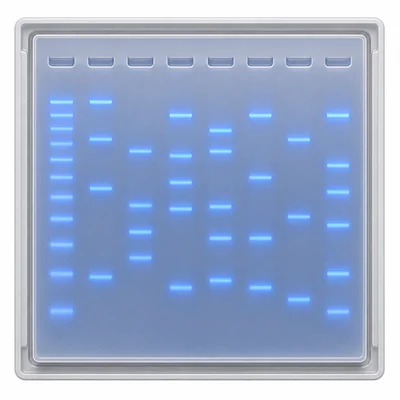
What is the purpose of gel electrophoresis after PCR?
- 9
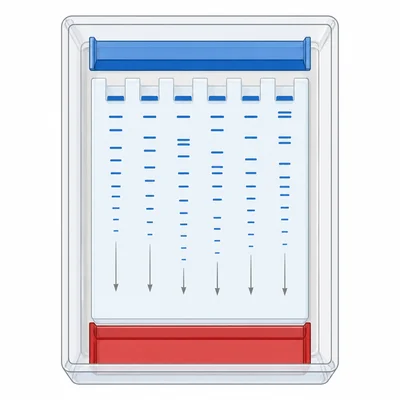
In gel electrophoresis, DNA fragments move toward the positive electrode. Explain why this happens.
- 10
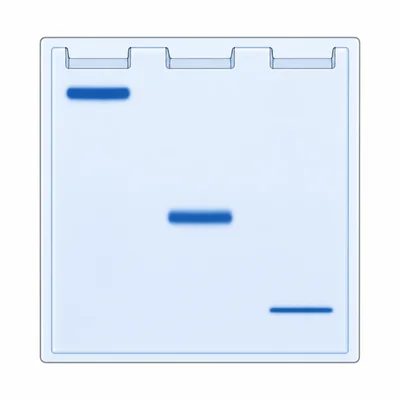
A gel has three DNA fragments: 200 base pairs, 800 base pairs, and 1500 base pairs. Which fragment will travel farthest from the wells, and why?
- 11
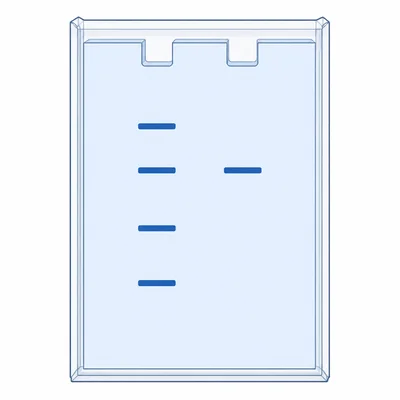
A DNA ladder shows bands at 100 bp, 500 bp, 1000 bp, and 1500 bp. An unknown sample band lines up closest to the 1000 bp ladder band. Estimate the size of the unknown DNA fragment.
- 12
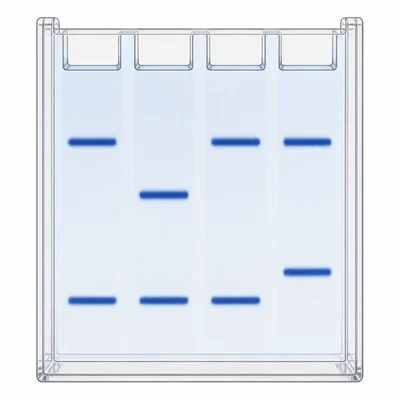
A forensic gel has these band patterns: crime scene sample has bands at 500 bp and 1200 bp, Suspect A has bands at 500 bp and 900 bp, Suspect B has bands at 500 bp and 1200 bp, and Suspect C has bands at 700 bp and 1200 bp. Which suspect matches the crime scene sample?
- 13
A PCR experiment includes a positive control and a negative control. Explain what each control is used to check.
- 14
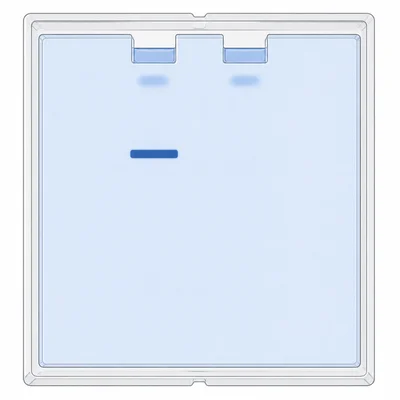
A student runs a PCR product on a gel and sees no band in the sample lane, but the positive control worked. Give two possible reasons the sample lane has no band.
- 15
Compare the roles of PCR and gel electrophoresis in a DNA analysis workflow.