Practice using the density formula, reading lab data, choosing units, and connecting density to floating and sinking.
Read each problem carefully. Show your work in the space provided. Include units in your final answers.
Calculating density, mass, and volume from lab data
Chemistry - Grade 6-8
- 1
A metal cube has a mass of 54 grams and a volume of 6 cubic centimeters. What is its density?
- 2
A liquid sample has a mass of 40 grams and a volume of 50 milliliters. Calculate the density of the liquid.
- 3
A student measures an unknown solid. The mass is 32 grams and the volume is 4 cubic centimeters. The student says the density is 128 grams per cubic centimeter. Explain the mistake and give the correct density.
- 4
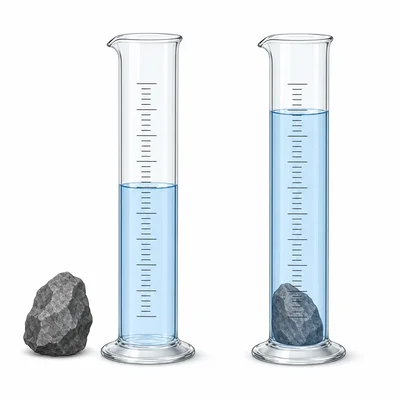
A rock has a mass of 75 grams. When placed in a graduated cylinder, the water level rises from 30 milliliters to 45 milliliters. What is the rock's volume and density?
- 5
An object has a density of 2 grams per cubic centimeter and a volume of 12 cubic centimeters. What is its mass?
- 6
A sample has a density of 4 grams per milliliter and a mass of 36 grams. What is its volume?
- 7
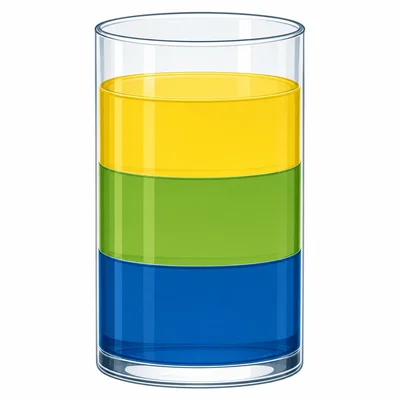
Three liquids are poured into a container and form layers. Liquid A has a density of 1.2 grams per milliliter, Liquid B has a density of 0.8 grams per milliliter, and Liquid C has a density of 1.0 gram per milliliter. List the liquids from top to bottom.
- 8
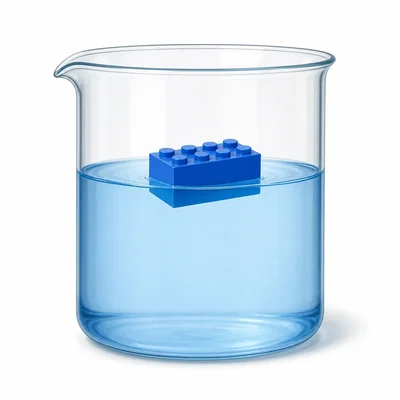
A plastic block has a density of 0.7 grams per cubic centimeter. Water has a density of 1.0 gram per milliliter. Will the plastic block float or sink in water? Explain your answer.
- 9
A piece of aluminum has a mass of 27 grams and a density of 2.7 grams per cubic centimeter. What is its volume?
- 10
A student collects the following data for four objects: Object W has a mass of 20 grams and a volume of 10 cubic centimeters. Object X has a mass of 18 grams and a volume of 6 cubic centimeters. Object Y has a mass of 12 grams and a volume of 12 cubic centimeters. Object Z has a mass of 30 grams and a volume of 5 cubic centimeters. Which object has the greatest density?
- 11
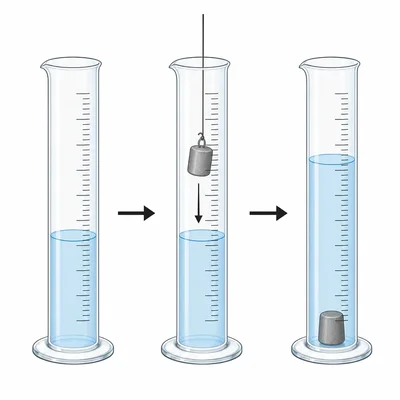
A graduated cylinder contains 20 milliliters of water. A student adds a small object, and the water rises to 28 milliliters. The object has a mass of 24 grams. Draw or describe the steps needed to find the object's density, then calculate it.
- 12
In a lab, two groups measure the same solid. Group 1 reports a density of 7.8 grams per cubic centimeter. Group 2 reports a density of 5.1 grams per cubic centimeter. Give one possible lab error that could explain the difference.