Practice real-world budgeting skills for renting an apartment, including security deposits, utilities, renter's insurance, and monthly affordability.
Read each problem carefully. Show your calculations and explain your reasoning in complete sentences when asked.
Practice calculating move-in costs, monthly expenses, and affordable rent
Financial Literacy - Grade 9-12
- 1
A landlord requires first month's rent of $1,150, a security deposit equal to one month's rent, and an application fee of $45. How much money is needed before moving in?
- 2
Maya earns $3,600 per month before taxes. A common guideline says rent should be no more than 30% of gross monthly income. What is the maximum rent Maya should consider under this guideline?
- 3
A studio apartment costs $975 per month. Estimated monthly utilities are electricity $85, water $35, internet $60, and renter's insurance $18. What is the total monthly housing cost?
- 4
Jamal has saved $3,000 for moving costs. The apartment he wants requires first month's rent of $1,200, last month's rent of $1,200, a security deposit of $900, and a pet deposit of $250. Does he have enough saved? If not, how much more does he need?
- 5
The table shows three apartments. Apartment A: rent $1,050, utilities $180, parking $0. Apartment B: rent $980, utilities $230, parking $75. Apartment C: rent $1,125, utilities $120, parking $50. Which apartment has the lowest total monthly cost?
- 6
A lease says the security deposit is refundable if the apartment is clean and undamaged, except for normal wear and tear. Explain what refundable means in this situation.
- 7
A tenant pays a $1,000 security deposit. After move-out, the landlord deducts $160 for carpet cleaning and $95 for a broken window. How much of the deposit should the tenant receive back?
- 8
Lena's monthly take-home pay is $2,850. Her monthly expenses are rent $1,050, utilities $170, groceries $360, transportation $220, phone $65, insurance $120, entertainment $150, and savings $250. How much money is left after these expenses?
- 9
A lease requires a 12-month commitment. Rent is $1,300 per month. What is the total rent paid over the full lease term, not including utilities or fees?
- 10
Compare two internet plans for an apartment. Plan A costs $55 per month with no installation fee. Plan B costs $45 per month with a $120 installation fee. Which plan is cheaper for the first 12 months, and by how much?
- 11
A corrected comparison of two internet plans: Plan A costs $55 per month with no installation fee. Plan B costs $45 per month with a $120 installation fee. Which plan is cheaper for the first 12 months, and by how much?
- 12
A renter's electricity bill is $96 in June, $112 in July, $128 in August, and $104 in September. What is the average monthly electricity cost for these four months?
- 13
Noah wants to rent an apartment that costs $1,250 per month. His take-home pay is $3,200 per month. After rent, he estimates utilities $190, food $420, transportation $250, phone $70, student loan payment $180, and savings $300. How much money will he have left each month?
- 14
A landlord offers two move-in options. Option 1 requires $1,100 first month's rent and a $1,100 security deposit. Option 2 requires $1,100 first month's rent, a $500 nonrefundable move-in fee, and a $300 security deposit. Which option costs less upfront, and which option may return more money later?
- 15
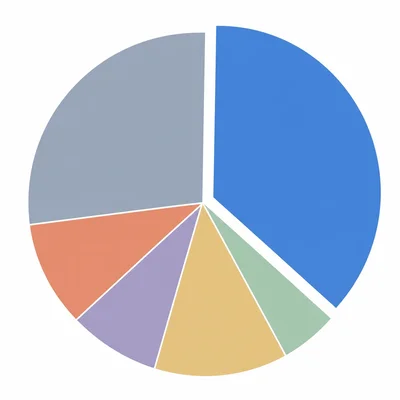
The pie chart shows a monthly take-home pay of $3,000 divided into rent $1,050, utilities $180, food $390, transportation $240, savings $300, and other expenses $840. What percent of take-home pay goes to rent?
- 16
Sofia is deciding whether she can afford an apartment. Her monthly take-home pay is $2,600. Her estimated monthly costs would be rent $950, utilities $160, internet $55, renter's insurance $20, groceries $340, transportation $210, phone $65, and other spending $300. She wants to save at least $300 per month. Can she afford this apartment and still meet her savings goal?