Practice comparing student loan options, calculating interest, reading repayment information, and making informed borrowing decisions.
Read each problem carefully. Show your work in the space provided and explain your reasoning when asked.
Understanding borrowing costs, repayment plans, and smart loan decisions
Financial Literacy - Grade 9-12
- 1
Maya is comparing two ways to pay for a college program. Option A is a $5,000 scholarship that does not need to be repaid. Option B is a $5,000 student loan that must be repaid with interest. Which option is financially better for Maya, and why?
- 2
A student borrows $4,000 in a loan with a 5% annual simple interest rate. If the student pays it back after 1 year, how much interest will the loan earn?
- 3
A student loan statement shows a principal balance of $8,500 and accrued interest of $340. What is the total amount owed at that time?
- 4
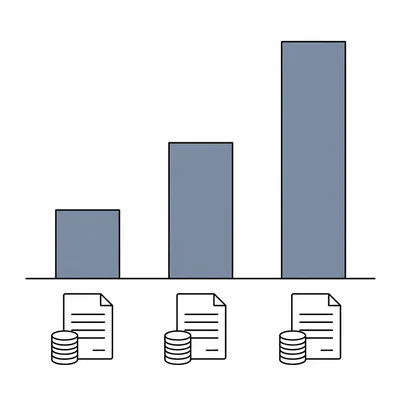
The chart shows three loan offers for the same $10,000 amount. Loan A has a 4.5% interest rate, Loan B has a 6.0% interest rate, and Loan C has a 7.5% interest rate. If all other terms are the same, which loan will usually cost the least over time?
- 5
Jamal has a monthly student loan payment of $225. His monthly take-home pay is $2,500. What percent of his take-home pay goes to the student loan payment? Round to the nearest whole percent.
- 6
A repayment plan offers a lower monthly payment but takes more years to pay off the loan. Explain one benefit and one drawback of this plan.
- 7
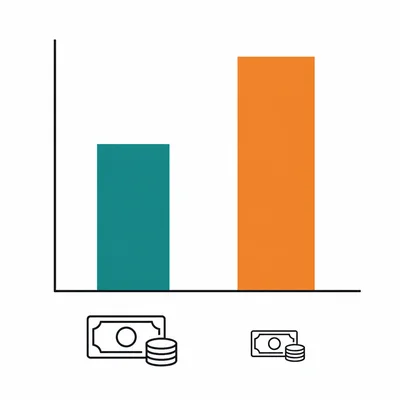
The graph shows the total cost of a loan under two repayment plans. Plan 1 has higher monthly payments and a total cost of $18,200. Plan 2 has lower monthly payments and a total cost of $21,600. Which plan costs more overall, and by how much?
- 8
A student is offered a subsidized federal loan and an unsubsidized federal loan. During certain periods, the government may pay the interest on the subsidized loan. Why might the subsidized loan be a better choice if the student qualifies?
- 9
A college financial aid letter lists these yearly costs: tuition $9,800, fees $1,200, housing $6,500, books $900, and transportation $600. The student receives $7,000 in grants and scholarships. How much is left to pay before using loans or personal savings?
- 10
A student has $1,200 available from summer savings and is deciding whether to borrow the full $6,000 needed for school or borrow only $4,800. Explain why borrowing only $4,800 could be a smart financial choice.
- 11
A borrower misses a student loan payment and does not contact the loan servicer. Name two possible consequences of missing payments.
- 12
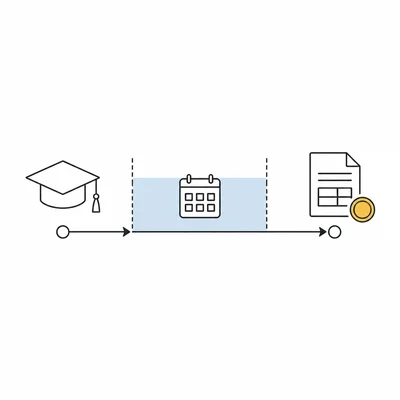
The timeline shows a student graduating in May, a 6-month grace period, and repayment beginning in November. What is the purpose of a grace period, and what should a borrower do during that time?