Sign in to save

Bookmark this page so you can find it later.

Sign in to save

Bookmark this page so you can find it later.

Math Grade 9-12

Math: Systems of Inequalities

Solving and graphing systems of linear inequalities

View Answer Key

Practice solving, graphing, and interpreting systems of linear inequalities in two variables.

Read each problem carefully. Solve each system or describe its solution set. Show your work and use graph paper if needed.

Name:
Date:
Score: / 15

Solving and graphing systems of linear inequalities

Math - Grade 9-12

Instructions: Read each problem carefully. Solve each system or describe its solution set. Show your work and use graph paper if needed.
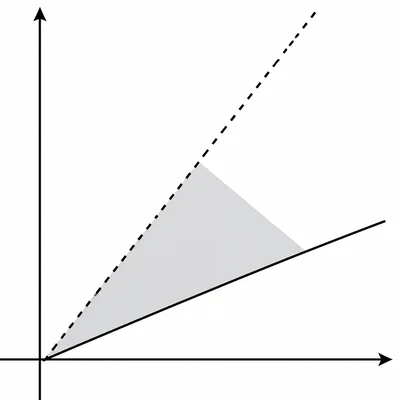
  1. 1
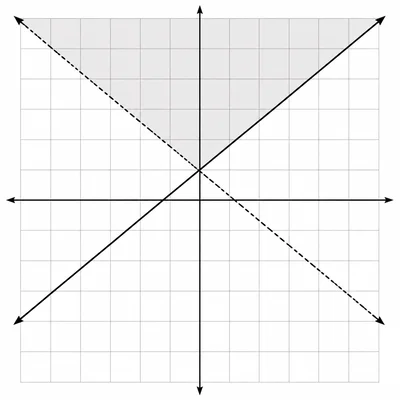
    Coordinate graph showing a shaded wedge between a dashed steeper rising line and a solid gentler rising line.

    Solve the system and describe the solution set: y > 2x - 1 and y <= x + 3.

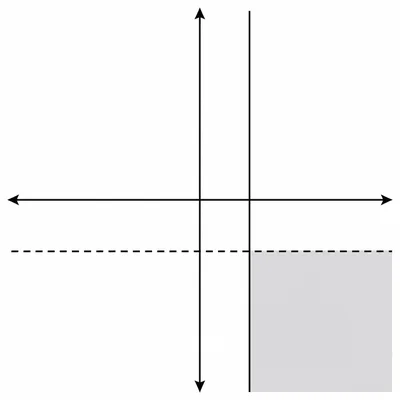
  2. 2
    Coordinate graph with shading right of a solid vertical line and below a dashed horizontal line.

    Graph the system: x >= -2 and y < 4. Describe the region that is shaded.

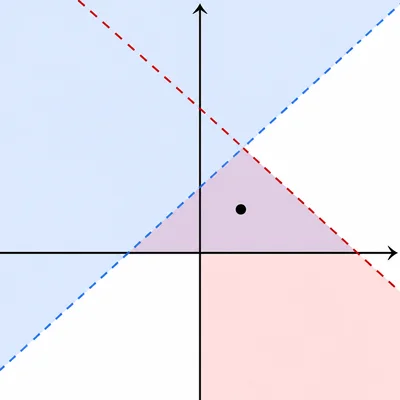
  3. 3
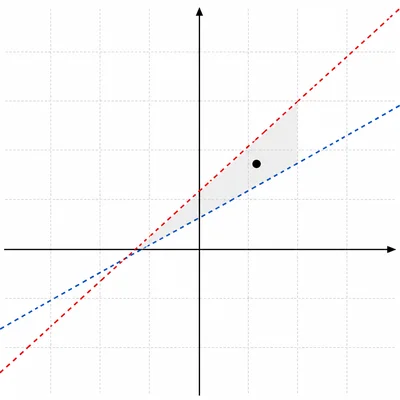
    Coordinate graph with a point inside the overlap of two inequality regions.

    Determine whether the point (2, 1) is a solution to the system: y < x and y >= -x + 2.

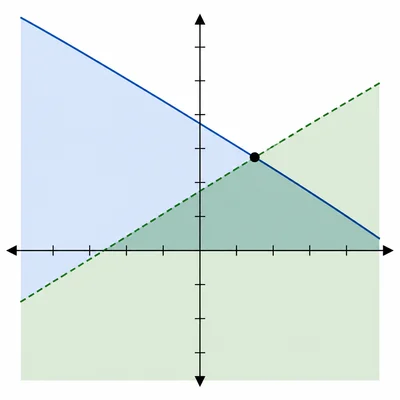
  4. 4
    Coordinate graph with a point on a solid boundary line inside the overlapping solution region.

    Determine whether the point (-1, 3) is a solution to the system: y <= 2x + 5 and y > -x + 1.

  5. 5
    Coordinate graph showing the region above a dashed falling line and below a solid rising line.

    Write the system of inequalities represented by this description: the region above the line y = -3x + 2 and on or below the line y = x - 1.

  6. 6
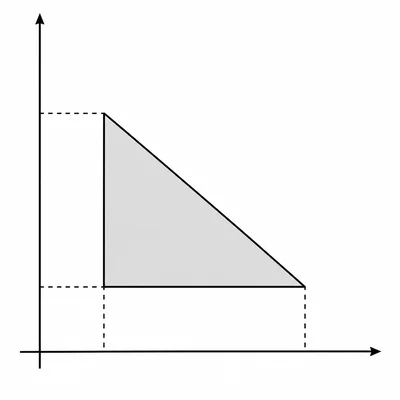
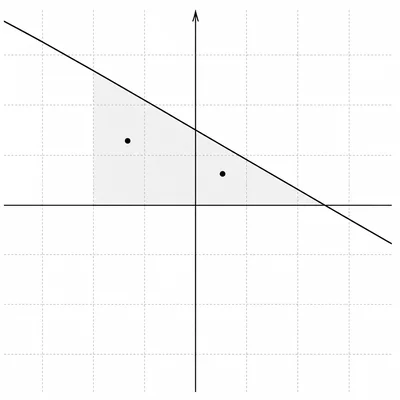
    Feasible triangular region for two prices bounded by minimum values and a total maximum.

    A school club sells notebooks for x dollars and pens for y dollars. The prices must satisfy x >= 1, y >= 0.5, and x + y <= 5. Describe what the solution set represents.

  7. 7
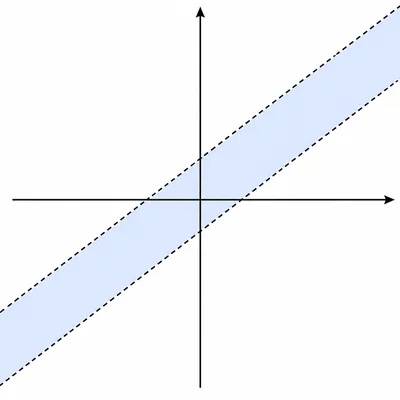
    Coordinate graph showing a shaded strip between two parallel dashed lines.

    Solve the system: y < -2x + 6 and y > -2x + 1. Describe the region between the lines.

  8. 8
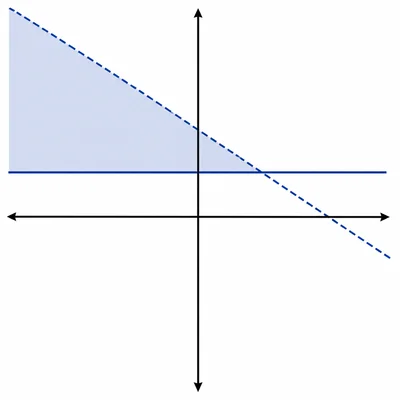
    Coordinate graph with shading above a solid horizontal line and below a dashed falling line.

    Graph and describe the solution set for the system: y >= 3 and y < -x + 7.

  9. 9
    Coordinate graph showing a sample point inside the overlap between two dashed rising lines.

    Find one point that satisfies the system y > x - 4 and y < 2x + 1. Explain why it works.

  10. 10
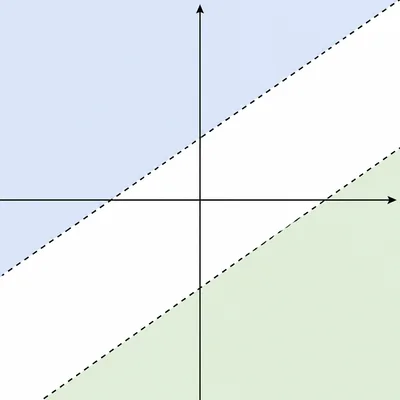
    Coordinate graph with two parallel dashed lines and separated shaded half-planes showing no overlap.

    Is there a solution to the system y > x + 2 and y < x - 1. Explain your reasoning.

  11. 11
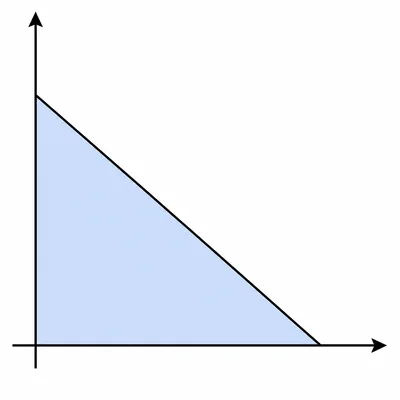
    First-quadrant triangular region below a downward-sloping line.

    Write a system of two inequalities whose solution is the region in the first quadrant below the line y = -x + 6.

  12. 12
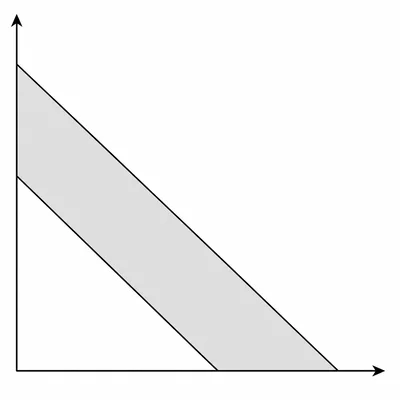
    First-quadrant feasible band between two parallel diagonal total-time boundaries.

    A student must spend at least 4 hours on math, x, and science, y, combined, so x + y >= 4. The student also wants to spend no more than 6 hours total, so x + y <= 6, with x >= 0 and y >= 0. Describe the feasible region.

  13. 13
    Coordinate graph showing two sample points in the region above a horizontal line and below a falling line.

    For the system y <= -x + 5 and y >= 2, find two ordered pairs that are solutions.

  14. 14
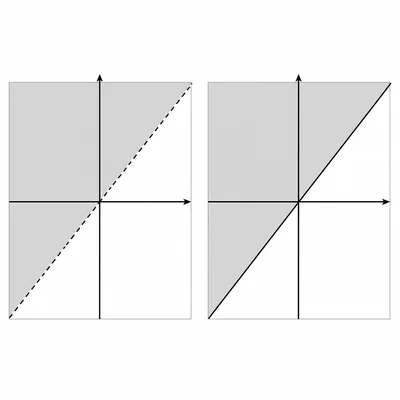
    Side-by-side graphs comparing a dashed boundary line with a solid boundary line.

    Explain the difference between graphing y < 2x + 1 and y <= 2x + 1 in a system of inequalities.

  15. 15
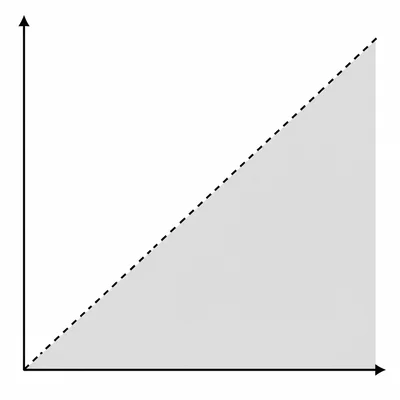
    First-quadrant region shaded below a dashed rising diagonal line.

    A graph shows the overlap of these inequalities: x > 0, y > 0, and y < x + 2. Describe the solution set in words.

LivePhysics™.com Math - Grade 9-12

More Math Worksheets

See all Math worksheets

More Grade 9-12 Worksheets

See all Grade 9-12 worksheets