Linear Equation Solver
Solve systems of linear equations with step-by-step Gaussian elimination, interactive augmented matrix visualization, and exact fraction arithmetic.
Equations
Augmented Matrix [A|b]
| x | y | b |
|---|---|---|
Solution
Free variables x, y
Augmented Matrix
| [ | ] | |||
Open this tool with your own values
This tool reads its inputs from the page address, so a link can open it with the values from a problem already entered. Include every value the problem needs, because one left out keeps the tool's default. Use plain numbers in the stated units.
- n
- number of equations and unknowns, 1 to 10
- m
- coefficients then the constant of each equation, equation by equation, comma-separated, as whole numbers or fractions written like 1_2
Example link
Reference Guide
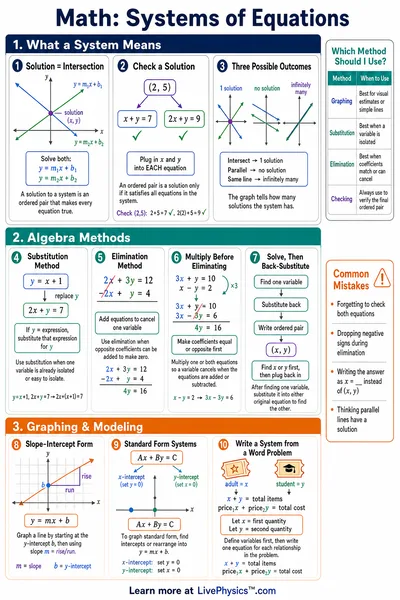
Types of Solutions
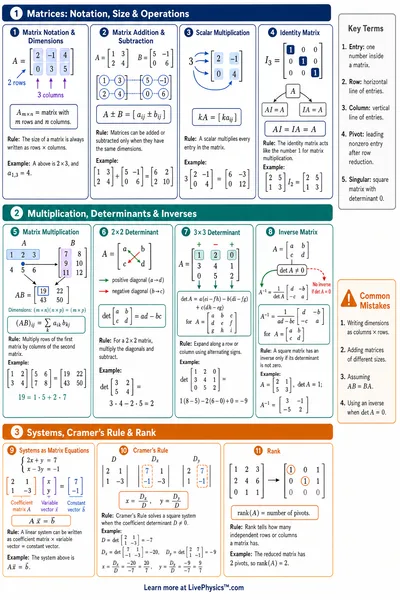
Gaussian Elimination
A systematic algorithm to solve systems by transforming the augmented matrix to reduced row echelon form (RREF).
- Forward elimination Use row operations to create zeros below each pivot
- Scale pivots Divide each pivot row so the pivot becomes 1
- Back substitution Eliminate above each pivot to get RREF
Cramer's Rule
For a 2×2 system , when :
Where replaces column 1 of with , and similarly for .
For a 2×2 matrix
Matrix Rank & Solution Type
The rank of a matrix is the number of non-zero rows after row reduction (the number of pivot positions).
: Unique solution
: No solution
: Infinite solutions with free variables