Class C airspace protects busy airports that have an operational control tower and radar approach control. Pilots use this cheat sheet to identify Class C boundaries, prepare the correct equipment, and communicate properly before entry. It is especially useful for student pilots planning cross-country flights or practicing controlled-airspace procedures.
Knowing these rules helps pilots integrate safely with faster and higher volumes of traffic.
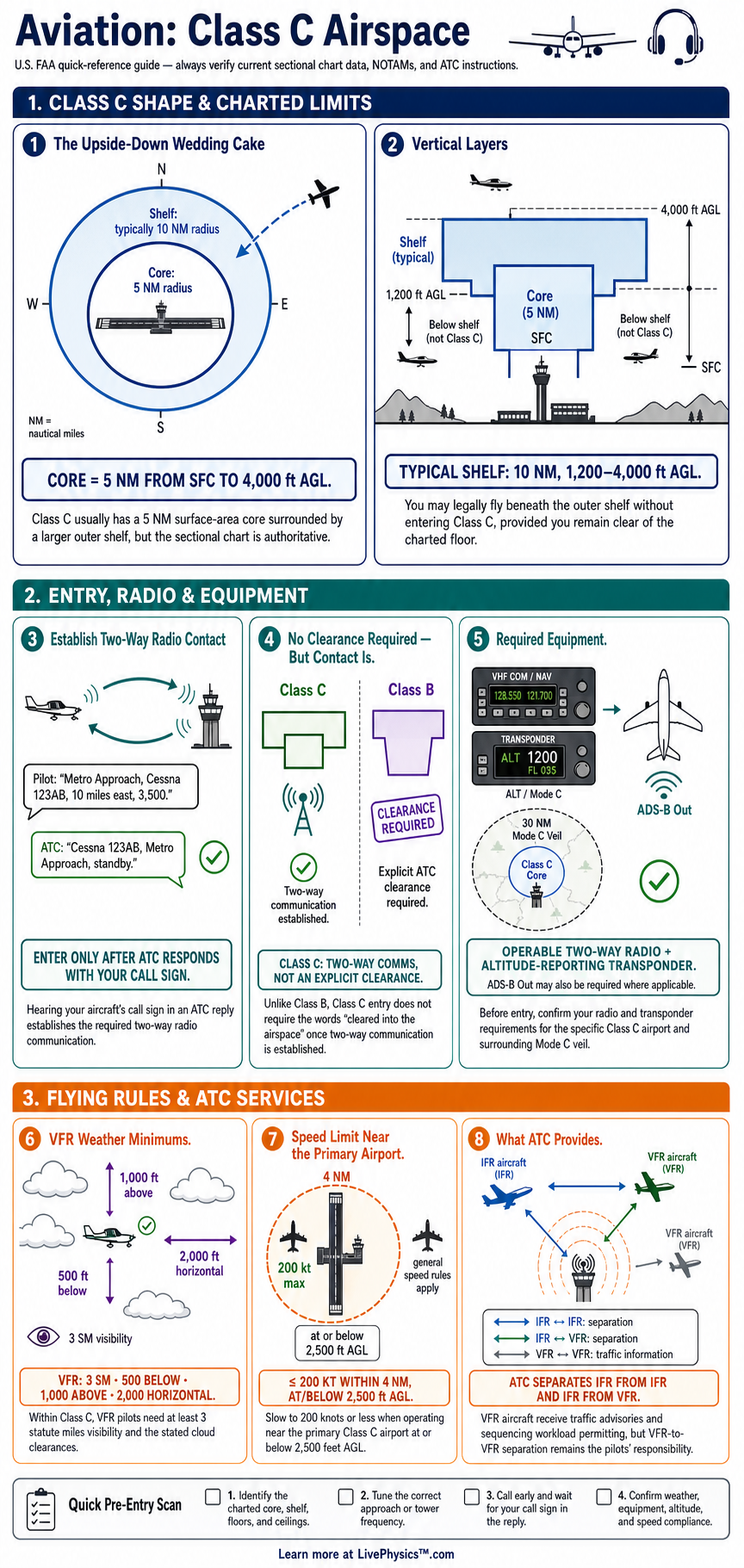
A typical Class C area has a five nautical mile inner core and a larger outer shelf that reaches ten nautical miles from the airport. The inner core usually extends from the surface to 4,000 feet above airport elevation, while the shelf usually begins at 1,200 feet above ground level. Pilots must establish two-way radio communication with ATC before entering.
A functioning transponder with altitude reporting is normally required, and VFR pilots must meet the required visibility and cloud-clearance rules.
Key Facts
- The Class C inner core normally extends from the surface to 4,000 feet above airport elevation within a radius of 5 nautical miles.
- The Class C outer shelf normally extends from 1,200 feet above ground level to 4,000 feet above airport elevation from 5 to 10 nautical miles from the airport.
- A pilot must establish two-way radio communication with ATC before entering Class C airspace.
- Two-way communication is established only when ATC replies using the aircraft call sign.
- Class C entry requires communication but does not require the explicit ATC clearance required for Class B airspace.
- VFR weather minimums in Class C are 3 statute miles visibility, 500 feet below clouds, 1,000 feet above clouds, and 2,000 feet horizontally from clouds.
- Aircraft in Class C airspace normally require a two-way radio and an operable Mode C altitude-reporting transponder.
- ATC separates IFR aircraft from IFR aircraft and from VFR aircraft, while VFR pilots remain responsible for see-and-avoid separation from other VFR aircraft.
Vocabulary
- Class C airspace
- Controlled airspace surrounding certain busy airports that provides radar services and organized traffic flow.
- Inner core
- The central Class C area, usually a five nautical mile radius extending from the surface upward.
- Outer shelf
- The outer ring of Class C airspace that usually starts above the surface and extends farther from the airport.
- Two-way radio communication
- An exchange in which ATC acknowledges a pilot by using that aircraft's call sign.
- Mode C transponder
- A transponder setting that sends an aircraft identification code and pressure altitude to ATC radar.
- See and avoid
- The pilot responsibility to visually detect and avoid other aircraft when operating under visual flight rules.
Common Mistakes to Avoid
- Entering after hearing only an instruction to standby is wrong because ATC has not used the aircraft call sign and two-way communication is not established.
- Treating Class C like Class B is wrong because Class C requires established communication before entry, not an explicit clearance.
- Reading charted altitude numbers as heights above ground level is wrong because sectional chart Class C limits are normally shown in hundreds of feet mean sea level.
- Assuming every Class C shelf begins at 1,200 feet above ground level is wrong because pilots must use the specific floor and ceiling printed on the chart.
- Relying on ATC to prevent every VFR conflict is wrong because VFR pilots still have the see-and-avoid responsibility for other VFR aircraft.
Practice Questions
- 1 A Class C inner core has a radius of 5 nautical miles. How far from the airport does its lateral boundary extend?
- 2 A Class C shelf floor is 1,200 feet above ground level, and the terrain elevation is 600 feet mean sea level. What is the shelf floor in mean sea level?
- 3 State the VFR visibility and cloud-clearance minimums required in Class C airspace.
- 4 ATC replies to a pilot's initial call with the words aircraft calling standby. Explain why the pilot must remain outside Class C airspace until a further response.
Understanding Class C Airspace
Class C airspace is designed around airports with moderate to heavy traffic. These airports commonly have airline service, business jets, training aircraft, and local general aviation operations. The airspace gives controllers a way to organize arrivals and departures before aircraft reach the runway environment.
On a sectional chart, the solid magenta rings show the lateral boundaries. The printed numbers in each ring show the vertical limits in hundreds of feet above mean sea level.
The inner circle normally has a radius of five nautical miles. It reaches from the surface to 4,000 feet above the airport elevation. The outer shelf normally extends from five to ten nautical miles from the airport.
Its floor is commonly 1,200 feet above ground level, and its top is 4,000 feet above airport elevation. Pilots must read the chart carefully because each airport can have different dimensions, altitudes, and cutouts. A class C area may also have an outer area where ATC provides radar services, although that area is not itself controlled airspace.
Before entering Class C airspace, a pilot must establish two-way radio communication with the controlling ATC facility. The pilot calls approach control using the facility frequency shown on the chart. The initial call includes aircraft identification, position, altitude, and intended airport or request.
Entry is permitted when the controller responds with the aircraft call sign. A reply such as aircraft calling standby does not establish the required communication because it does not include the call sign. Unlike Class B airspace, Class C entry does not require an explicit clearance.
Aircraft operating in and above Class C airspace normally need a two-way radio and an operable Mode C transponder. Mode C reports pressure altitude to ATC radar. Many Class C airports are also surrounded by a 30 nautical mile Mode C veil, which generally requires altitude-reporting transponder equipment.
Pilots must check notices, chart notes, and equipment rules before flight. VFR weather minimums in Class C are three statute miles visibility, 500 feet below clouds, 1,000 feet above clouds, and 2,000 feet horizontally from clouds.
Controllers provide separation between IFR aircraft and other IFR aircraft. They also separate IFR aircraft from VFR aircraft in Class C airspace. VFR aircraft receive traffic advisories and sequencing, but pilots remain responsible for seeing and avoiding other VFR traffic.
A pilot should listen closely, follow headings or altitude instructions promptly, and report any inability to comply. Good preparation reduces radio workload and helps every aircraft move safely through the terminal area.