Cloud Type Identifier
Identify the main cloud types by altitude and shape. Explore high, middle, low, and vertical clouds, then take a quiz to match descriptions to cloud names and weather signals.
Cloud types by altitude
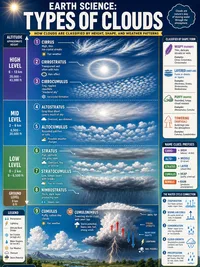
Clouds are grouped by how high they sit in the sky and by their shape. Tap a card to see how it looks and what weather it signals.
High clouds
Above 6,000 m (20,000 ft)Middle clouds
2,000 to 6,000 m (7,000 to 20,000 ft)Low clouds
Below 2,000 m (7,000 ft)Vertical development
From near the ground up past 12,000 mReading the names
Cloud names are built from Latin roots. Once you know the roots, you can often guess what a cloud looks like and where it sits.
How it works
Meteorologists sort clouds by two things, how high they sit and what shape they take. Switch to Reference to browse every cloud type grouped by altitude band, then open the Quiz to match a description to the right cloud. Learn mode shows an altitude hint, Practice removes it, and Challenge mixes in look-alike clouds.
Curriculum alignment
Cloud identification supports elementary and middle school Earth science weather units and high school meteorology. It builds toward NGSS standards on weather and climate patterns, including reading the sky to forecast short term weather changes.
Cloud Types Reference Guide
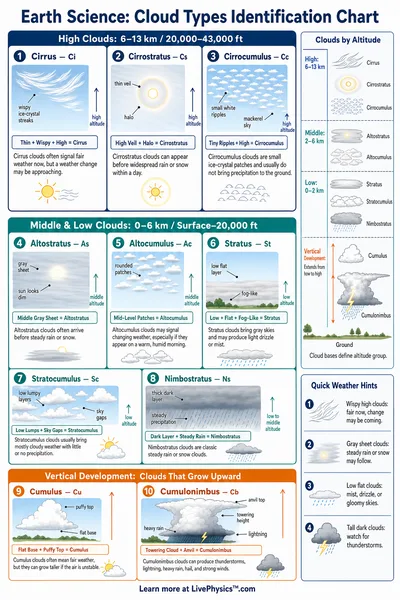
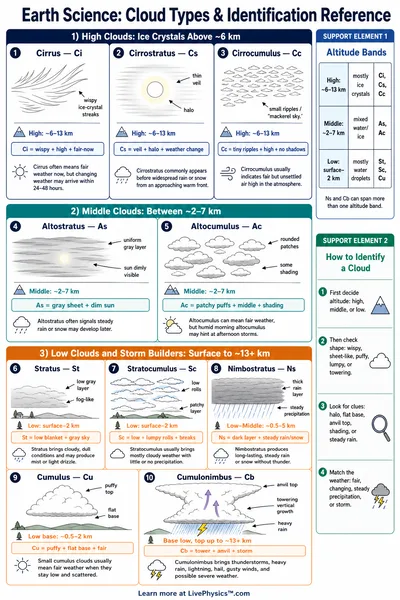
High clouds, above 6,000 m
High clouds are made of ice crystals and tend to be thin and pale.
- Cirrus. Thin wispy streaks of ice. Fair now, but a weather change may follow.
- Cirrostratus. A thin veil that can put a halo around the Sun or Moon, often before rain.
- Cirrocumulus. Small white ripples in rows, the mackerel sky. Usually fair but cold.
Middle clouds, 2,000 to 6,000 m
Middle clouds carry the prefix alto and are often gray sheets or clumps.
- Altostratus. A gray sheet that dims the Sun to a fuzzy disc. Steady rain often follows.
- Altocumulus. Gray and white rounded clumps in groups. Morning ones can warn of afternoon storms.
Low clouds, below 2,000 m
Low clouds sit close to the ground and often bring overcast skies.
- Stratus. A flat gray layer covering the whole sky, like lifted fog. Drizzle or mist.
- Stratocumulus. Low lumpy rolls with blue gaps between them. Usually dry.
- Nimbostratus. A dark thick layer that blocks the Sun and drops steady rain or snow.
Clouds of vertical development
These clouds grow upward through several altitude bands.
- Cumulus. Puffy white clouds with flat bottoms and rounded tops. Fair weather when small.
- Cumulonimbus. A towering anvil topped storm cloud. Heavy rain, lightning, thunder, and hail.
Reading the names
- Cirro or cirrus. High and wispy, made of ice.
- Alto. Middle level.
- Strato or stratus. Layered, spread in flat sheets.
- Cumulo or cumulus. Heaped, puffy and piled up.
- Nimbo or nimbus. Rain bearing.