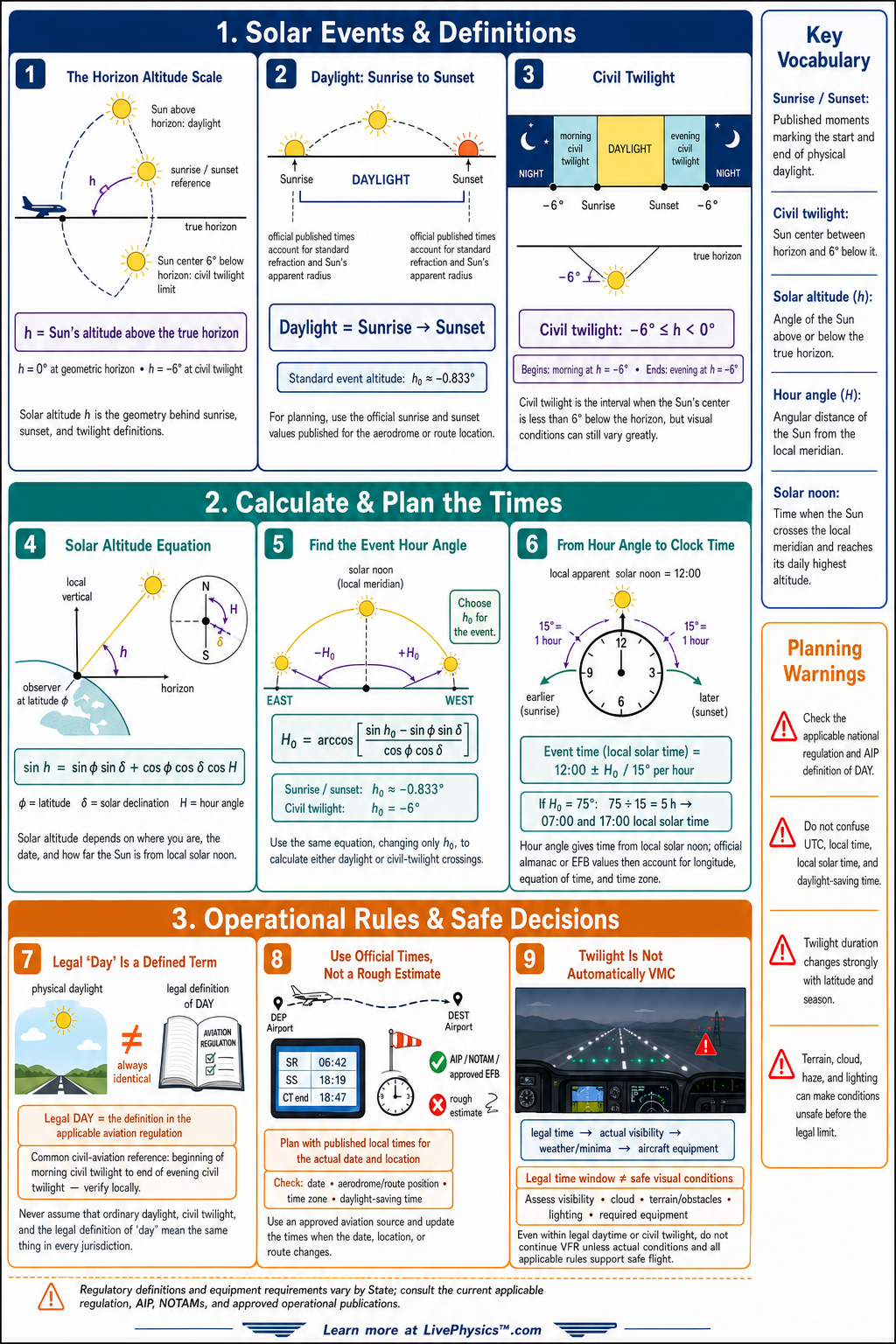
This cheat sheet explains the aviation time definitions that determine when daylight ends, when night begins, and which operating rules apply. Pilots use these definitions for flight planning, required aircraft lighting, passenger-carrying currency, and accurate logbook entries. Similar words can have different legal meanings, so using the correct time period matters.
This reference helps students separate everyday daylight from FAA regulatory definitions.
Civil twilight is based on the Sun's position below the horizon, while sunrise and sunset are separate published events. FAA daytime runs from the beginning of morning civil twilight to the end of evening civil twilight. FAA night runs from sunset to sunrise.
Some rules use a narrower period, including night passenger currency, which uses one hour after sunset through one hour before sunrise.
Key Facts
- FAA daytime begins at the beginning of morning civil twilight and ends at the end of evening civil twilight.
- FAA night equals the time from sunset to sunrise.
- Morning civil twilight begins when the center of the Sun is 6 degrees below the horizon before sunrise.
- Evening civil twilight ends when the center of the Sun is 6 degrees below the horizon after sunset.
- Position lights are required from sunset to sunrise.
- Night flight time may be logged from the end of evening civil twilight to the beginning of morning civil twilight when the pilot is a required flight crew member.
- Night passenger-carrying currency uses the period from 1 hour after sunset to 1 hour before sunrise.
- A pilot needs 3 takeoffs and 3 full-stop landings in the preceding 90 days during the night currency period to carry passengers at night.
Vocabulary
- Civil twilight
- Civil twilight is the low-light period when the Sun's center is 6 degrees below the horizon.
- Sunrise
- Sunrise is the published time when the upper edge of the Sun first appears above the horizon.
- Sunset
- Sunset is the published time when the upper edge of the Sun disappears below the horizon.
- FAA daytime
- FAA daytime is the period from the beginning of morning civil twilight to the end of evening civil twilight.
- FAA night
- FAA night is the period from sunset until sunrise.
- Night currency
- Night currency is the recent takeoff and landing experience required to carry passengers during the specified nighttime period.
Common Mistakes to Avoid
- Treating sunset as the end of FAA daytime is wrong because FAA daytime continues until the end of evening civil twilight.
- Using civil twilight to determine when position lights are required is wrong because position lights are required from sunset to sunrise.
- Assuming all legal night periods are identical is wrong because logging, aircraft lighting, and passenger currency use different time boundaries.
- Counting a landing shortly after sunset toward night passenger currency is wrong unless it occurs at least 1 hour after sunset.
- Estimating twilight from the visible sky is wrong because legal planning requires published times for the specific date and location.
Practice Questions
- 1 Sunset is at 1930 and the end of evening civil twilight is at 2002. At 1945, is it FAA daytime or FAA night?
- 2 Sunset is at 2010. What is the earliest time a takeoff or full-stop landing can count toward night passenger-carrying currency?
- 3 Morning civil twilight begins at 0548 and sunrise is at 0617. During which interval may a required flight crew member log night flight time?
- 4 Explain why a pilot can be operating during FAA night while enough natural light remains to see some ground features.
Understanding Daylight and Civil Twilight Rules
Aviation uses several time boundaries because the amount of visible light changes gradually. The sky does not become fully dark at the instant of sunset. Civil twilight describes the period when the Sun is just below the horizon but enough natural light may remain for many outdoor activities.
In the morning, civil twilight starts before sunrise. In the evening, it ends after sunset. Published aviation sources provide these times for a specific location and date.
The FAA definition of daytime is broader than the period between sunrise and sunset. Daytime starts at the beginning of morning civil twilight and ends at the end of evening civil twilight. This definition can affect rules that refer specifically to daytime operations.
The FAA definition of night is different. Night begins at sunset and ends at sunrise.
Therefore, there is a period after sunset that is legally night even though evening civil twilight has not ended. A similar overlap occurs before sunrise.
Aircraft lighting rules use the sunset to sunrise boundary. Position lights must be displayed from sunset to sunrise. Pilots should check the applicable operating rules and aircraft equipment requirements before flight.
Good planning also considers visibility, cloud cover, terrain, airport lighting, and the pilot's experience. Civil twilight may provide some natural illumination, but it does not guarantee that landmarks, obstacles, or unlighted terrain are easy to see.
Logging and passenger-carrying rules use yet another time window. For night flight time, a pilot may log time from the end of evening civil twilight until the beginning of morning civil twilight, when acting as required flight crew. For carrying passengers at night, recent takeoff and landing experience must be completed during the period beginning one hour after sunset and ending one hour before sunrise.
This narrower period is intended to ensure practice in darker conditions. A flight can be legally at night without counting toward this passenger-carrying currency requirement.
Students should always identify the rule first, then select the matching time definition. Record local published sunset, sunrise, and civil twilight times during preflight planning. Convert times carefully when sources use coordinated universal time rather than local time.
Do not estimate from the brightness outside the window. Accurate time use supports legal compliance, safer decisions, and correct logbook records.