Sign in to save

Bookmark this page so you can find it later.

Sign in to save

Bookmark this page so you can find it later.

Moon Phases & Eclipse Geometry Explorer

Three modes let you explore the lunar cycle, eclipse conditions, and seasonal variations. Adjust the Moon's age to see illumination changes, set the node angle to trigger eclipses, or pick any day and latitude to compute day length and solar altitude.

Mode

Presets

days

Orbital View

SunEarthMoon🌑 New MoonIllumination: 0.0%Moon age: 0.0 daysPhase angle: 0.0°

Moon Phase Results

Phase
🌑 New Moon
Illumination
0.0%
Phase Angle
0.0°
Moon Age
0.0 days
Rise Time
06:00
Set Time
18:00

Rise/set times are approximate, based on the average relationship between phase angle and moonrise. Actual times vary with observer latitude, date, and orbital eccentricity.

Moon Phase
🌑 New Moon
Illumination
0.0%
Season
Spring
Day Length
11.9 hr

Reference Guide

Lunar Phases and the Synodic Month

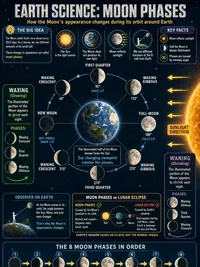
The Moon completes one cycle of phases every 29.53 days (the synodic month). The phase angle measures how far the Moon has traveled in its orbit relative to the Sun-Earth line.

θphase=d29.53×360°\theta_{\text{phase}} = \frac{d}{29.53} \times 360°

Illumination follows a cosine curve. At New Moon (0°) the illuminated fraction is 0%. At Full Moon (180°) it is 100%.

f=1cosθ2×100%f = \frac{1 - \cos\theta}{2} \times 100\%
🌑 New Moon 🌓 First Quarter90° 🌕 Full Moon180° 🌗 Third Quarter270°

Eclipse Geometry

Eclipses require the Moon to be near a node, where its orbital plane crosses the ecliptic. The Moon's orbit is tilted about 5°, so eclipses only occur when the Moon is close to the line of nodes at New or Full Moon.

Eclipse typePhaseMax node angle
Total lunar Full Moon < 3.5°
Total solar New Moon < 2°
Annular solar New Moon < 10°
Penumbral lunar Full Moon < 11.5°

Seasons and Axial Tilt

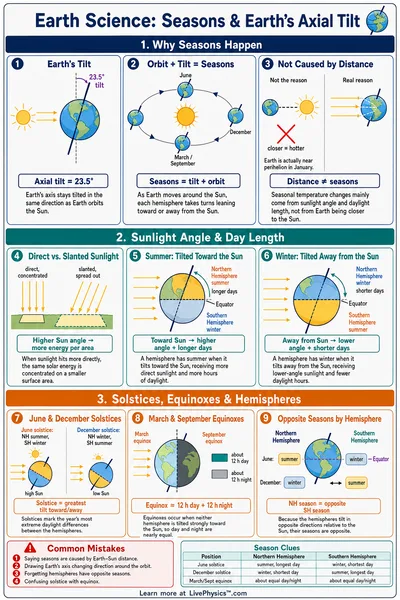
Earth's axis is tilted 23.44° from the orbital plane. This tilt causes the Sun's declination to oscillate throughout the year, producing the seasons.

δ=23.44°×sin ⁣(360°365(d81))\delta = 23.44° \times \sin\!\left(\frac{360°}{365}(d - 81)\right)

At the summer solstice (around June 21), the Northern Hemisphere receives maximum sunlight. At the winter solstice (around December 21), it receives the least.

The equator always receives close to 12 hours of daylight regardless of the time of year. Polar regions experience midnight sun or polar night when the declination exceeds the complement of the latitude.

Day Length and Solar Altitude

Day length is computed from the sunrise equation. The hour angle at sunrise or sunset depends on latitude and solar declination.

ω=arccos(tanϕtanδ)\omega = \arccos\bigl(-\tan\phi \cdot \tan\delta\bigr)
D=2ω15°/hrD = \frac{2\omega}{15°/\text{hr}}

Solar altitude at noon is the maximum elevation of the Sun above the horizon for a given day and location.

hnoon=90°ϕδh_{\text{noon}} = 90° - |\phi - \delta|

Where φ is the observer's latitude and δ is the solar declination on that date.
Related Content

Related Tools

Earthquake Magnitude Calculator
Four modes: magnitude scales (Richter Mₗ, moment magnitude M𝑤, energy), energy comparison (each step = 31.6× more energy, logarithmic bar chart), Modified Mercalli Intensity I-XII with descriptions, and Richter magnitude from seismograph amplitude. Presets include Minor M3 through Great M8, 1906 San Francisco M7.9, and 2011 Japan M9.1.
Carbon Footprint Calculator
Estimate annual CO₂ emissions from transportation (car miles, fuel type, flights), home energy (electricity, heating, AC), diet (meat consumption, food waste), and lifestyle (shopping, recycling). Pie chart breakdown, country comparison bar chart, trees-to-offset and equivalent-driving metrics. Five presets: Average American, Eco-Conscious, Heavy Commuter, Frequent Flyer, Work from Home.
Star Lifecycle Visualizer
Three modes: interactive HR diagram with 23 real stars (click to see properties), stellar evolution pathway from nebula to end state (white dwarf, neutron star, or black hole based on initial mass), and star properties calculator (luminosity L∝M^3.5, radius, lifetime t∝M^-2.5, apparent magnitude). Six presets: Sun, Red Dwarf (0.3 M☉), Sirius A (2 M☉), Blue Giant (20 M☉), Betelgeuse (15 M☉), Supergiant (50 M☉). Includes spectral class colour strip and SVG star visualization.
H-R Diagram Explorer
Three modes: plot a single star on the Hertzsprung-Russell diagram from temperature, radius, and mass (Stefan-Boltzmann luminosity, spectral class O-M, absolute magnitude, HR region); compare multiple stars side by side; and browse the spectral atlas with typical properties for each class. 23 reference stars plotted, 6 presets from Proxima Centauri to Rigel.