Sunrise, Sunset and Day Length Calculator
Pick any location and date to see exact sunrise and sunset times, solar noon, day length, night length, and civil, nautical, and astronomical twilight times. Polar day and polar night are handled automatically.
Location
Requires browser permission. Or enter coordinates below.
Quick presets
Date and Time Zone
e.g. -5 for EST, +1 for CET, +5.5 for IST
Select a location to calculate sun times
Use the location panel to pick a city, enter coordinates, or allow browser geolocation.
Reference Guide
Why Day Length Changes
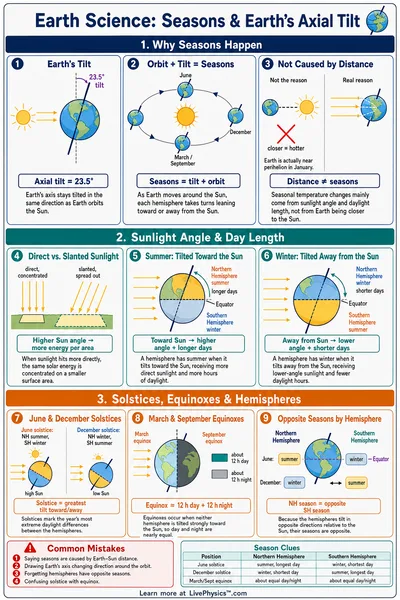
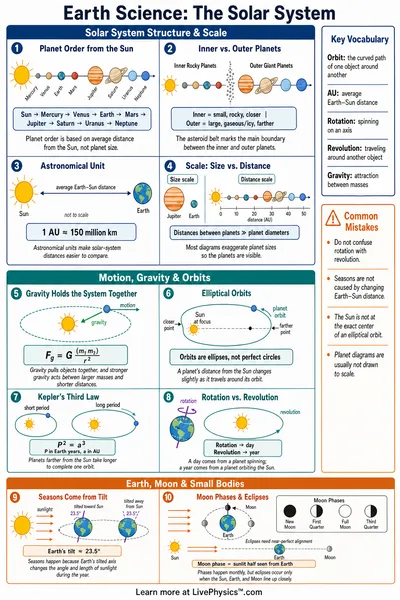
Earth's axis tilts at 23.5 degrees relative to its orbit around the sun. As Earth travels around the sun over the year, that tilt means one hemisphere leans toward the sun (summer, longer days) while the other leans away (winter, shorter days).
At the equator the effect is small, day length stays near 12 hours all year. At higher latitudes the effect grows dramatically. London ranges from about 8 hours in December to nearly 17 hours in June.
The two equinoxes (around March 20 and September 22) are the only days when every location on Earth has roughly equal day and night.
The Sunrise Equation
The standard sunrise equation uses an hour-angle formula. The sun rises when its zenith distance equals about 90.833 degrees (the extra 0.833 degrees accounts for atmospheric refraction and the sun's apparent disk radius).
The key formula is cos(H) = (cos(z) - sin(lat) sin(dec)) / (cos(lat) cos(dec)), where H is the hour angle at sunrise, z is the zenith distance, lat is latitude, and dec is the sun's declination.
Solar noon occurs when the sun crosses the observer's meridian, roughly at 720 - 4 * longitude - equation_of_time minutes after UTC midnight.
Civil, Nautical, and Astronomical Twilight
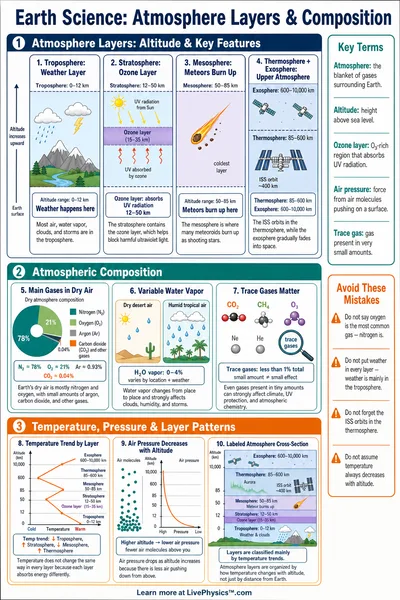
Twilight is the period before sunrise and after sunset when the sky is still partially lit by sunlight scattered by the upper atmosphere.
- Civil twilight (sun 0-6 degrees below horizon), bright enough for outdoor activities without artificial light. Legal definition for streetlights in many countries.
- Nautical twilight (6-12 degrees below), horizon still visible at sea; navigators can take star sights.
- Astronomical twilight (12-18 degrees below), sky dark enough for most observations; faint objects become visible.
Solar Declination
The sun's declination is its angle north or south of the celestial equator. It ranges from +23.5 degrees (June solstice) to -23.5 degrees (December solstice), crossing zero at the equinoxes.
Declination determines the sun's maximum altitude at solar noon, altitude = 90 - |latitude - declination|. A higher declination (summer in the northern hemisphere) means the sun climbs higher in the sky and shines longer.
The equation of time is a small correction (up to about 16 minutes) caused by Earth's elliptical orbit and its axial tilt, shifting solar noon slightly earlier or later than clock noon.
Polar Day and Polar Night
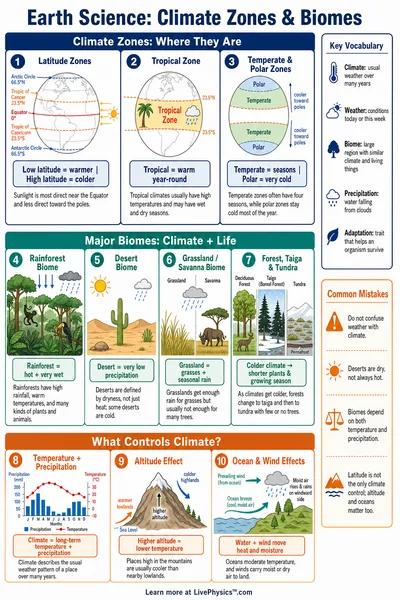
Above the Arctic Circle (about 66.5 degrees N) and below the Antarctic Circle (66.5 degrees S), the sun can stay above the horizon for a full 24 hours in summer (midnight sun or polar day) or remain below it all day in winter (polar night).
This happens mathematically when |cos(H)| exceeds 1 in the hour-angle formula, meaning no valid sunrise or sunset angle exists for that day.
The number of polar days and nights per year increases with latitude. At the North Pole itself, there is roughly six months of continuous daylight followed by six months of darkness.