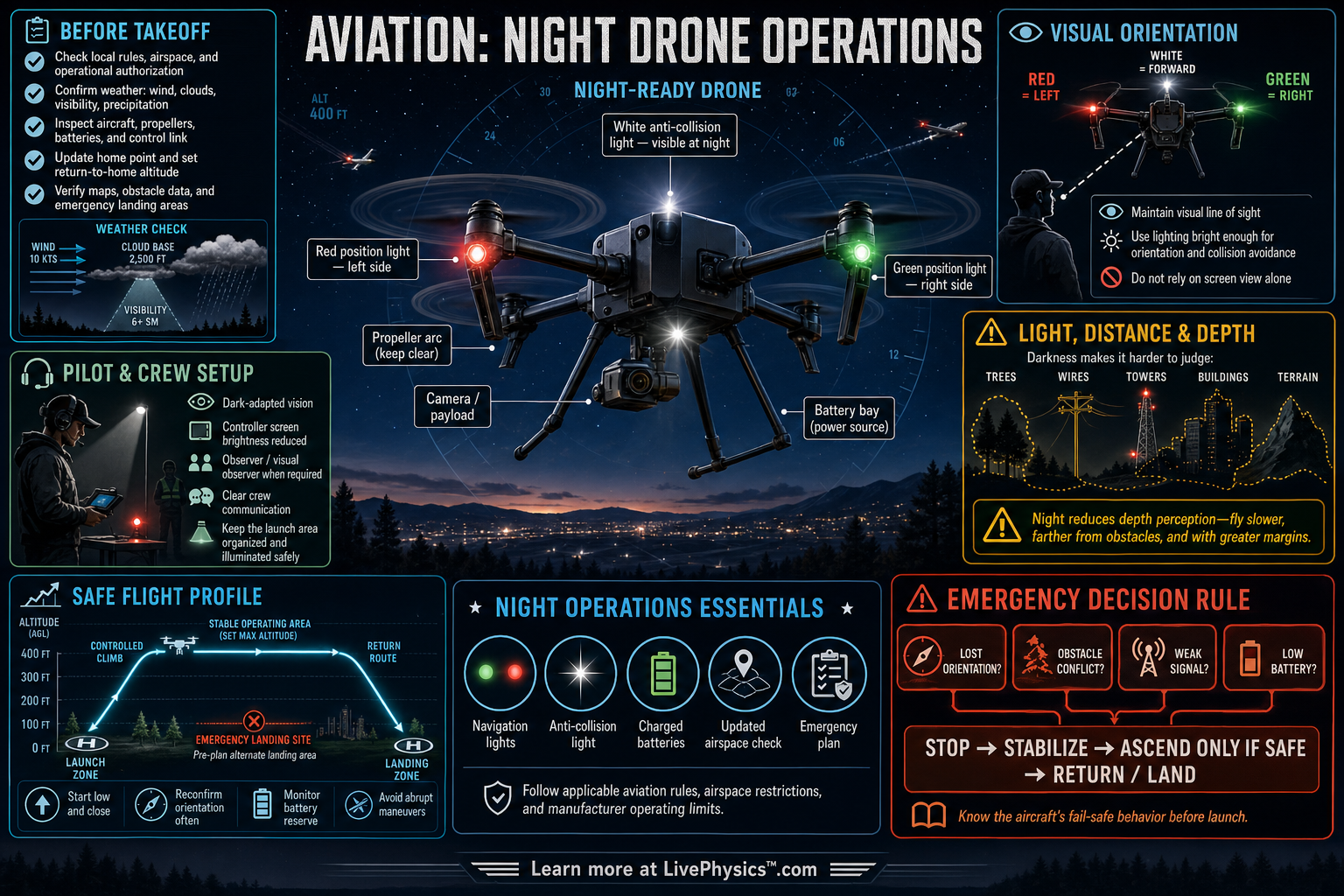
Night drone operations let pilots collect images, inspect infrastructure, and support public safety after daylight fades. They matter because darkness reduces visual detail and makes distance, speed, and obstacles harder to judge. A safe flight depends on a prepared aircraft, clear operating limits, and continuous awareness of the surrounding airspace.
A drone flying at night needs visible navigation lights and an anti-collision light that helps others detect it. In the United States, many Part 107 operations at night require the remote pilot to complete the required recurrent training and use an anti-collision light visible for at least 3 statute miles. The pilot must still keep the drone within visual line of sight and avoid creating a hazard to people, property, or other aircraft.
Understanding Aviation, Night Drone Operations
Human vision changes sharply after sunset. Color vision becomes weaker, while the eye becomes more sensitive to motion and bright points of light. This makes a drone light easy to notice but makes the drone body, thin wires, trees, and distant terrain difficult to see.
Depth perception suffers because familiar visual clues disappear. A pilot can mistake a nearby small light for a distant bright light. Night planning must account for these limits rather than assuming the aircraft camera shows everything the pilot needs.
Lighting has separate jobs. Navigation lights show orientation, with red commonly used on the left side and green on the right side. A white anti-collision strobe is designed to make the aircraft noticeable from a greater distance.
These lights help the pilot maintain orientation, but they do not make every obstacle visible. Bright lights can even reduce dark adaptation when they reflect from low clouds, haze, snow, or nearby surfaces. Pilots should check that lights work before takeoff and should know how each light appears from the ground.
Weather becomes more difficult to judge at night. Haze and thin clouds may be nearly invisible against a dark sky. Wind can increase after sunset near buildings, ridges, and water, even when conditions looked calm at launch.
Moisture can collect on propellers or camera lenses and reduce performance. Temperature matters because cold batteries deliver less usable energy. A conservative pilot uses a larger battery reserve, checks forecasts and local observations, then ends the mission early when visibility or wind becomes uncertain.
Airspace awareness is essential because crewed aircraft may operate low at night. Helicopters, medical flights, agricultural aircraft, and airplanes approaching airports can appear suddenly. The remote pilot should identify nearby airports, heliports, flight paths, and temporary flight restrictions before launch.
A visual observer can help scan the sky, track the drone, and warn the pilot about hazards. The remote pilot remains responsible for the operation and must yield to crewed aircraft. A camera view is useful for the mission, but it does not replace direct visual observation.
A good night mission begins with a written plan. Select a launch site with a clear view, safe footing, known obstacles, and little distracting light. Set a lower maximum altitude and shorter operating range when local conditions make visual tracking difficult.
Practice orientation close to the pilot before attempting complex routes. Focus on recognizing the drone light pattern, estimating distance cautiously, managing battery reserve, and using a clear return procedure. Follow the aviation rules that apply in the location of the flight, since requirements differ by country and operation type.
Key Facts
- Under FAA Part 107, night operations require recurrent training and an anti-collision light visible for at least 3 statute miles.
- Red navigation light is conventionally on the left side of an aircraft, while green is on the right side.
- The remote pilot must keep the drone within visual line of sight unless an authorized operation allows otherwise.
- Distance = speed × time
- Illuminance = luminous intensity / distance²
- Usable flight time at night should include a battery reserve for return, landing, and unexpected delays.
Vocabulary
- Anti-collision light
- A bright light, often flashing, that helps other people and aircraft detect an aircraft.
- Visual line of sight
- The ability of the remote pilot or visual observer to directly see the drone well enough to control it safely.
- Dark adaptation
- The process by which the eyes become more sensitive in low light after time away from bright light.
- Navigation light
- A colored light that indicates an aircraft's orientation and direction.
- Visual observer
- A person who helps the remote pilot watch the drone and surrounding airspace during a flight.
Common Mistakes to Avoid
- Relying only on the drone camera view is unsafe because a camera can miss aircraft, wires, and hazards outside its narrow field of view. Keep direct visual awareness of the drone and airspace.
- Assuming navigation lights make obstacles visible is wrong because the lights show the drone's position, not trees, wires, or terrain. Inspect the site in daylight when possible and set conservative boundaries.
- Using the same battery plan as a daytime flight is risky because cold temperatures and uncertainty can reduce usable flight time. Keep a larger reserve and return earlier.
- Flying toward bright streetlights or illuminated buildings can ruin dark adaptation and hide the drone. Choose a launch position with fewer glare sources and avoid staring at bright lights.
Practice Questions
- 1 A drone travels at 8 m/s for 45 s during a night mapping pass. Calculate the distance traveled in meters.
- 2 A pilot plans to fly 600 m away from the launch site at a ground speed of 10 m/s. Calculate the minimum one-way travel time in seconds, ignoring wind.
- 3 A drone remains visible on its outbound route but becomes hard to judge against city lights on its return route. Explain two changes the pilot should make before continuing the mission.