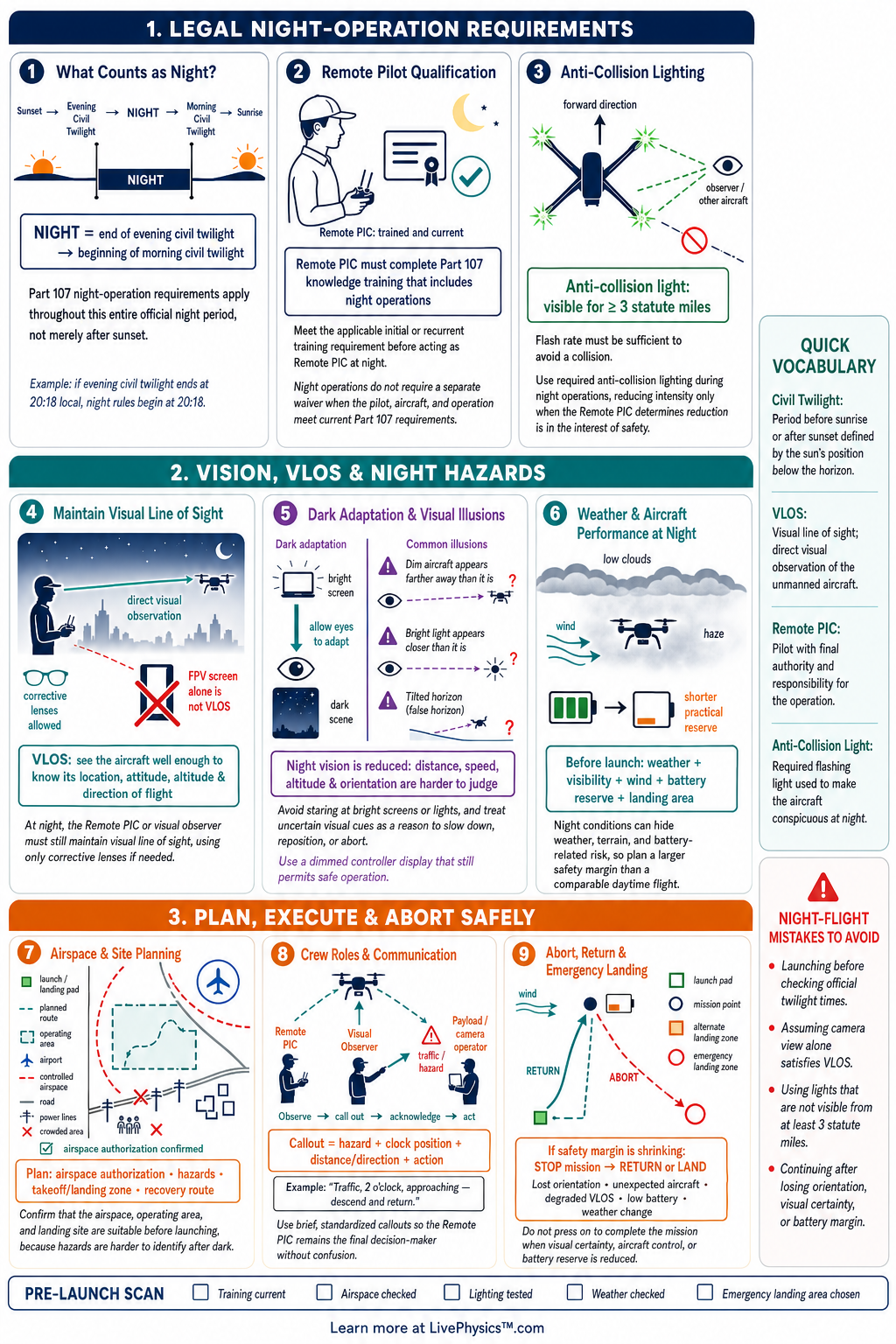
Part 107 allows qualified remote pilots to operate small unmanned aircraft at night when they meet specific FAA requirements. Night flights add risks because pilots have less visual detail, weaker depth perception, and more difficulty seeing hazards. This cheat sheet helps pilots organize the rules, equipment standards, and planning steps needed for safe night operations.
It is designed as a quick study and preflight reference for FAA Part 107 operations.
The central night-operation rule is found in section 107.29. The aircraft must use anti-collision lighting that is visible for at least 3 statute miles and flashes at a rate sufficient to avoid a collision. The remote pilot in command must still maintain visual line of sight, follow airspace rules, and conduct a careful risk assessment.
Operations during civil twilight also require anti-collision lighting.
Key Facts
- Under section 107.29, night operation requires anti-collision lighting visible for at least 3 statute miles.
- The anti-collision light must flash at a rate sufficient to avoid a collision.
- Night for this rule begins 30 minutes after official sunset and ends 30 minutes before official sunrise.
- Civil twilight operations require anti-collision lighting even though some natural light remains.
- The remote pilot in command may reduce anti-collision light intensity only when doing so does not create a hazard.
- Part 107 visual line of sight requires the remote pilot in command to see the aircraft well enough to know its location, attitude, altitude, and direction of flight.
- A small unmanned aircraft must remain at or below 400 feet above ground level unless it qualifies for the structure exception in Part 107.
- A remote pilot must obtain required FAA airspace authorization before operating in controlled airspace, including during night operations.
Vocabulary
- Anti-collision lighting
- Lighting on an aircraft that helps other people detect the aircraft and avoid a collision.
- Civil twilight
- The period before sunrise and after sunset when natural light is present but anti-collision lighting is required for Part 107 operations.
- Remote pilot in command
- The certificated remote pilot who has final responsibility for the safety and legality of a drone operation.
- Visual line of sight
- The ability to see the unmanned aircraft directly and clearly enough to control it safely and detect hazards.
- Statute mile
- A standard land-distance mile equal to 5,280 feet and used in the Part 107 lighting visibility requirement.
- Controlled airspace
- Airspace where FAA authorization is generally required before a Part 107 drone flight can occur.
Common Mistakes to Avoid
- Assuming a drone's standard navigation lights meet the rule is wrong because Part 107 requires anti-collision lighting visible for at least 3 statute miles.
- Flying after sunset without checking civil twilight is wrong because anti-collision lighting is required during civil twilight, not only during the full night period.
- Using a bright light that ruins the pilot's night vision is unsafe because glare can make it harder to see the aircraft, obstacles, and other aircraft.
- Treating a visual observer as a replacement for the remote pilot is wrong because the remote pilot in command remains responsible for visual line of sight and operational safety.
- Skipping an airspace check at night is wrong because controlled-airspace authorization requirements apply at night just as they do during daytime operations.
Practice Questions
- 1 A pilot plans to fly 45 minutes after official sunset. What lighting requirement applies to the unmanned aircraft under section 107.29?
- 2 An anti-collision light is visible for 2.5 statute miles. Does it meet the Part 107 night-operation visibility requirement, and by how many statute miles does it fall short?
- 3 Official sunset is at 7:20 p.m. At what time does the Part 107 night period begin for the purpose of section 107.29?
- 4 Explain why a pilot may need to cancel a night flight even when the aircraft has compliant anti-collision lighting.
Understanding Night Operations Under Part 107
Night operations under Part 107 require more planning than daytime flights. Darkness can hide trees, wires, people, buildings, and changes in terrain. A pilot may also have trouble judging an aircraft's distance, altitude, direction, and speed.
Bright ground lights can create glare, while dark areas can make obstacles nearly invisible. Good night operations begin with a detailed site survey completed before conditions become too dark.
Section 107.29 applies from 30 minutes after official sunset until 30 minutes before official sunrise. During this period, the small unmanned aircraft must have anti-collision lighting visible for at least 3 statute miles. The light must flash at a rate sufficient to help avoid a collision.
The remote pilot in command may reduce the light intensity if the reduced intensity does not create a hazard. For example, a very bright light might interfere with the pilot's ability to see the aircraft or surrounding area safely.
Civil twilight is the period around sunrise and sunset when some natural light remains. Part 107 requires anti-collision lighting during civil twilight as well. Civil twilight begins before sunrise and continues after sunset, based on official published times.
Pilots should check local sunrise, sunset, and twilight information before every flight. These times can differ by location and date, so estimates are not enough for a professional operation.
The lighting requirement does not replace the visual line of sight rule. The remote pilot in command must be able to see the aircraft well enough to know its location, attitude, altitude, and direction of flight. The pilot must also watch for other aircraft and potential hazards.
A visual observer can help scan the airspace and monitor the flight area, but the remote pilot remains responsible for the operation. If the aircraft cannot be seen clearly and safely, the pilot must adjust the operation or land.
Night flights often occur near city lights, events, construction sites, inspections, or emergency scenes. These environments can contain distracted people, moving vehicles, cranes, power lines, and manned aircraft. Pilots should establish a launch and recovery area, identify emergency landing locations, set a conservative flight boundary, and brief all crew members.
They should confirm airspace authorization when operating in controlled airspace. Strong preparation, reliable lighting, battery planning, and conservative decisions make night operations safer and more compliant.