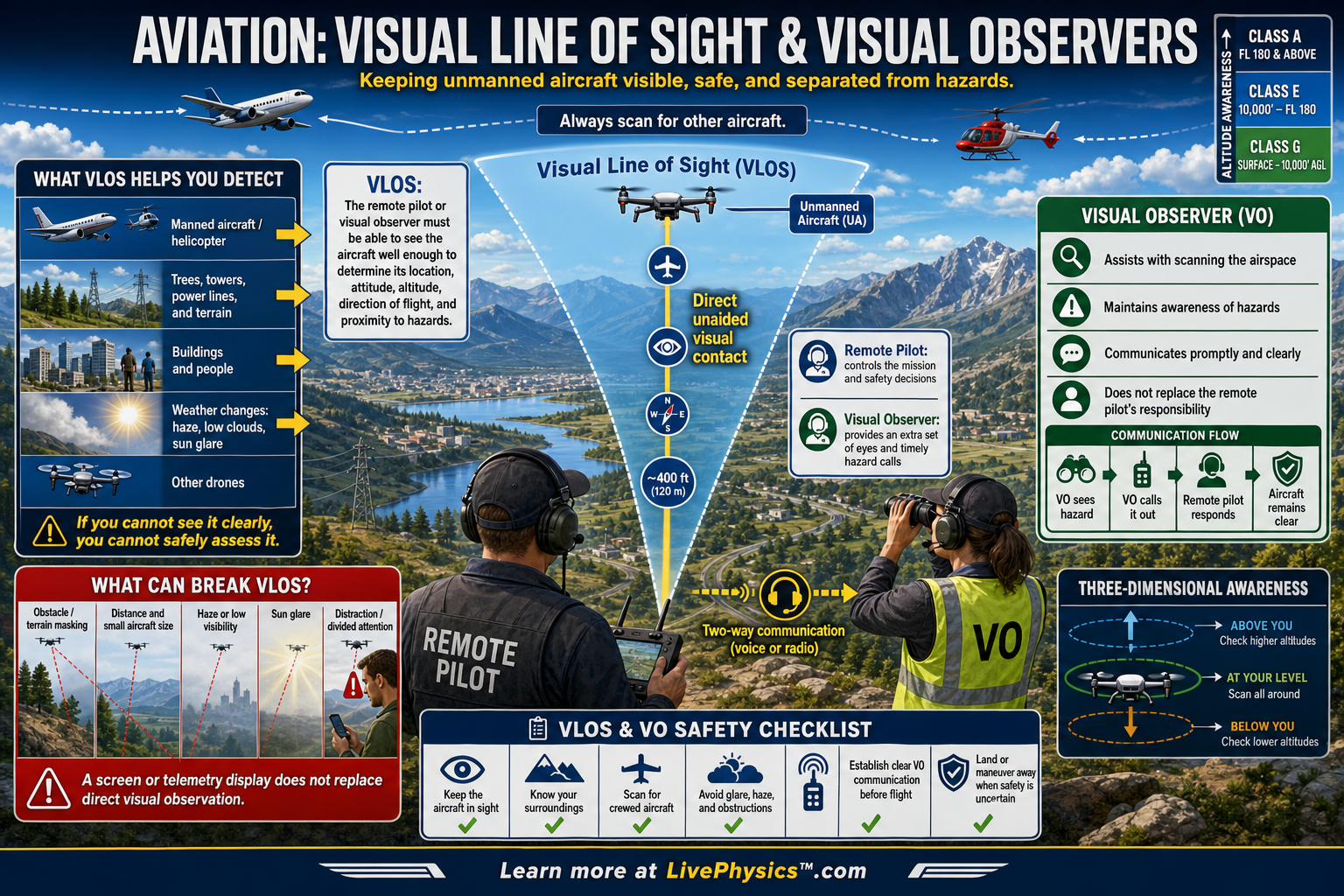
Visual line of sight, often called VLOS, means keeping a drone in direct unaided visual contact during flight. The pilot must be able to see the aircraft well enough to judge where it is, which way it is moving, and whether it could create a hazard. This basic rule helps pilots detect people, buildings, power lines, birds, and other aircraft before a collision occurs.
A live camera feed is useful, but it does not by itself satisfy visual line of sight.
A visual observer is a person who helps the remote pilot monitor the airspace and the drone. The observer can scan for hazards while the pilot focuses on aircraft control, but clear communication is essential. In United States Part 107 operations, the remote pilot in command remains responsible for the safety of the flight.
The pilot must plan the operation so that the aircraft stays visible under the actual weather, lighting, terrain, and background conditions.
Understanding Aviation, Visual Line of Sight and Visual Observers
Visual line of sight is more than being able to spot a small dot in the sky. The person watching the drone needs enough detail to determine its location, altitude, attitude, and direction of travel. They must recognize nearby hazards in time to respond.
A drone can blend into clouds, trees, dark ground, or a bright sun. Its visibility can change quickly as it moves farther away.
There is no single legal distance that guarantees VLOS in every situation. The safe distance depends on the aircraft size, lighting, weather, terrain, visual clutter, and the observer's eyesight.
Direct unaided visual contact means the drone is viewed with the natural eye, although ordinary corrective lenses are allowed. Binoculars, telescopes, and a first person view camera cannot replace this requirement. These tools narrow the field of view or show only one camera angle.
They can hide an approaching aircraft, a person entering the area, or a change in the drone's position. A screen can support safe flight by showing battery status, map position, and camera images. It should not become the only source of awareness when the operation requires VLOS.
A visual observer works as part of a small flight crew. Before takeoff, the remote pilot should explain the planned route, maximum altitude, landing area, likely hazards, and the words used for urgent calls. Short reports are best.
An observer might call out a helicopter approaching from the west, a person near the landing zone, or a drone moving behind a tree line. The remote pilot decides what action to take, such as landing, descending, or moving away. The observer should stay where communication is reliable and where their own view is not blocked by vehicles, structures, or terrain.
Students often meet these ideas when flying a small camera drone for photography, mapping, inspections, or school projects. A map may show an open field, yet the real site can contain poles, changing light, wildlife, and people. Hills and tree lines matter because they can block both the controller signal and the observer's sight.
Flights near airports need special care because crewed aircraft may arrive quickly and have priority. Good preflight planning includes selecting a visible operating area, checking weather and airspace, setting a conservative distance, and identifying a clear response for lost sight of the drone.
When learning VLOS, focus on observation rather than memorizing one distance number. Practice estimating direction, height, and distance using familiar landmarks. Notice how a drone becomes harder to see against different backgrounds.
Keep the aircraft close enough to identify its orientation, not merely its location. Use a visual observer when the task increases workload or when a second set of eyes improves hazard detection. If the drone cannot be seen clearly, the safe response is to stop expanding the flight and regain a safe visual situation.
Key Facts
- VLOS = direct unaided visual contact with the drone.
- Safe VLOS = ability to determine location, altitude, attitude, and direction of flight.
- FPV camera view ≠ visual line of sight.
- Corrective lenses are allowed, but binoculars cannot replace direct visual observation.
- Flight crew awareness = pilot observation + visual observer reports + preflight planning.
- Remote pilot in command responsibility = final responsibility for safe operation.
Vocabulary
- Visual line of sight
- The ability to see a drone directly well enough to know its position, movement, and potential hazards.
- Visual observer
- A person who assists the remote pilot by watching the drone and surrounding airspace for hazards.
- Remote pilot in command
- The person with final authority and responsibility for the safe operation of a drone flight.
- Unaided visual contact
- Viewing an aircraft with the natural eye, with normal corrective lenses permitted when needed.
- Situational awareness
- An accurate understanding of the aircraft, airspace, environment, and hazards during a flight.
Common Mistakes to Avoid
- Treating a camera screen as a substitute for VLOS. A screen has a limited view and may not reveal hazards approaching from outside the camera frame.
- Flying until the drone is only a tiny speck. Seeing a speck does not mean the pilot can determine the drone's orientation or direction of movement.
- Using a visual observer without a communication plan. The observer must be able to give prompt, clear reports that the pilot can understand and act on.
- Assuming an open area always provides clear sight. Sun glare, haze, trees, terrain, and background clutter can quickly hide a drone in an otherwise open location.
Practice Questions
- 1 A drone is flying 120 feet above level ground. If the angle of elevation from the pilot to the drone is 30 degrees, what is the horizontal distance from the pilot to the point directly below the drone? Use tan 30 degrees = 0.577.
- 2 A drone is 100 feet above the ground and 300 feet horizontally from a visual observer. What is the straight line distance from the observer to the drone? Round to the nearest foot.
- 3 A drone remains visible as a small dot against a bright cloud layer, but the pilot can no longer tell which direction its nose is pointing. Explain why this condition does not provide adequate visual line of sight and describe a safe pilot response.