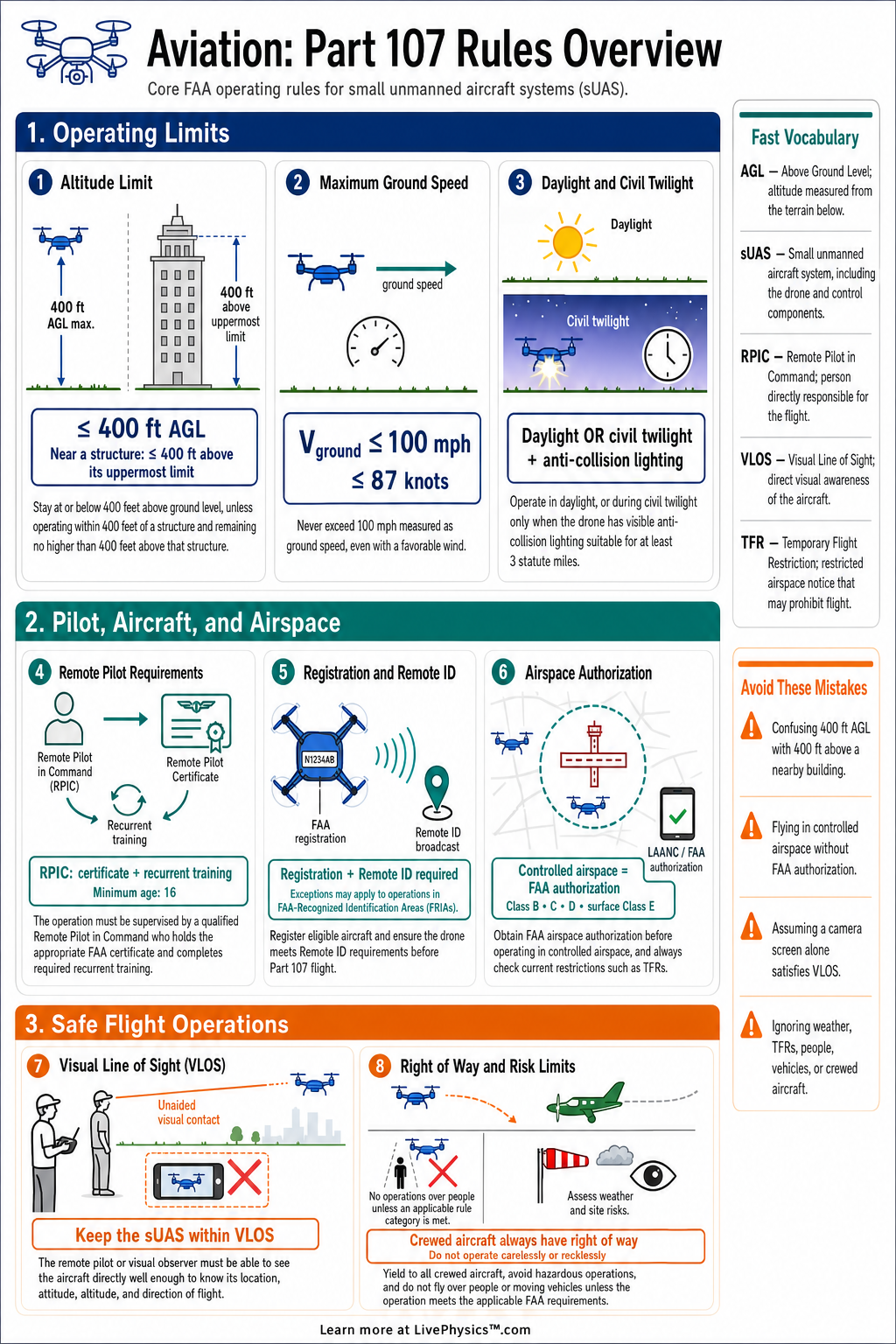
FAA Part 107 rules govern most commercial and nonrecreational small drone operations in the United States. Students preparing for the Remote Pilot knowledge test need to know these rules because safe flight decisions depend on applying them correctly. This cheat sheet organizes the most tested operating limits, pilot responsibilities, and airspace requirements.
It is designed as a quick reference for review before a flight or exam.
Part 107 applies to unmanned aircraft that weigh less than 55 pounds at takeoff. The remote pilot in command is responsible for the operation, even when another person is handling the controls. Key limits include a maximum groundspeed of 100 miles per hour and a maximum altitude of 400 feet above ground level in most situations.
Pilots must also understand visual line of sight, daylight operations, controlled airspace authorization, and rules for flying near people, vehicles, and airports.
Key Facts
- Part 107 applies to small unmanned aircraft systems that weigh less than 55 pounds at takeoff.
- The maximum permitted groundspeed under Part 107 is 100 miles per hour.
- The normal maximum altitude is 400 feet above ground level.
- A drone may fly up to 400 feet above the top of a structure when it remains within a 400 foot horizontal radius of that structure.
- Minimum flight visibility from the control station is 3 statute miles.
- A drone must remain at least 500 feet below clouds and 2,000 feet horizontally from clouds.
- The remote pilot in command must maintain visual line of sight through direct vision by the pilot or visual observer.
- Operations in Class B, Class C, Class D, and surface Class E airspace require FAA authorization before flight.
Vocabulary
- Remote Pilot in Command
- The certificated person with final responsibility and authority for a Part 107 drone operation.
- Visual Line of Sight
- The ability of the remote pilot or visual observer to see the drone well enough to control and avoid hazards.
- Above Ground Level
- A height measurement taken from the surface of the ground directly below the aircraft.
- Controlled Airspace
- Airspace where air traffic control services apply and drone operations may require FAA authorization.
- Civil Twilight
- The period before sunrise and after sunset when the sun is no more than 6 degrees below the horizon.
- Waiver
- FAA permission to conduct an operation that does not meet a specific standard Part 107 rule.
Common Mistakes to Avoid
- Confusing 400 feet above ground level with 400 feet above sea level is wrong because Part 107 normally measures the altitude limit from the ground below the drone.
- Assuming a camera view satisfies visual line of sight is wrong because the pilot or visual observer must use direct vision to track the aircraft and hazards.
- Flying into controlled airspace without authorization is wrong because Class B, C, D, and surface Class E areas require FAA approval before the operation.
- Treating the 100 mile per hour limit as airspeed is wrong because Part 107 states the maximum as groundspeed.
- Assuming every flight over people is prohibited or automatically allowed is wrong because Part 107 permits only certain operations over people when specific category requirements are met.
Practice Questions
- 1 A drone is operating in open Class G airspace. What is its maximum normal altitude above ground level under Part 107?
- 2 A drone is inspecting a 600 foot tower and stays within 400 feet horizontally of the tower. What is the highest altitude it may fly above the tower top under the structure exception?
- 3 A remote pilot reports 2 statute miles of flight visibility at the control station. Does this meet the standard Part 107 weather minimum?
- 4 Explain why checking airspace and temporary flight restrictions before a flight is necessary even when the drone will remain below 400 feet above ground level.
Understanding Part 107 Rules Overview
Part 107 is the Federal Aviation Administration rule set for operating small unmanned aircraft systems for work, business, public safety, education, and many other nonrecreational purposes. A small unmanned aircraft must weigh less than 55 pounds at takeoff, including its payload. The person who holds the remote pilot certificate is called the remote pilot in command.
This person has final authority over the flight and must make sure the aircraft is safe to operate. A visual observer may help, but the remote pilot remains responsible.
The standard operating limits are central to the knowledge test. The drone may not fly faster than 100 miles per hour groundspeed. It normally may not fly higher than 400 feet above ground level.
An important exception allows flight within 400 feet above the top of a structure, provided the drone stays within a 400 foot horizontal radius of that structure. This rule lets pilots inspect tall towers and buildings while keeping the aircraft close to the object. Pilots must still avoid hazards and comply with airspace restrictions.
Visual line of sight means the remote pilot or visual observer must be able to see the drone throughout the operation without relying only on a camera feed. They need enough visual awareness to determine the drone's position, altitude, direction, and relation to other aircraft or obstacles. Standard operations occur during daylight or civil twilight with proper anti collision lighting.
Weather also matters. Minimum flight visibility is 3 statute miles from the control station, and the drone must stay at least 500 feet below clouds and 2,000 feet horizontally from clouds.
Airspace knowledge prevents conflicts with crewed aircraft. Operations in Class B, Class C, Class D, and the surface area of Class E airspace require FAA authorization before flight. Many pilots request authorization through the Low Altitude Authorization and Notification Capability system.
Class G airspace generally does not require prior FAA airspace authorization, but all other Part 107 rules still apply. A pilot must review sectional charts, temporary flight restrictions, notices to air missions, and local conditions before each operation.
Part 107 also places strong attention on risk management. The remote pilot must inspect the drone and control station before flight. Operations over people or moving vehicles have specific categories and conditions, so pilots cannot assume these flights are always allowed.
The drone must yield right of way to all aircraft. Alcohol, drugs, fatigue, distraction, and poor maintenance can make an otherwise legal flight unsafe. When a planned operation does not meet a standard rule, the pilot may need an FAA waiver rather than simply proceeding.