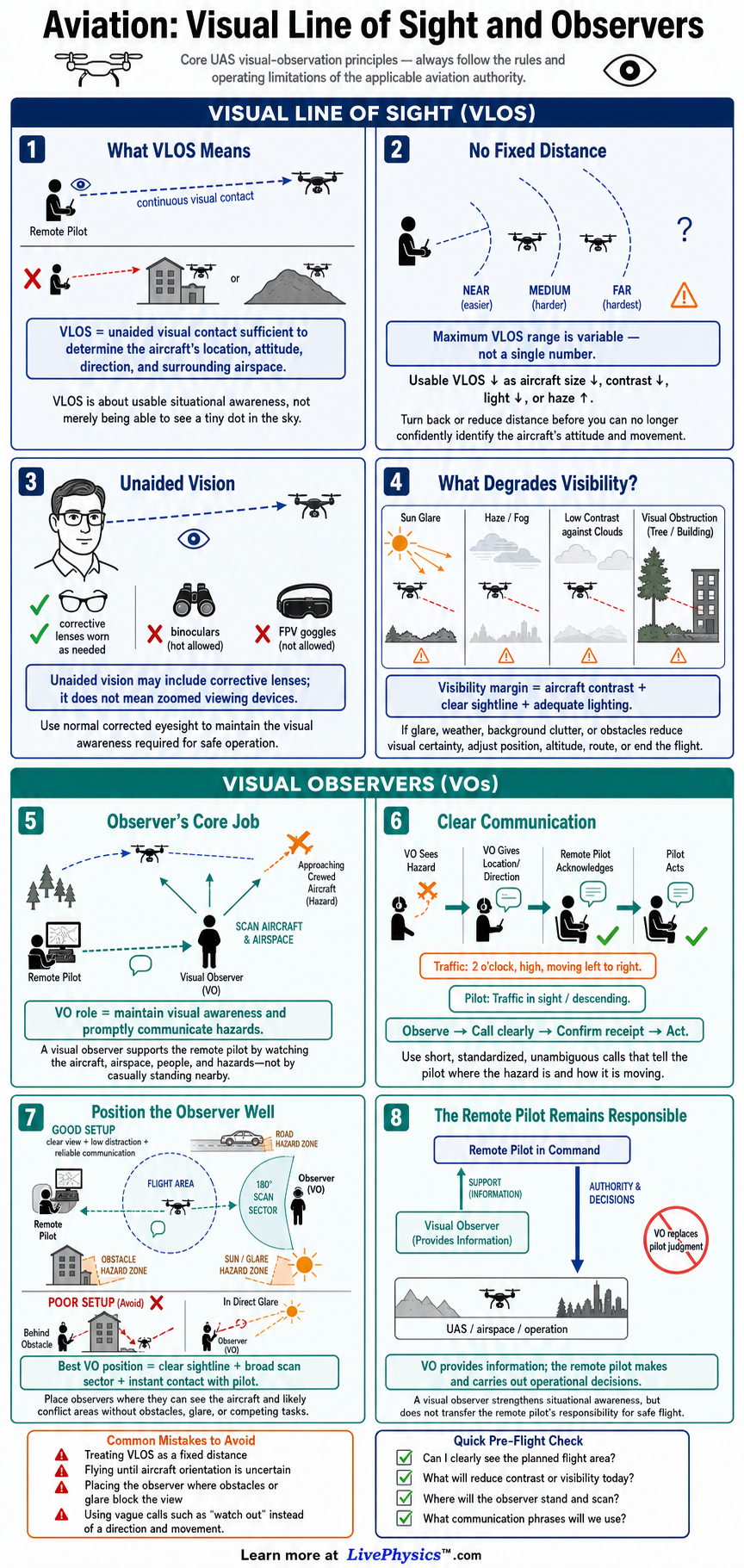
Visual line of sight is a core safety requirement in many uncrewed aircraft operations. It means the remote pilot or visual observer can directly see the aircraft well enough to judge its position, direction, altitude, and movement. This cheat sheet helps students understand the practical duties behind that simple phrase.
It also separates good operational practice from assumptions based only on a camera view or map display.
A visual observer supports the remote pilot by watching the aircraft and the surrounding airspace. The observer looks for hazards, other aircraft, people, obstacles, and changing conditions that may affect the flight. Clear communication between the observer and remote pilot is essential.
Local aviation rules and the approved operating category always determine whether an observer is required and what procedures apply.
Key Facts
- Visual line of sight means maintaining direct unaided visual contact sufficient to determine the aircraft’s position, direction, altitude, and movement.
- A first person view camera feed does not replace direct visual observation when an operation requires visual line of sight.
- The remote pilot must maintain safe control of the aircraft and respond promptly to hazards reported by a visual observer.
- A visual observer should scan the aircraft, surrounding airspace, people, obstacles, and weather rather than stare only at the aircraft.
- The crew should establish communication procedures before takeoff, including hazard calls, acknowledgments, and a lost-communication action.
- If glare, haze, distance, terrain, or obstacles prevent reliable visual judgment, the flight should be reduced, paused, or ended.
- The allowed use and number of visual observers depend on the applicable aviation authority rules and approved operating procedure.
Vocabulary
- Visual line of sight
- Direct visual contact that lets a person judge an aircraft’s position, direction, altitude, and movement safely.
- Visual observer
- A crewmember who helps the remote pilot detect aircraft, obstacles, people, and other hazards.
- Remote pilot
- The person responsible for operating an uncrewed aircraft and conducting the flight safely.
- First person view
- A live camera view from an aircraft that shows what the aircraft camera sees.
- Situational awareness
- An accurate understanding of the aircraft, environment, hazards, and conditions affecting a flight.
- Sterile operating area
- An area and period in which crew members avoid unnecessary distractions and focus on flight safety.
Common Mistakes to Avoid
- Treating a camera feed as visual line of sight is wrong because a camera can hide hazards outside its field of view and may not show aircraft orientation clearly.
- Using an observer only to watch the video screen is wrong because the observer must scan the surrounding airspace and operating area for hazards.
- Flying until the aircraft becomes a barely visible dot is wrong because safe visual contact requires more than knowing the general direction of the aircraft.
- Giving vague calls such as watch out is wrong because the remote pilot needs the hazard location, movement, and required action to respond quickly.
- Assuming an observer makes unlimited distance acceptable is wrong because observer use must follow the applicable rules and maintain effective communication.
Practice Questions
- 1 A drone is 400 metres away and becomes difficult to distinguish from a bright cloud background. State two actions the remote pilot should take.
- 2 An observer sees a helicopter approaching from the west while the drone is flying at 60 metres. Write a short, clear hazard call and an appropriate pilot response.
- 3 During a flight, a building blocks the observer’s direct view of the drone for 15 seconds. Explain why relying only on the live camera feed may not satisfy a visual line of sight requirement.
- 4 Explain why a visual observer should scan the whole operating environment instead of watching only the uncrewed aircraft.
Understanding Visual Line of Sight and Observers
Visual line of sight, often shortened to VLOS, means direct unaided visual contact with an aircraft. The pilot or observer must be able to see enough detail to control the aircraft safely. Seeing a small dot in the sky is not always enough.
The person watching needs to judge the aircraft’s location, flight path, attitude, and possible conflict with obstacles or other air traffic. Corrective lenses are normally acceptable when they are needed for normal vision. Binoculars, cameras, and video goggles do not replace the required direct view when a rule requires VLOS.
VLOS becomes harder as distance increases. Small aircraft can blend into clouds, terrain, buildings, or bright sunlight. Their orientation can become unclear, especially when they are flying toward or away from the observer.
Wind can also move an aircraft farther than expected. Before launch, the crew should choose a position with a clear view of the operating area.
They should consider trees, poles, rooflines, glare, haze, and the direction of the sun. A planned flight area may look open on a map but still have poor visibility from ground level.
A visual observer is a crewmember who assists the remote pilot. The observer’s main job is usually to scan for hazards and report them quickly. The remote pilot remains responsible for the safe conduct of the flight unless a specific rule says otherwise.
The observer should not become distracted by a phone, spectators, or the aircraft video feed. A strong observer watches the whole environment, then returns attention to the aircraft. This scanning pattern helps detect approaching aircraft, people entering the area, moving vehicles, birds, and changing weather.
Communication must be brief, clear, and understood. The crew should agree on simple words before flight, such as aircraft left, aircraft right, descending, manned aircraft, stop, and land. A report should identify the hazard, its direction, and the action needed.
For example, an observer may report that an aircraft is approaching from the north and that the drone should descend and land. The remote pilot should acknowledge important calls. If communication fails, the crew should use the preplanned response, which may include pausing the mission or landing.
Observers do not extend the aircraft’s range without limit. The aircraft must remain within the required visual condition for the operation, and the crew must maintain effective communication. Some operations permit multiple observers or special procedures, while others have stricter limits.
Students should learn the rules that apply in their country and operating category. Good VLOS practice combines legal compliance, careful site selection, active scanning, conservative decisions, and a willingness to stop a flight when visual control is reduced.