Angle of Elevation & Depression Visualizer
Solve real-world right-triangle problems with angles of elevation and depression. Enter any two of the horizontal distance, height, line of sight, or angle and see the scaled scene and worked steps.
Set up the problem
Results
Worked steps
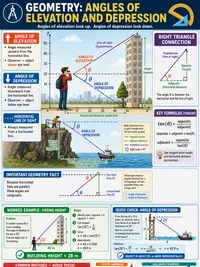
Angle of elevation vs depression
The line of sight is the straight path from the observer's eye to the object. The horizontal is a level line through the observer's eye.
Angle of elevation. Measured upward from the horizontal when the observer looks up at a higher object, such as the top of a building or a flying kite.
Angle of depression. Measured downward from the horizontal when the observer looks down at a lower object, such as a boat seen from a cliff top.
Which ratio to use
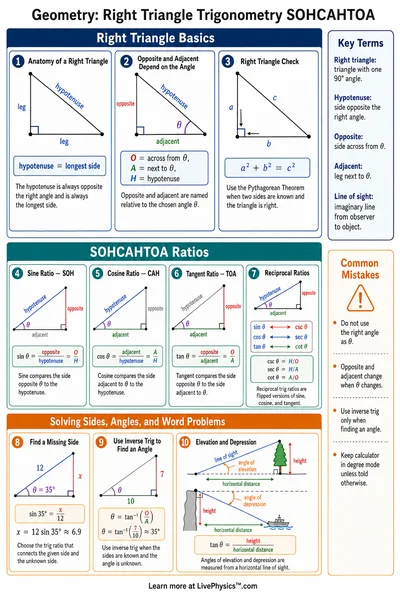
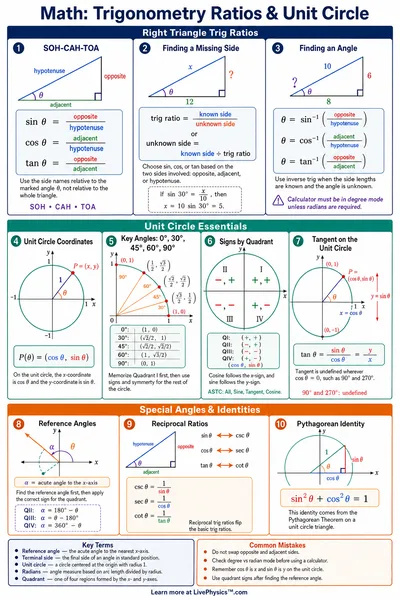
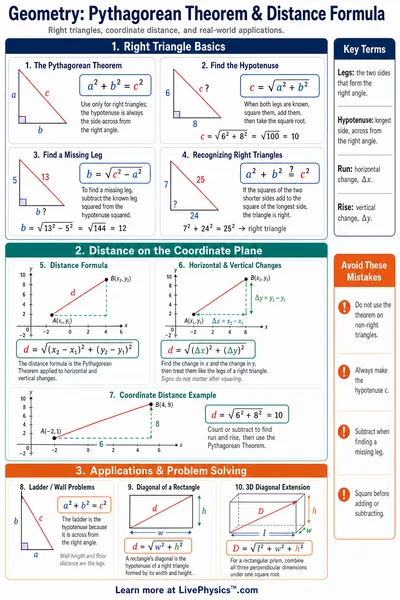
The right triangle has a horizontal leg d, a vertical leg h, a hypotenuse L (the line of sight), and the angle θ at the observer.
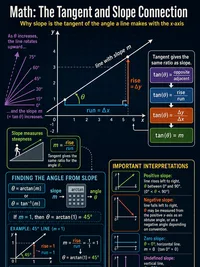
- Know d and θ, or h and θ. Use tan θ = h / d.
- Know a side and L with the angle. Use sin θ = h / L or cos θ = d / L.
- Know both legs d and h. Find θ = tan⁻¹(h / d) and L from the Pythagorean theorem.
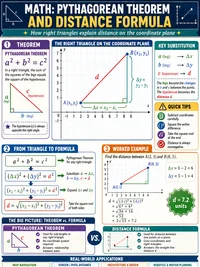
- Know two sides. The third comes from d² + h² = L².
The elevation equals the depression
The angle of elevation from point A up to point B equals the angle of depression from point B down to point A.
The horizontal at A and the horizontal at B are parallel, and the line of sight is a transversal cutting both. The two angles are alternate interior angles, so they are equal. This lets you swap viewpoints in a problem without recomputing the angle.
Worked examples
- Building. Stand 50 m from a building with an elevation angle of 30°. The height is h = 50 tan 30° ≈ 28.87 m.
- Kite. A kite is 30 m up with a string angle of 40°. The string length is L = 30 / sin 40° ≈ 46.67 m.
- Boat. From a cliff the line of sight to a boat is 100 m at a 25° depression. The horizontal distance is d = 100 cos 25° ≈ 90.63 m.
Reference Guide
Angle of elevation and depression problems are applied right-triangle trigonometry. The observer, the object, the horizontal, and the line of sight form a right triangle. Choose the trig ratio that connects what you know to what you want.
tan θ = h / d
Relates the two legs. Use it when the horizontal distance and the height are the quantities in play, or to recover the angle from both legs.
sin θ = h / L
Relates the height to the line of sight. Use it when the hypotenuse and the vertical height are involved.
cos θ = d / L
Relates the horizontal distance to the line of sight. Use it for the adjacent leg and the hypotenuse.
To find an unknown angle from two sides, apply the inverse function, for example θ = tan⁻¹(h / d). When two sides are known the third follows from d² + h² = L². This tool is the applied, real-world framing of right-triangle trigonometry, distinct from the abstract SOH CAH TOA solver.