Sign in to save

Bookmark this page so you can find it later.

Sign in to save

Bookmark this page so you can find it later.

Math middle-school May 24, 2026

Why Does a Negative Times a Negative Equal a Positive?

A rule that keeps number systems consistent
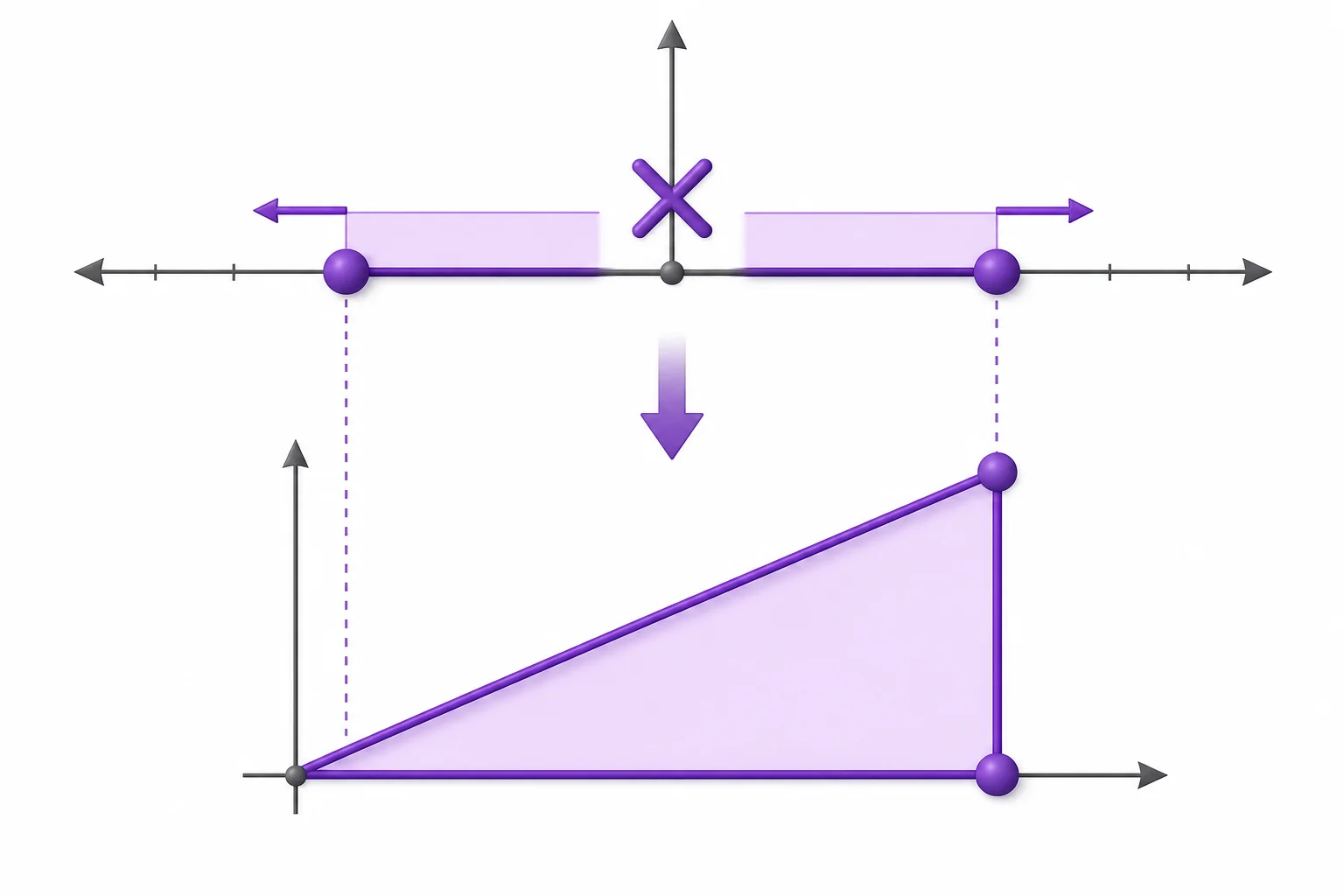
A number line showing negative and positive directions with multiplication arrows that reverse direction.

A negative number can mean the opposite of a quantity. Multiplying by a negative means taking the opposite direction or the opposite action. The opposite of a negative amount is positive.

Big Idea. Common Core 7.NS.A.2 asks students to understand multiplication and division of rational numbers, including why a negative times a negative is positive.

The rule $(-3)(-4)=12$ can feel strange at first. It is easy to picture three groups of four, but it is harder to picture negative groups of negative four. The key is that multiplication must follow the same rules for all numbers, not just counting numbers. If one rule worked for positives and a different rule worked for negatives, algebra would break. The distributive law gives a clean reason. So does a number line model, where a negative multiplier reverses direction. A debt model also helps, because removing debt raises a balance. These are not separate tricks. They point to the same idea. Negative signs act like opposites. Two opposite changes can bring you back to a positive direction or amount. This article connects the rule to Common Core 7.NS and to the reasoning students use later in algebra.

Start with patterns
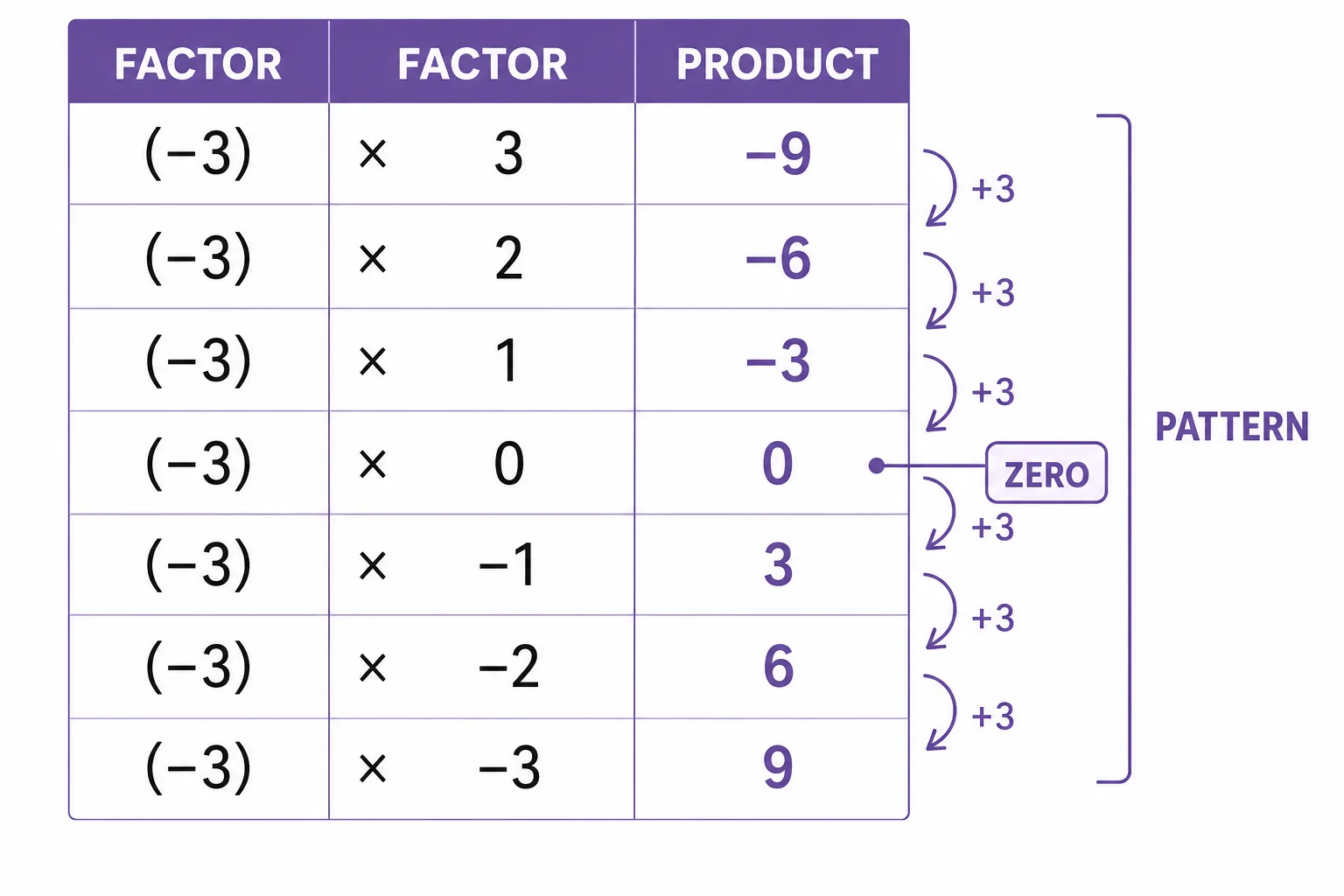
A table showing the pattern of multiplying negative three by numbers from three down to negative three.
The product pattern continues through zero.
A good first step is to watch a pattern. Keep the first factor at $-3$ and count the second factor down by 1. The products go $(-3)(3)=-9$, $(-3)(2)=-6$, $(-3)(1)=-3$, and $(-3)(0)=0$. Each time the second factor drops by 1, the product increases by 3. To keep the pattern going, $(-3)(-1)$ must be 3. Then $(-3)(-2)$ must be 6, and $(-3)(-3)$ must be 9. This is not guessing. It is using the same steady change that multiplication already has. If the products suddenly stopped increasing by 3 at zero, multiplication would lose its pattern. Middle school math often builds rules this way. A rule is trusted when it fits the patterns and still agrees with older facts.

The rule fits a steady multiplication pattern.

Use the distributive law
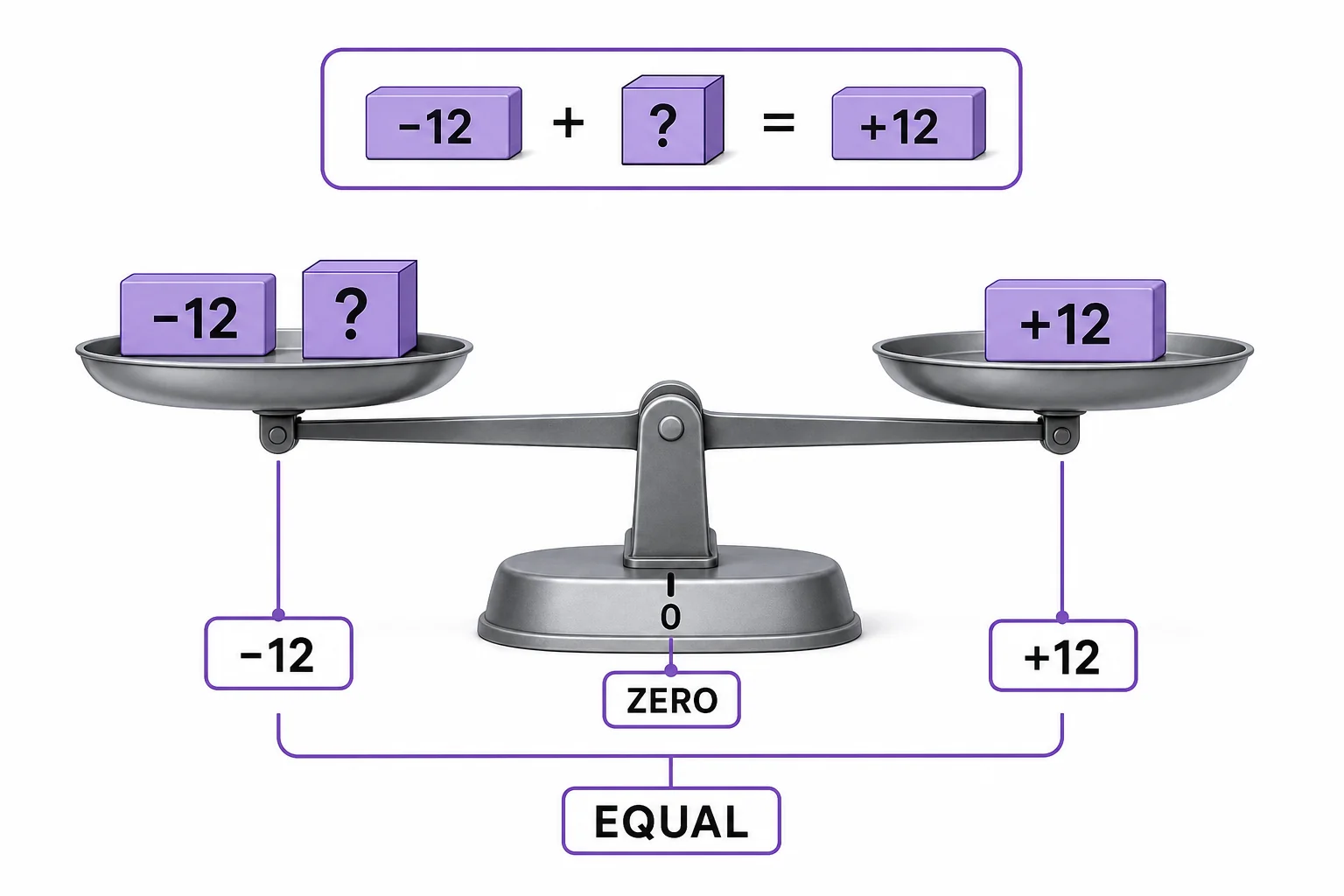
A balance diagram showing negative twelve plus an unknown product equaling zero, so the unknown product is positive twelve.
The distributive law forces the answer.
The distributive law says that multiplying a number by a sum gives the same answer as multiplying each part and adding the results. This law already works for positive numbers. We want it to keep working for negatives too. Start with zero written as $4+(-4)$. Multiplying by $-3$ gives $(-3)(4+(-4))$. Since the part inside equals zero, the whole product equals zero. The distributive law says this is also $(-3)(4)+(-3)(-4)$. We already know $(-3)(4)=-12$. So $-12+(-3)(-4)=0$. The only number that makes that true is 12. That means $(-3)(-4)=12$. This proof is powerful because it does not depend on a picture. It depends on keeping one basic property of arithmetic true for all numbers.

If the distributive law stays true, a negative times a negative must be positive.

Reverse on a number line
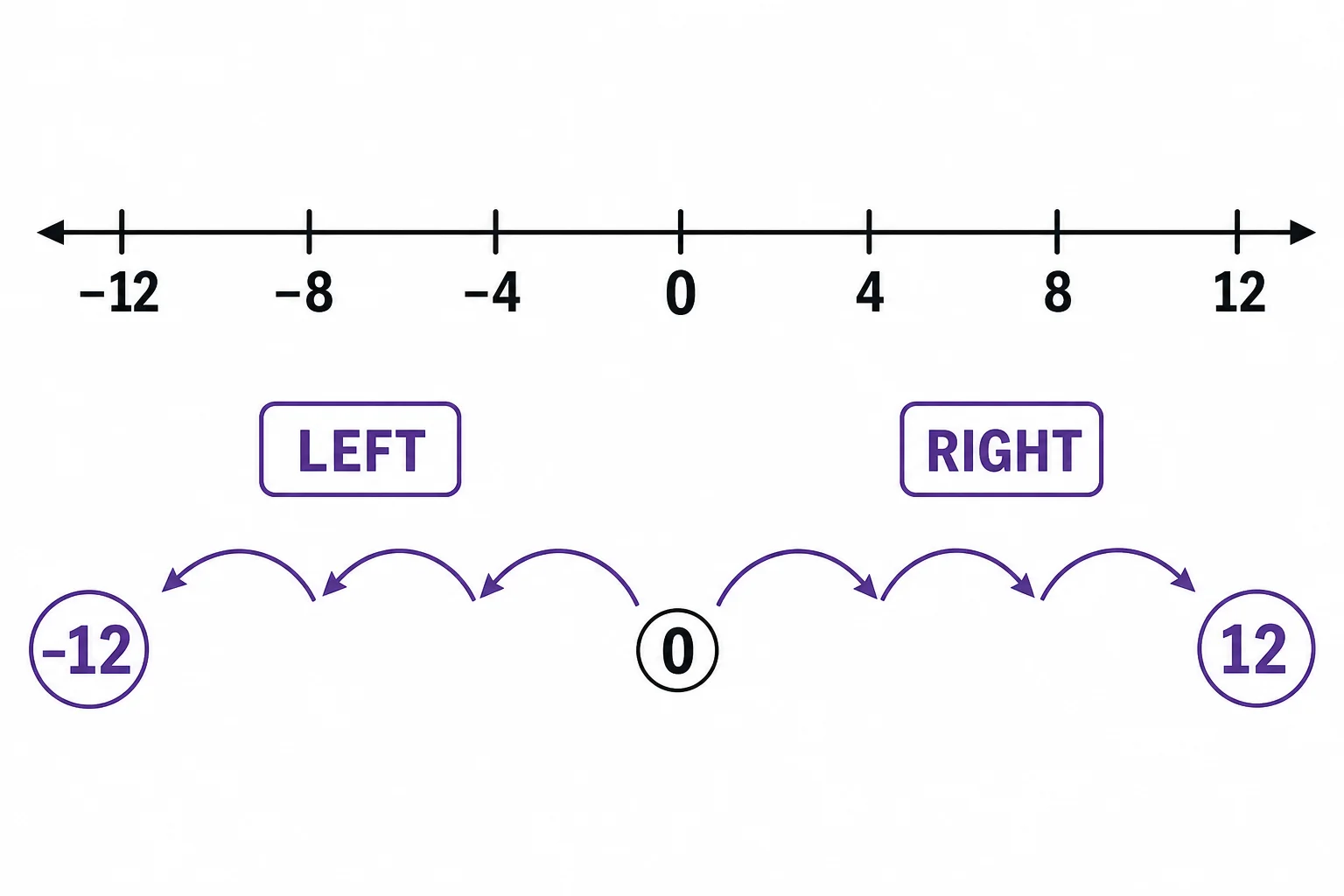
A number line showing three leftward steps for three times negative four and three rightward steps for negative three times negative four.
A negative multiplier reverses direction.
A number line gives another model. Think of multiplying by a positive number as repeating steps in the same direction. For example, $3(-4)$ means three steps of negative four. You move left 4, left 4, and left 4, ending at negative 12. A negative multiplier changes the action. It means take the opposite of those repeated steps. So $-3(-4)$ means the opposite of three steps left by 4. The opposite of moving left is moving right. Three steps of 4 to the right lands at 12. This model helps explain why the sign changes. It is not that two minus signs disappear. Each negative sign has a job. One marks a leftward quantity. The other reverses the action.

Multiplying by a negative means taking the opposite.

Connect it to debt
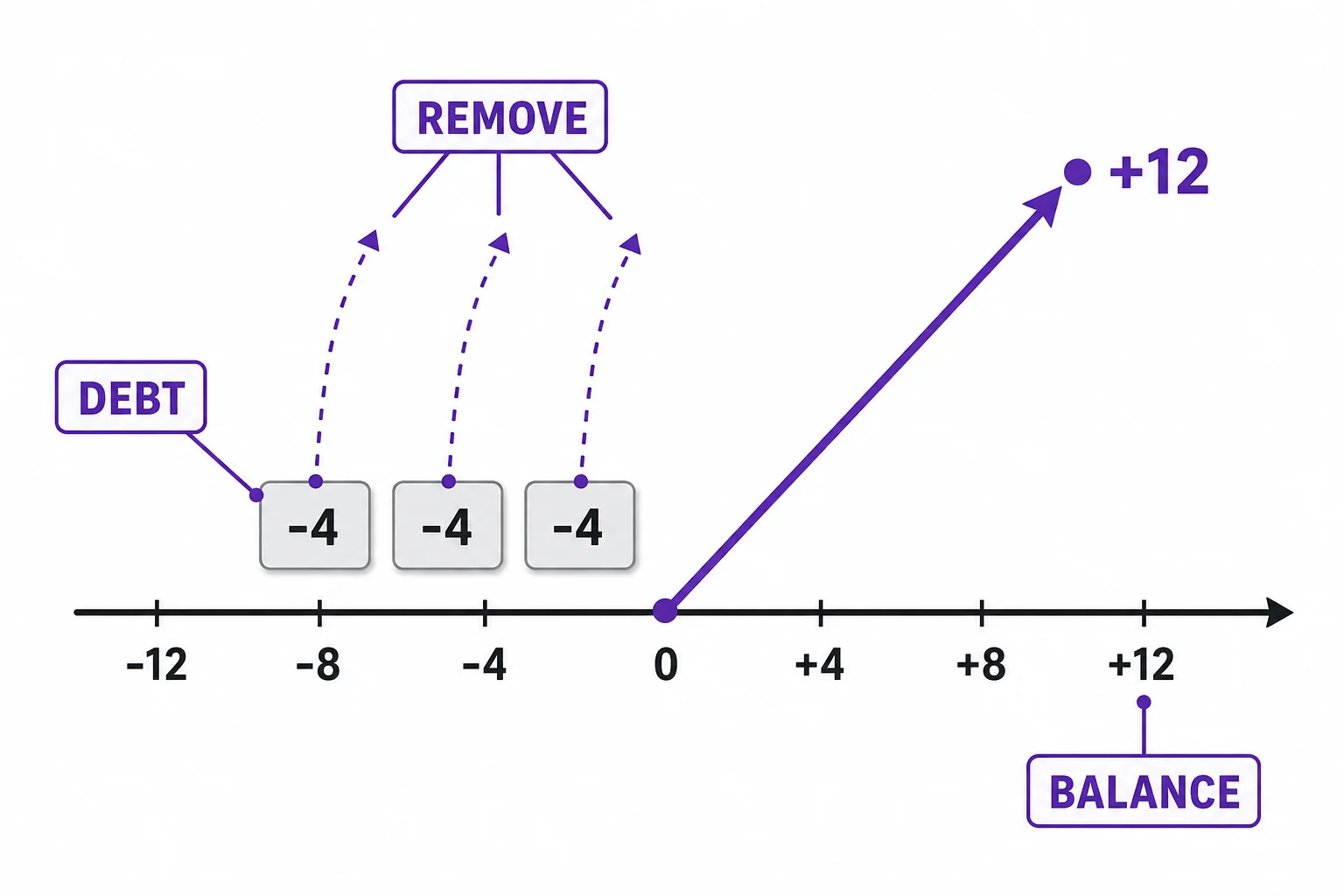
A balance account model showing three removed debt cards of negative four dollars leading to a positive twelve dollar change.
Removing debt raises the balance.
Money is not a perfect model for every multiplication problem, but it can make the sign rule feel concrete. A debt can be represented by a negative number. If you owe 4 dollars, that is $-4$. Having three debts of 4 dollars is $3(-4)=-12$. Your balance is 12 dollars below zero. Now change the action. Removing a debt is the opposite of adding a debt. If three debts of 4 dollars are removed, the change in your balance is positive 12 dollars. That can be written as $(-3)(-4)=12$ if negative three means removing three groups. The model works because it tracks direction. Adding debt moves a balance down. Removing debt moves a balance up. Two negative meanings combine to make a positive change.

Taking away a negative amount makes a positive change.

Why the rule matters
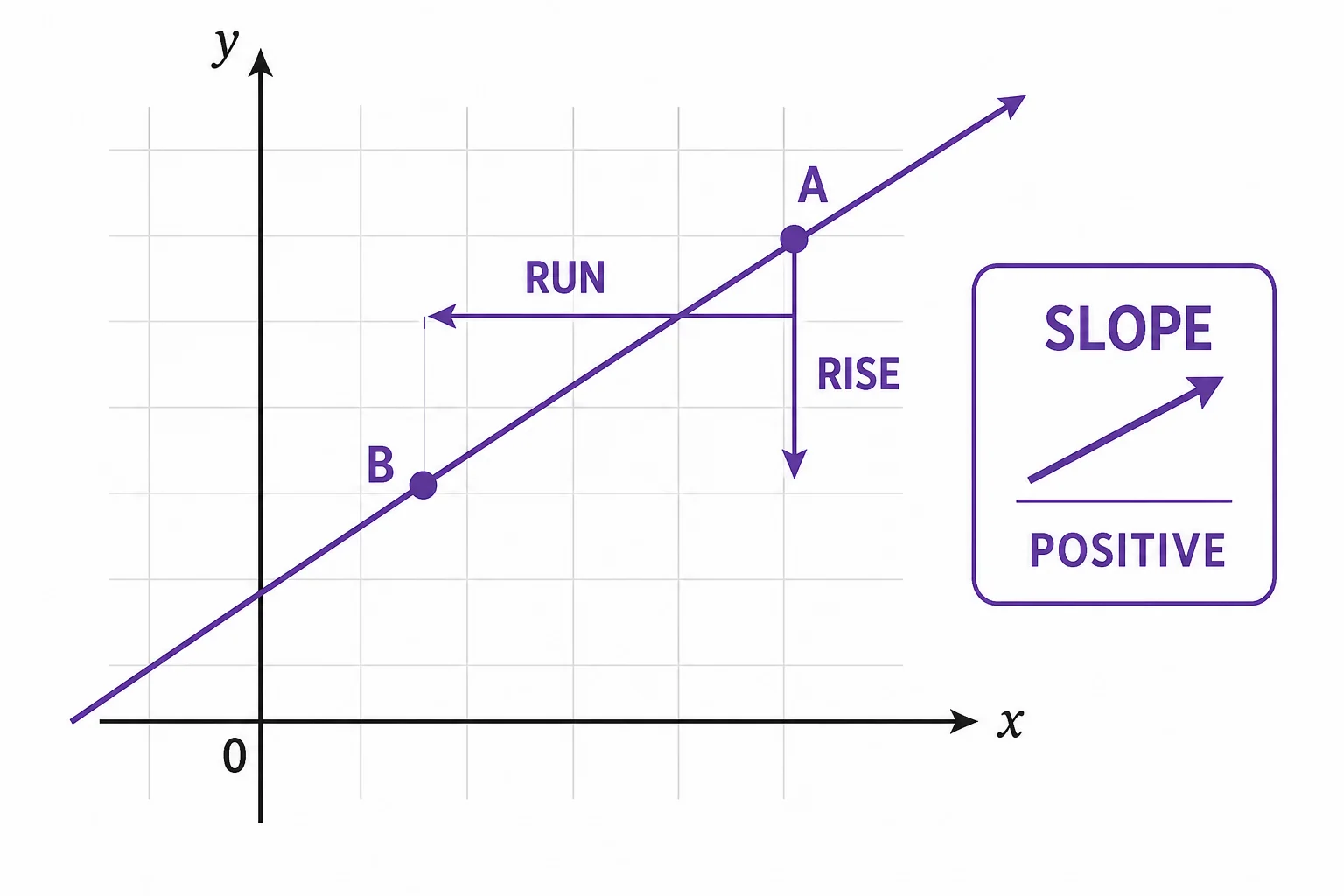
A coordinate graph showing a line with positive slope found from a negative rise and a negative run between two points.
The rule also explains positive slope.
The sign rule is not only a memory fact. It helps the whole number system stay consistent. Later, students use it when simplifying expressions, solving equations, graphing lines, and working with rates. For example, the slope formula can include differences that are both negative. If both the rise and run are negative, their ratio is positive. That matches a line that goes upward from left to right. The same reasoning appears in science data too. A negative change over a negative time direction can describe a positive rate in a reversed view. The main idea stays simple. A negative sign can mean opposite. Multiplying by a negative takes the opposite of a quantity or action. When the quantity is already negative, its opposite is positive.

The sign rule supports algebra, graphs, and rates.

Vocabulary

Negative number
A number less than zero. It can represent a value below zero, a debt, or movement in the opposite direction.
Product
The result of multiplying two or more numbers.
Opposite
A number or action that is the same distance from zero but in the other direction.
Distributive law
A property that lets you multiply a number by each part of a sum and then add the results.
Number line
A straight line used to show numbers in order, with positive numbers on one side of zero and negative numbers on the other.

In the Classroom

Build the product pattern

15 minutes | Grades 6-8

Students make a table for $(-2)(n)$ as $n$ moves from 4 to -4. They explain why the product changes by the same amount each row and use the pattern to predict negative times negative products.

Number-line reversal walk

20 minutes | Grades 6-8

Tape a number line on the floor and have students take repeated steps left or right. Then introduce a negative multiplier as reversing the planned motion.

Debt-card cancellation

25 minutes | Grades 7-8

Give students cards marked as debts and credits. They model adding debt, removing debt, and connect each action to a multiplication expression.

Key Takeaways

  • A negative sign can mean an opposite direction, amount, or action.
  • Multiplying by a negative means taking the opposite.
  • The opposite of a negative quantity is positive.
  • The distributive law shows that $(-3)(-4)$ must equal 12.
  • The rule keeps arithmetic, algebra, graphs, and rates consistent.