Sign in to save

Bookmark this page so you can find it later.

Sign in to save

Bookmark this page so you can find it later.

Math middle-school May 21, 2026

Why Does the Pythagorean Theorem Work?

A square-area reason for a famous rule
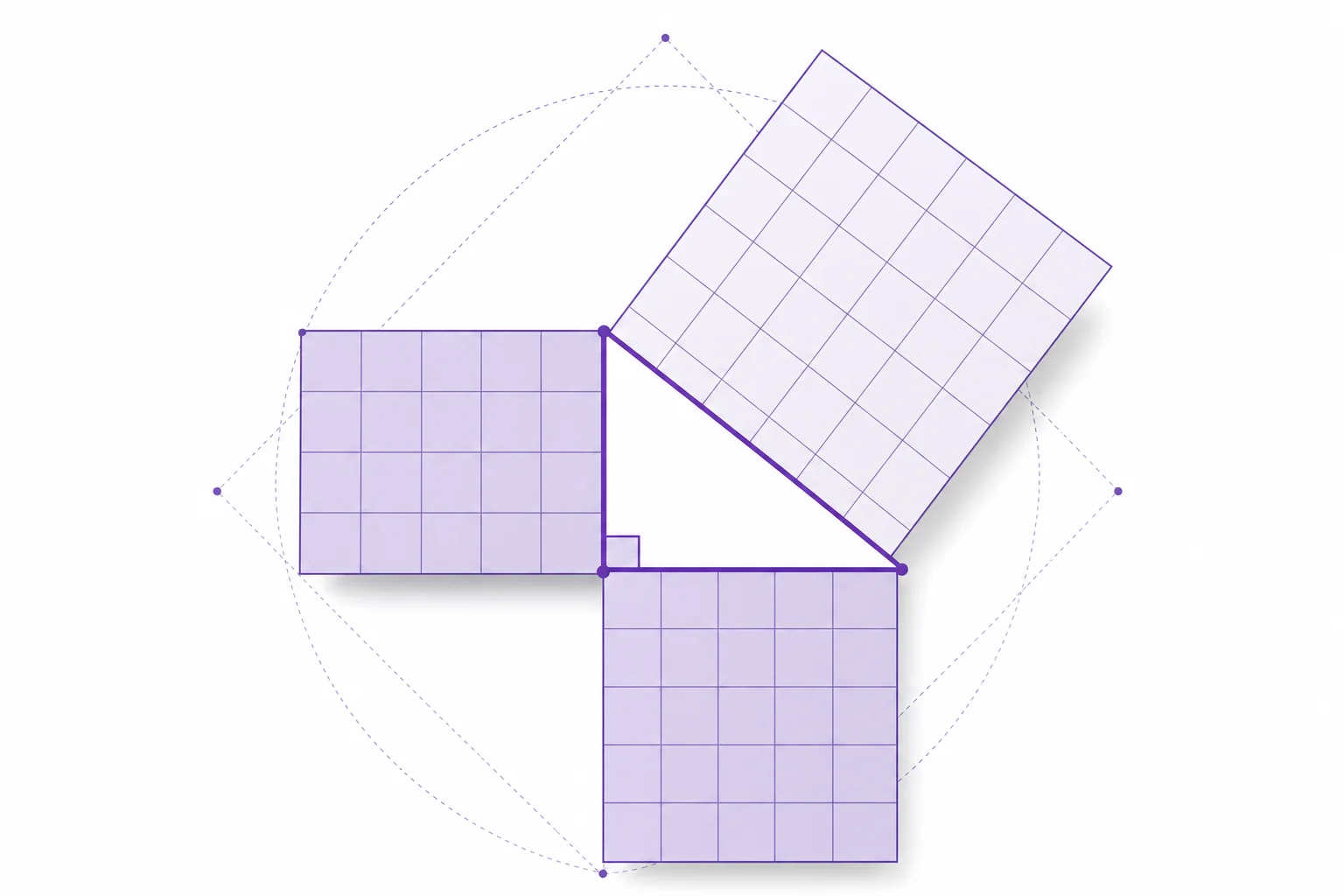
A right triangle with a square drawn on each side to show the relationship among the side lengths.

The Pythagorean Theorem works because the three squares are tied to the same right triangle. When the triangle has a right angle, the two smaller square areas always fit together to equal the largest square area. That is why the side lengths follow a^2 + b^2 = c^2.

Big Idea. Common Core 8.G.B.6 asks students to explain a proof of the Pythagorean Theorem and its converse.

The Pythagorean Theorem is often taught as a formula, a^2 + b^2 = c^2. The formula is useful, but it can feel like a rule to memorize. A better way to understand it is to look at area. Build a square on each side of a right triangle. The square on one leg has area a^2. The square on the other leg has area b^2. The square on the longest side has area c^2. The theorem says the first two areas add up to the third. This only works for right triangles. It connects geometry, measurement, and coordinate graphs. It also explains why the distance formula works. When you move across and up on a grid, those two moves act like the legs of a right triangle. The straight-line distance is the hypotenuse.

Start with three squares
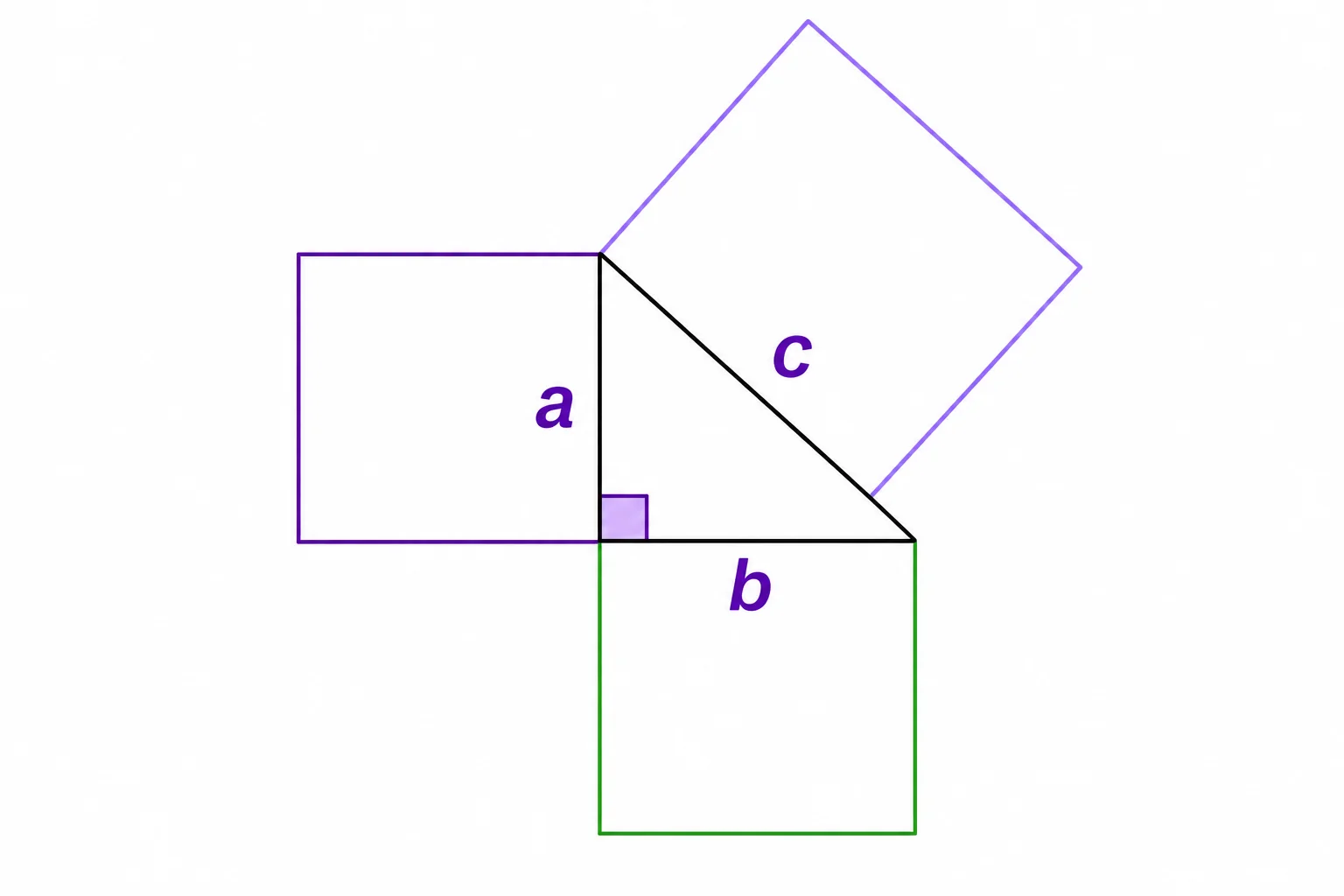
A right triangle with a square drawn on each side and labels a, b, and c on the side lengths.
Squares on the sides of a right triangle
Draw any right triangle. Label the two shorter sides a and b. Label the longest side c. Now draw a square outward from each side. The area of a square is side length times itself. So the square on side a has area a^2. The square on side b has area b^2. The square on side c has area c^2. The theorem is not mainly about the triangle’s area. It is about the areas of these three attached squares. For a right triangle, the two smaller square areas have the same total area as the largest square. This area relationship stays true even when the triangle is long and skinny, short and wide, or tilted on the page. The right angle is the key condition.

The theorem compares square areas, not just side lengths.

One square, two arrangements
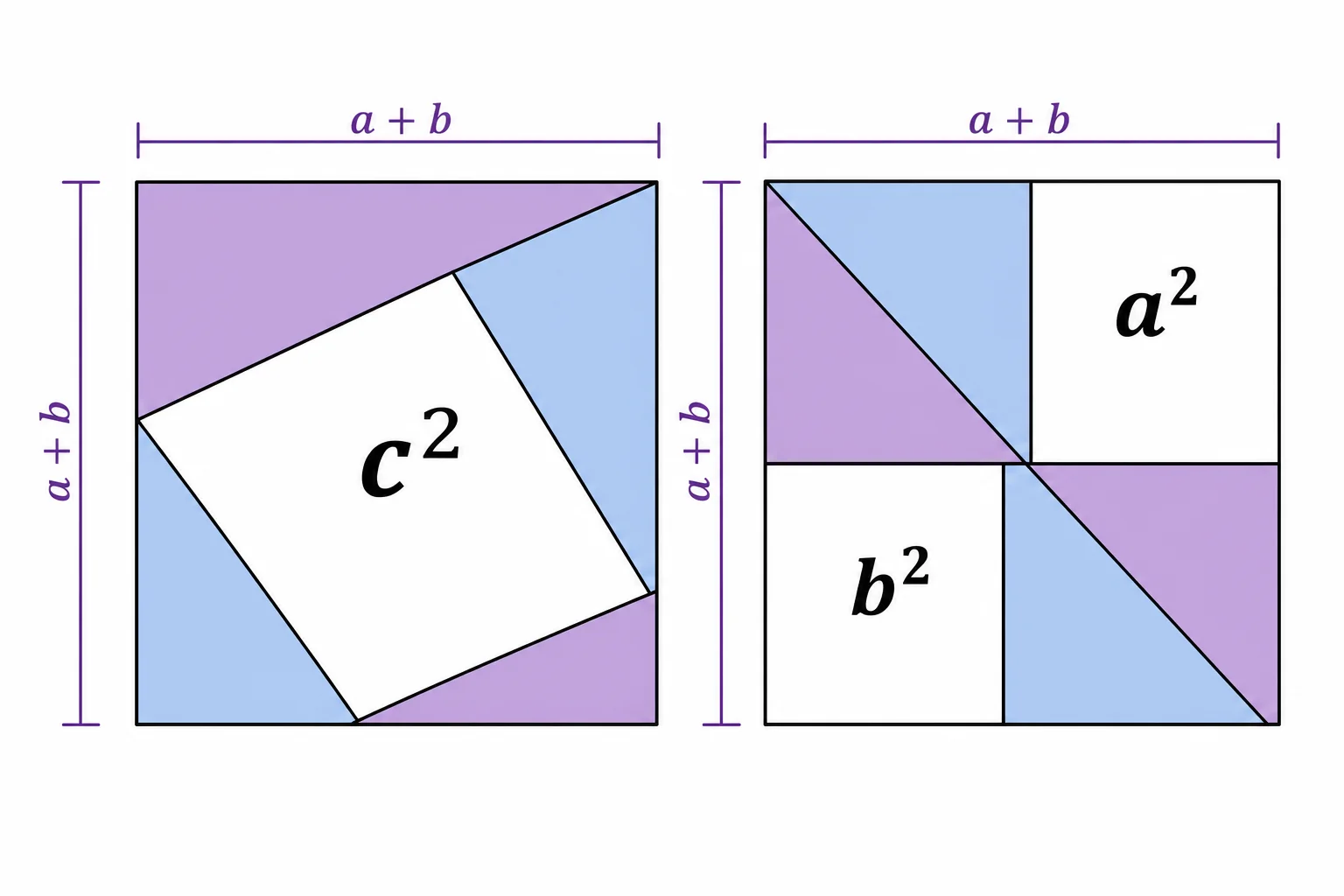
Two large squares made from the same four right triangles, one leaving a c square and the other leaving a and b squares.
Same pieces, same leftover area
A classic proof uses four copies of the same right triangle. Put them inside one large square. The large square has the same outer size in both arrangements. In one arrangement, the empty space in the middle is a square with side c. Its area is c^2. In the other arrangement, the empty spaces are two squares with side a and side b. Their total area is a^2 + b^2. The four triangles did not change. The outer square did not change. So the leftover area must be the same in both pictures. That means c^2 equals a^2 + b^2. This proof is powerful because it does not depend on measuring one special triangle. It works for every right triangle.

If the same pieces fill the same big square, the leftover areas must match.

Why the right angle matters
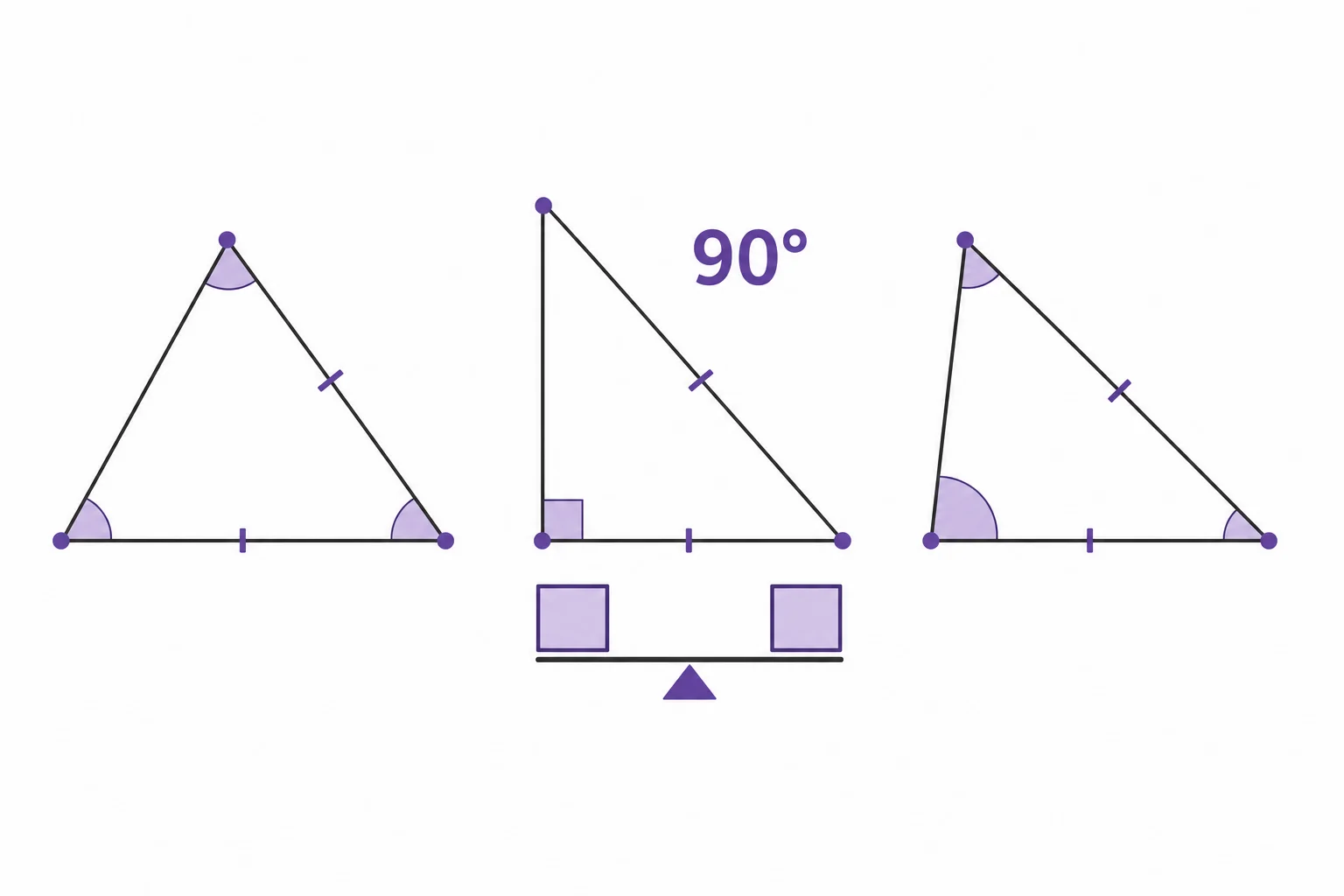
Three triangles with the same two side lengths but different included angles, showing that only the right triangle matches the square-area rule.
Only the 90 degree case balances
The rule works only when the angle between a and b is exactly 90 degrees. If that angle opens wider, the longest side becomes longer than the Pythagorean rule predicts. If the angle closes smaller, the opposite side becomes shorter. The square areas no longer balance as a^2 + b^2 = c^2. This is why the theorem is also a test. If three side lengths make a^2 + b^2 equal c^2, then they form a right triangle when c is the longest side. If the equality fails, the triangle is not right. This connects the theorem to the idea of a converse. A statement goes one direction. Its converse goes the other direction. For right triangles, both directions are true.

The equality a^2 + b^2 = c^2 signals a right angle.

From triangles to distance
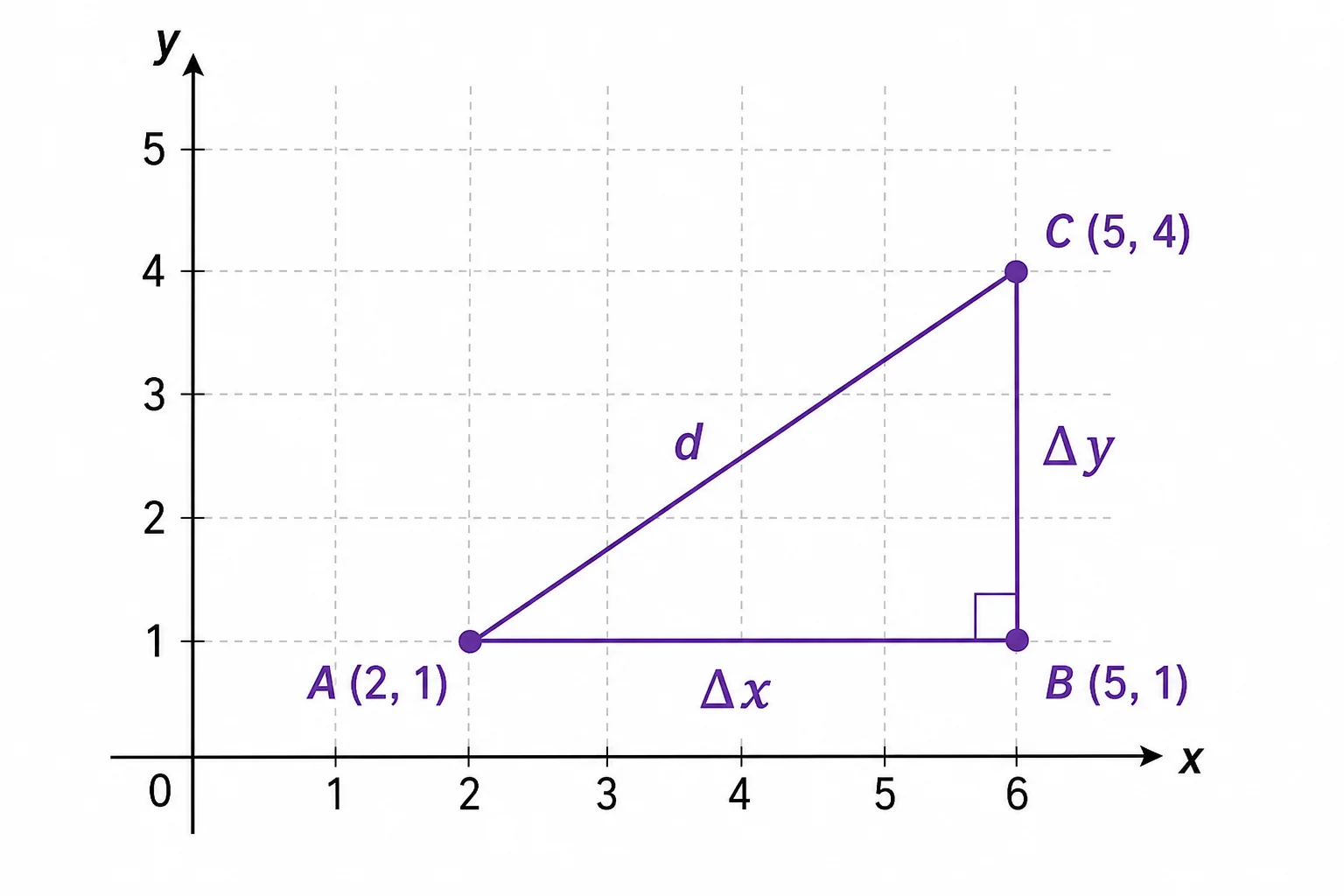
A coordinate grid with two points connected by horizontal and vertical legs and a diagonal distance as the hypotenuse.
The distance formula comes from the theorem
The Pythagorean Theorem also explains distance on a coordinate plane. Suppose one point is 5 units to the right and 3 units up from another point. Those horizontal and vertical moves form the legs of a right triangle. The straight path between the points is the hypotenuse. Its length is found by squaring the two moves, adding them, and taking the square root. That gives the distance formula. On a grid, the horizontal change is often called x change, and the vertical change is called y change. The formula uses the same area idea. The squares on the two grid moves add to the square on the straight-line distance. This is why a geometry theorem can help measure paths on maps, screens, and graphs.

A diagonal distance is the hypotenuse of a grid triangle.

Check it with numbers
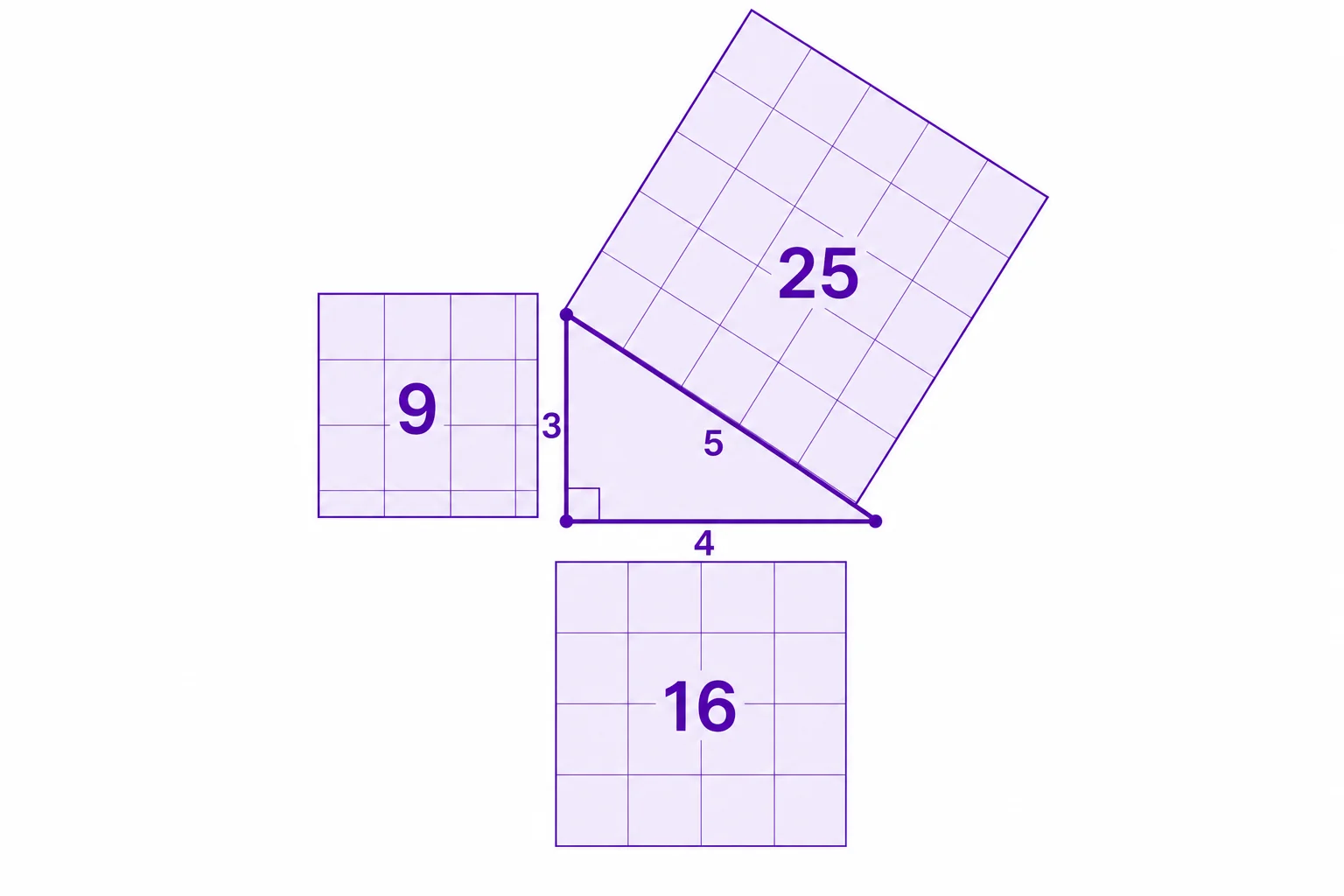
A 3-4-5 right triangle with grid squares showing areas 9, 16, and 25 on the sides.
A 3, 4, 5 triangle by area
A 3, 4, 5 triangle is a simple example. The square on the side of length 3 has area 9. The square on the side of length 4 has area 16. Together, those areas make 25. The square on the side of length 5 also has area 25. So 3^2 + 4^2 = 5^2. This does not prove the theorem for every triangle, but it makes the area relationship easy to see. Students can cut paper squares or count grid spaces to test it. The visual proof explains why every right triangle works. The numerical example helps the formula feel concrete. The same pattern appears in other right-triangle triples, such as 5, 12, 13 and 8, 15, 17.

For a 3, 4, 5 triangle, 9 plus 16 equals 25.

Vocabulary

Right triangle
A triangle with one angle that measures exactly 90 degrees.
Hypotenuse
The longest side of a right triangle, opposite the right angle.
Leg
One of the two shorter sides that meet to form the right angle.
Square area
The space inside a square, found by multiplying a side length by itself.
Converse
A related statement that reverses the if and then parts of another statement.
Distance formula
A coordinate rule for finding the straight-line distance between two points.

In the Classroom

Build the area proof

25 minutes | Grades 7-8

Students cut out four identical right triangles and arrange them in two different large squares. They compare the leftover regions to explain why a^2 + b^2 = c^2.

Grid distance walk

20 minutes | Grades 6-8

Students plot two points on graph paper and draw the horizontal, vertical, and diagonal paths. They use the Pythagorean Theorem to find the diagonal distance and compare it with a ruler measurement.

Right triangle test

15 minutes | Grades 8

Give students sets of three side lengths. They square the two shorter lengths, add them, and decide whether the set can form a right triangle.

Key Takeaways

  • The Pythagorean Theorem is an area relationship about squares on the sides of a right triangle.
  • For any right triangle, the two smaller square areas add to the largest square area.
  • A rearrangement proof works because the same pieces leave equal leftover areas.
  • The theorem only works when the triangle has a 90 degree angle.
  • The distance formula uses the same idea on a coordinate grid.