Pythagorean Theorem Lab
Discover why a² + b² = c² for every right triangle. Enter the two legs, watch the hypotenuse compute instantly, then record Pythagorean triples in your data table.
Guided ExperimentPythagorean Theorem Lab
Before you explore, write your prediction, if you know the two shorter sides of a right triangle, how do you think you can find the longest side (hypotenuse)?
Write your hypothesis in the Lab Report panel, then click Next.
Enter Side Lengths
Quick presets
Right Triangle Diagram
Computed Values
Controls
Data Table
(0 rows)| # | Side a | Side b | a² | b² | a² + b² | Side c | Pythagorean Triple? |
|---|
Reference Guide
The Pythagorean Theorem
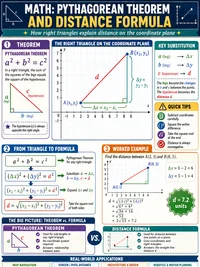
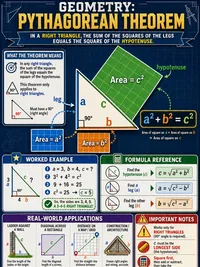
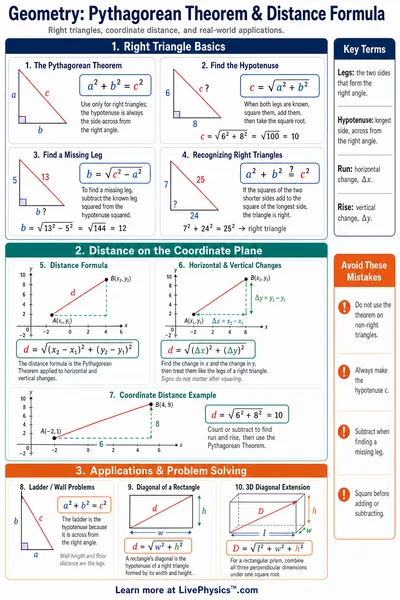
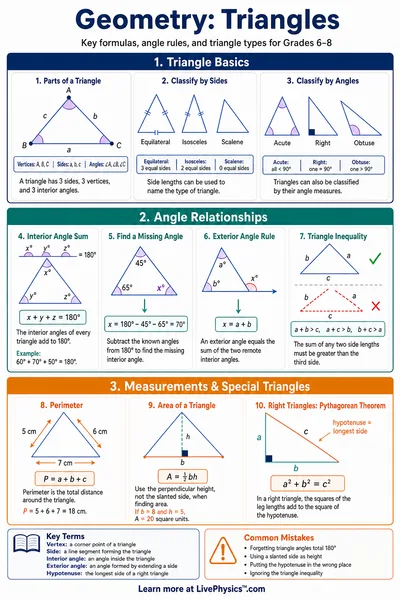
For any right triangle with legs a and b and hypotenuse c a² + b² = c².
To find c, compute the square root of a² + b². For example, with a = 3 and b = 4: 9 + 16 = 25, so c = 5.
You can rearrange to find a missing leg, a = sqrt(c² - b²) or b = sqrt(c² - a²).
Pythagorean Triples
A Pythagorean triple is a set of three whole numbers that satisfy a² + b² = c².
Classic triples, 3-4-5, 5-12-13, 8-15-17, 7-24-25.
Any whole-number multiple of a triple is also a triple. The 6-8-10 triple is double 3-4-5. Scaling all three sides by the same factor preserves the relationship.
Geometric Meaning
The area of the square drawn on the hypotenuse equals the combined area of the squares on the two legs.
This geometric interpretation was known to ancient Greek mathematicians including Euclid, and to Babylonian and Chinese scholars even earlier.
The theorem applies only to right triangles. For non-right triangles, the equality becomes an inequality, a² + b² is either less than or greater than c² depending on the angle.
Analysis Questions
1. For the 3-4-5 triangle, 3² = 9, 4² = 16, 9 + 16 = 25 = 5². Does this match c²?
2. How does 6-8-10 relate to 3-4-5? What happens when you multiply all three sides by 2?
3. If a = 5 and b = 12, what is c? Show your calculation using a² + b² = c².
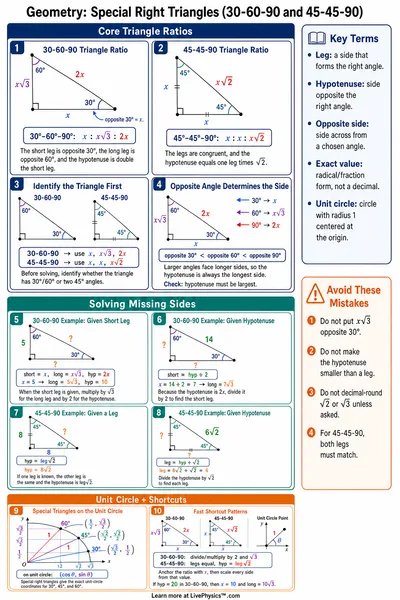
4. Can you find any triple where a and b are equal (an isosceles right triangle)? What would the ratio a to c be?