Geometry Proof Helper
Pick a theorem and step through the proof one line at a time. Each step shows the geometric statement and its justification, with a diagram that highlights the relevant parts as you progress.
Select a Proof
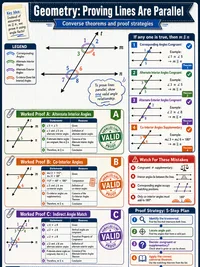
When a transversal crosses two parallel lines, alternate interior angles are equal.
Given
- Lines m and n are parallel (m || n)
- Line t is a transversal crossing both m and n
- Angles 3 and 6 are alternate interior angles
Proof Steps
0 / 6Diagram
Press Next Step to begin
How Geometry Proofs Work
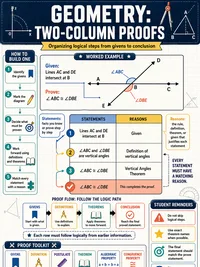
Structure of a Two-Column Proof
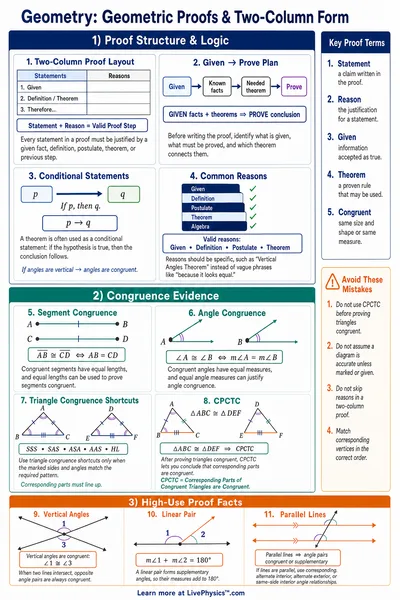
A two-column proof organises each logical step into two columns, the Statement (what is true at that step) and the Reason (why it is true).
- Start with the Given information
- Apply definitions, postulates, or theorems
- End with the Conclusion you were asked to prove
Every statement must be justified - either by a prior step, a definition, or a named theorem.
Common Proof Reasons
- Given - stated in the problem
- Definition - the meaning of a geometric term
- Reflexive Property - any segment or angle equals itself
- Transitive Property - if A = B and B = C, then A = C
- Substitution - replace one equal quantity with another
- Vertical Angles Theorem - vertical angles are equal
- Linear Pair Postulate - a straight line measures 180 degrees
- CPCTC - corresponding parts of congruent triangles are equal
Proof Strategies
Three main approaches appear throughout these proofs
- Direct proof. Start from the given facts and apply theorems step by step until you reach the conclusion.
- Proof by contradiction. Assume the opposite of what you want to prove, then show this leads to an impossible situation.
- Construction. Add an auxiliary line or point that was not originally in the diagram, then use it to connect ideas.
Triangle Congruence and Similarity
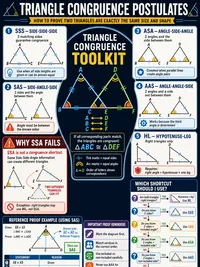
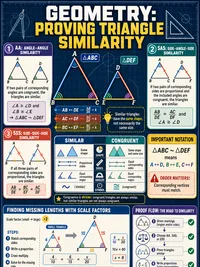
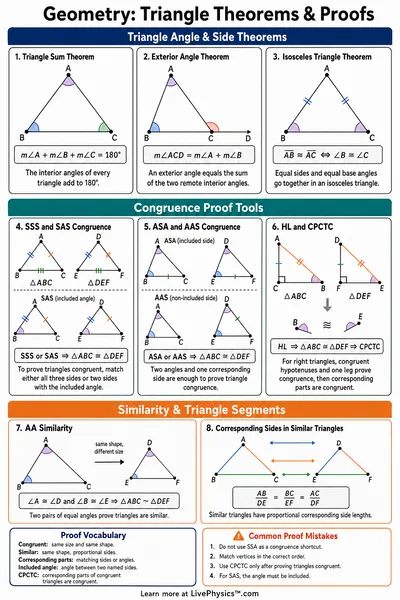
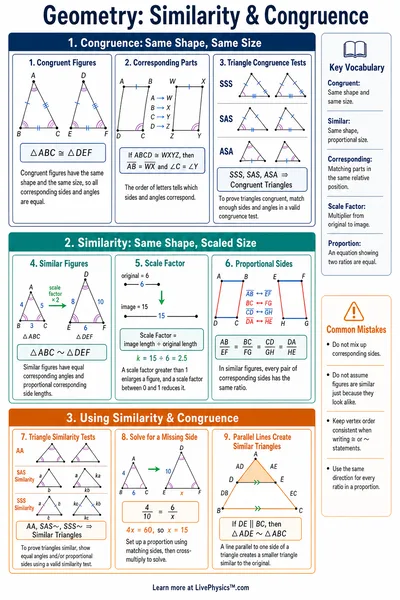
Congruent triangles are identical in size and shape. Similar triangles have the same shape but may differ in size.
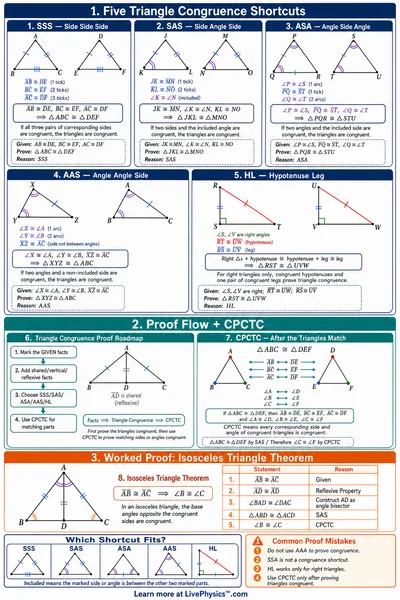
Congruence criteria (triangles are congruent if)
- SSS - three sides equal
- SAS - two sides and included angle equal
- ASA or AAS - two angles and a side
Similarity criteria:
- AA - two angles equal (third must also match)
- SAS - two sides proportional with equal included angle