Area & Perimeter Explorer
Pick a shape, drag the sliders, and watch the area and perimeter update in real time. Every answer includes the formula and a step-by-step calculation. All computation runs in your browser.
Shape
Dimensions
Try an example
Area
40
square units
Perimeter
26
units
Area Calculation
Perimeter Calculation
Open this tool with your own values
This tool reads its inputs from the page address, so a link can open it with the values from a problem already entered. Include every value the problem needs, because one left out keeps the tool's default. Use plain numbers in the stated units.
- s
- shape, rectangle, triangle, parallelogram, trapezoid or circle
- w
- width, rectangle only, 1 to 20
- h
- height, for every shape except the circle, 1 to 20
- b
- base, for a triangle, parallelogram or trapezoid, 1 to 20
- b2
- second parallel side, trapezoid only, 1 to 20
- a
- length of the slanted side, used for the perimeter of a triangle, parallelogram or trapezoid
- r
- radius, circle only, 0.5 to 10
Example links
Reference Guide
Rectangle and Square
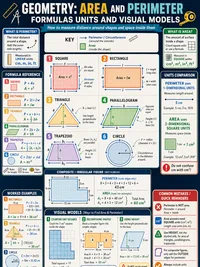
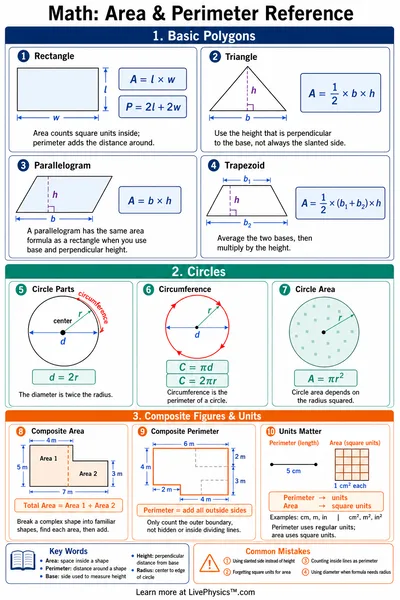
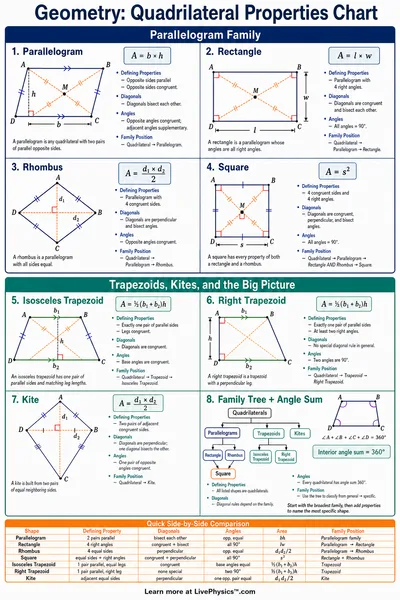
A rectangle has four right angles. A square is a special rectangle where all sides are equal.
For a square with side , the area simplifies to and the perimeter to .
Triangle
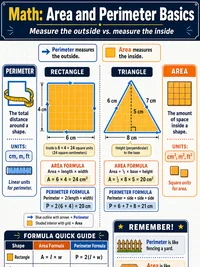
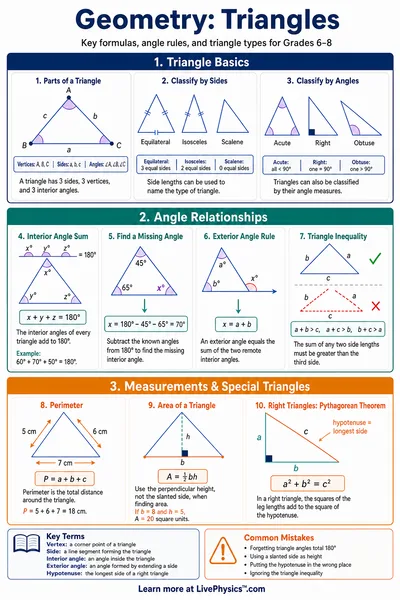
The area of a triangle is half the product of its base and height. The height must be perpendicular to the base.
The perimeter is the sum of all three sides. For a right triangle with legs and , the hypotenuse is .
Parallelogram and Trapezoid
A parallelogram has two pairs of parallel sides. Its area formula is the same as a rectangle using the perpendicular height, not the slant side.
A trapezoid has one pair of parallel sides. Its area uses the average of the two bases.
Circle
A circle is defined by its radius . Its perimeter is called the circumference.
The constant is the ratio of every circle's circumference to its diameter. You can also write the circumference as where .